

Copyright © Glencoe/McGraw-Hill, a division of The McGraw-Hill Companies, Inc.
232 Chemistry: Matter and Change
Solving Problems: A Chemistry Handbook
SOLVING PROBLEMS:
A CHEMISTRY HANDBOOK
CHAPTER 22
a. The compound is a carboxylic acid because it contains a carboxyl group, –COOH. The compound has a total of four carbon
atoms; therefore, its parent alkane is butane. The -ane suffix is
replaced by -anoic acid. The name of the compound is butanoic
acid.
b. The compound is an ester because the hydrogen of the hydroxyl
group on a carboxylic acid has been replaced by an alkyl group.
The alkyl group has two carbon atoms and is therefore an ethyl
group. The acid that corresponded to the left side of the molecule has four carbon atoms and is therefore butanoic acid. The
-ic acid ending is replaced by -ate. The name of the compound
is ethyl butanoate.
c. The compound is an amide because it contains a carboxyl group
whose hydroxyl group has been replaced by a nitrogen atom
bonded to other atoms. The alkane that has the same number of
carbon atoms, three, is propane. The final -e is replaced with
the suffix -amide. The name of the compound is propanamide.
Practice Problems
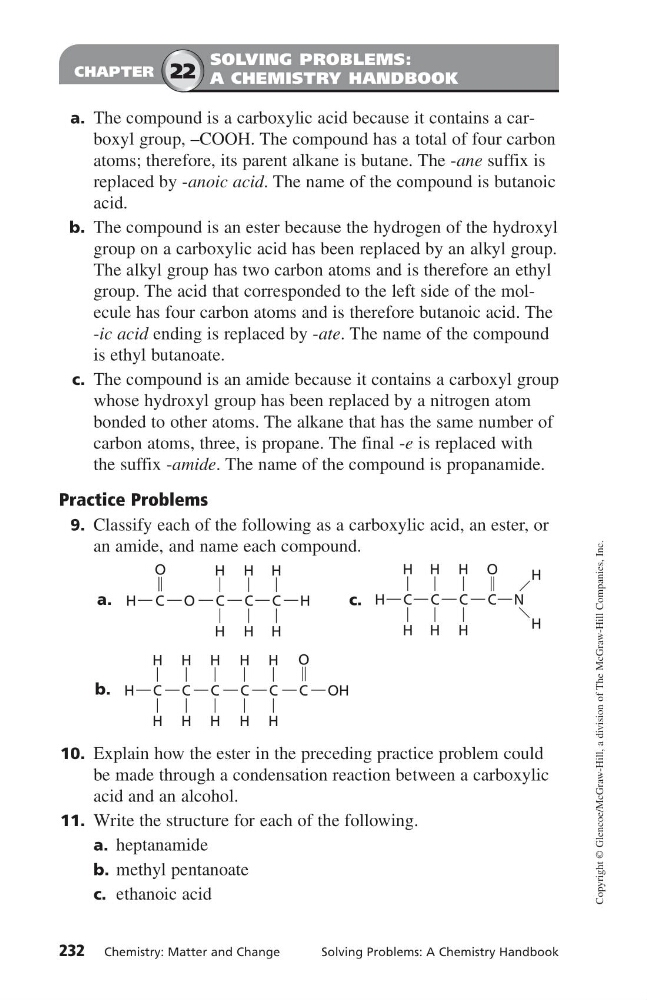
9. Classify each of the following as a carboxylic acid, an ester, or
an amide, and name each compound.
10. Explain how the ester in the preceding practice problem could
be made through a condensation reaction between a carboxylic
acid and an alcohol.
11. Write the structure for each of the following.
a. heptanamide
b. methyl pentanoate
c. ethanoic acid
H C
H
H
H
H
C
C
H
H
H
H O
C N
a. H
c.
H C
H
H
C
H
H
C
H
H
C
H
H
C
H
H
C OH
O
C
H
H
C
H
H
H
C
H
H
C O
O
b.
232 Chemistry: Matter and Change
Solving Problems: A Chemistry Handbook
SOLVING PROBLEMS:
A CHEMISTRY HANDBOOK
CHAPTER 22
a. The compound is a carboxylic acid because it contains a carboxyl group, –COOH. The compound has a total of four carbon
atoms; therefore, its parent alkane is butane. The -ane suffix is
replaced by -anoic acid. The name of the compound is butanoic
acid.
b. The compound is an ester because the hydrogen of the hydroxyl
group on a carboxylic acid has been replaced by an alkyl group.
The alkyl group has two carbon atoms and is therefore an ethyl
group. The acid that corresponded to the left side of the molecule has four carbon atoms and is therefore butanoic acid. The
-ic acid ending is replaced by -ate. The name of the compound
is ethyl butanoate.
c. The compound is an amide because it contains a carboxyl group
whose hydroxyl group has been replaced by a nitrogen atom
bonded to other atoms. The alkane that has the same number of
carbon atoms, three, is propane. The final -e is replaced with
the suffix -amide. The name of the compound is propanamide.
Practice Problems
9. Classify each of the following as a carboxylic acid, an ester, or
an amide, and name each compound.
10. Explain how the ester in the preceding practice problem could
be made through a condensation reaction between a carboxylic
acid and an alcohol.
11. Write the structure for each of the following.
a. heptanamide
b. methyl pentanoate
c. ethanoic acid
H C
H
H
H
H
C
C
H
H
H
H O
C N
a. H
c.
H C
H
H
C
H
H
C
H
H
C
H
H
C
H
H
C OH
O
C
H
H
C
H
H
H
C
H
H
C O
O
b.