

Copyright © Glencoe/McGraw-Hill, a division of The McGraw-Hill Companies, Inc.
200 Chemistry: Matter and Change
Solving Problems: A Chemistry Handbook
SOLVING PROBLEMS:
A CHEMISTRY HANDBOOK
CHAPTER 19
Note that this equation shows that the reaction occurs in acid solution. This is important because in acid solution, hydrogen ions and
water molecules are abundant and able to participate as either reactants or products in redox reactions. When a redox reaction occurs in
basic solution, hydroxide ions (OH Ϫ ) and water molecules are abundant and free to react.
The following example problem shows you how to balance a net
ionic equation for a redox reaction using the oxidation-number
method.
Example Problem 19-3
Balancing a Net Ionic Redox Equation
Use the oxidation-number method to balance the net ionic equation
for the redox reaction between the permanganate ion and the chloride ion in acid solution.
MnO 4
Ϫ (aq) ϩ Cl Ϫ (aq) 0 Mn 2ϩ (aq) ϩ Cl 2 (g) (in acid solution)
Step 1 Use the rules in Section 20.1 to assign oxidation numbers to
all atoms in the equation.
ϩ7 Ϫ2
Ϫ1
ϩ2
0
MnO 4
Ϫ (aq) ϩ Cl Ϫ (aq) 0 Mn 2ϩ (aq) ϩ Cl 2 (g) (in acid solution)
Step 2 Identify which atoms are oxidized and which are reduced.
ϩ7 Ϫ2
Ϫ1
ϩ2
0
MnO 4
Ϫ (aq) ϩ Cl Ϫ (aq) 0 Mn 2ϩ (aq) ϩ Cl 2 (g) (in acid solution)
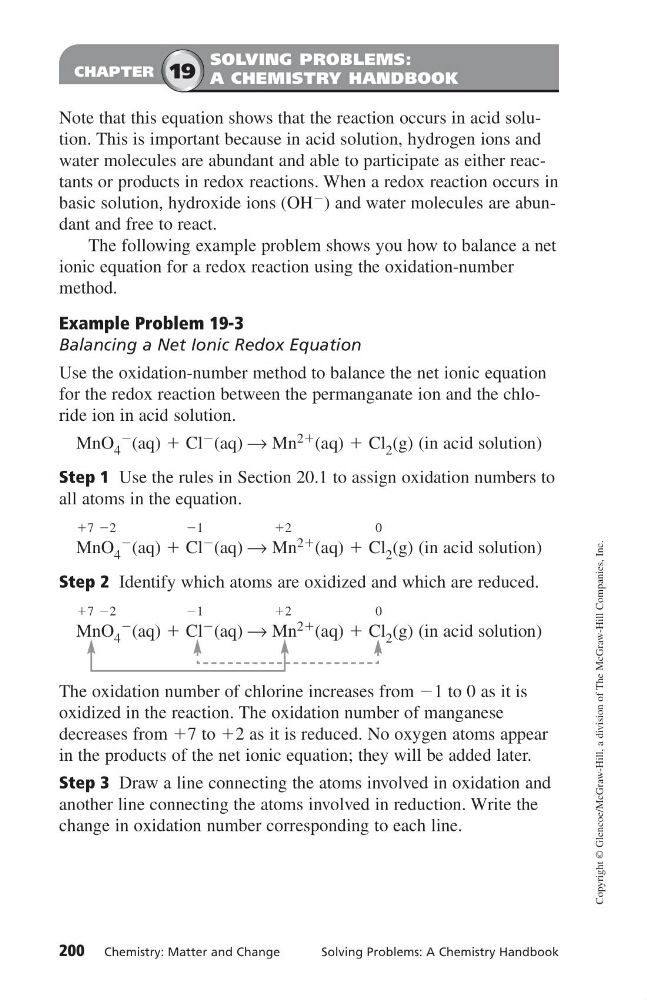
The oxidation number of chlorine increases from Ϫ1 to 0 as it is
oxidized in the reaction. The oxidation number of manganese
decreases from ϩ7 to ϩ2 as it is reduced. No oxygen atoms appear
in the products of the net ionic equation; they will be added later.
Step 3 Draw a line connecting the atoms involved in oxidation and
another line connecting the atoms involved in reduction. Write the
change in oxidation number corresponding to each line.
200 Chemistry: Matter and Change
Solving Problems: A Chemistry Handbook
SOLVING PROBLEMS:
A CHEMISTRY HANDBOOK
CHAPTER 19
Note that this equation shows that the reaction occurs in acid solution. This is important because in acid solution, hydrogen ions and
water molecules are abundant and able to participate as either reactants or products in redox reactions. When a redox reaction occurs in
basic solution, hydroxide ions (OH Ϫ ) and water molecules are abundant and free to react.
The following example problem shows you how to balance a net
ionic equation for a redox reaction using the oxidation-number
method.
Example Problem 19-3
Balancing a Net Ionic Redox Equation
Use the oxidation-number method to balance the net ionic equation
for the redox reaction between the permanganate ion and the chloride ion in acid solution.
MnO 4
Ϫ (aq) ϩ Cl Ϫ (aq) 0 Mn 2ϩ (aq) ϩ Cl 2 (g) (in acid solution)
Step 1 Use the rules in Section 20.1 to assign oxidation numbers to
all atoms in the equation.
ϩ7 Ϫ2
Ϫ1
ϩ2
0
MnO 4
Ϫ (aq) ϩ Cl Ϫ (aq) 0 Mn 2ϩ (aq) ϩ Cl 2 (g) (in acid solution)
Step 2 Identify which atoms are oxidized and which are reduced.
ϩ7 Ϫ2
Ϫ1
ϩ2
0
MnO 4
Ϫ (aq) ϩ Cl Ϫ (aq) 0 Mn 2ϩ (aq) ϩ Cl 2 (g) (in acid solution)
The oxidation number of chlorine increases from Ϫ1 to 0 as it is
oxidized in the reaction. The oxidation number of manganese
decreases from ϩ7 to ϩ2 as it is reduced. No oxygen atoms appear
in the products of the net ionic equation; they will be added later.
Step 3 Draw a line connecting the atoms involved in oxidation and
another line connecting the atoms involved in reduction. Write the
change in oxidation number corresponding to each line.