

Copyright © Glencoe/McGraw-Hill, a division of The McGraw-Hill Companies, Inc.
Solving Problems: A Chemistry Handbook
Chemistry: Matter and Change
199
SOLVING PROBLEMS:
A CHEMISTRY HANDBOOK
CHAPTER 19
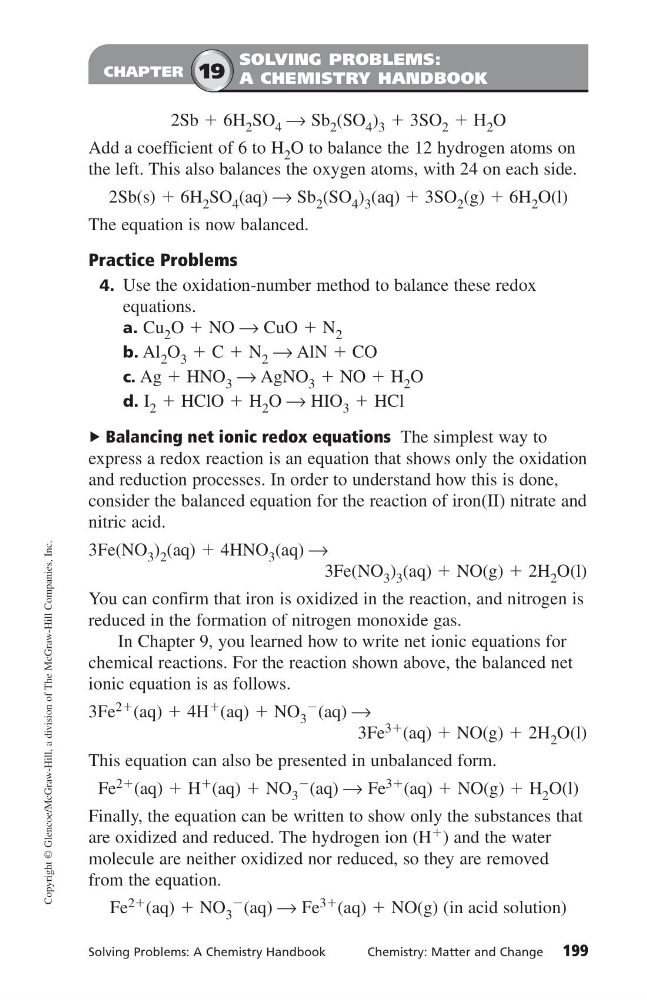
2Sb ϩ 6H 2 SO 4 0 Sb 2 (SO 4 ) 3 ϩ 3SO 2 ϩ H 2 O
Add a coefficient of 6 to H 2 O to balance the 12 hydrogen atoms on
the left. This also balances the oxygen atoms, with 24 on each side.
2Sb(s) ϩ 6H 2 SO 4 (aq) 0 Sb 2 (SO 4 ) 3 (aq) ϩ 3SO 2 (g) ϩ 6H 2 O(l)
The equation is now balanced.
Practice Problems
4. Use the oxidation-number method to balance these redox
equations.
a. Cu 2 O ϩ NO 0 CuO ϩ N 2
b. Al 2 O 3 ϩ C ϩ N 2 0 AlN ϩ CO
c. Ag ϩ HNO 3 0 AgNO 3 ϩ NO ϩ H 2 O
d. I 2 ϩ HClO ϩ H 2 O 0 HIO 3 ϩ HCl
Balancing net ionic redox equations The simplest way to
express a redox reaction is an equation that shows only the oxidation
and reduction processes. In order to understand how this is done,
consider the balanced equation for the reaction of iron(II) nitrate and
nitric acid.
3Fe(NO 3 ) 2 (aq) ϩ 4HNO 3 (aq) 0
3Fe(NO 3 ) 3 (aq) ϩ NO(g) ϩ 2H 2 O(l)
You can confirm that iron is oxidized in the reaction, and nitrogen is
reduced in the formation of nitrogen monoxide gas.
In Chapter 9, you learned how to write net ionic equations for
chemical reactions. For the reaction shown above, the balanced net
ionic equation is as follows.
3Fe 2ϩ (aq) ϩ 4H ϩ (aq) ϩ NO 3
Ϫ (aq) 0
3Fe 3ϩ (aq) ϩ NO(g) ϩ 2H 2 O(l)
This equation can also be presented in unbalanced form.
Fe 2ϩ (aq) ϩ H ϩ (aq) ϩ NO 3
Ϫ (aq) 0 Fe 3ϩ (aq) ϩ NO(g) ϩ H 2 O(l)
Finally, the equation can be written to show only the substances that
are oxidized and reduced. The hydrogen ion (H ϩ ) and the water
molecule are neither oxidized nor reduced, so they are removed
from the equation.
Fe 2ϩ (aq) ϩ NO 3
Ϫ (aq) 0 Fe 3ϩ (aq) ϩ NO(g) (in acid solution)
▲
Solving Problems: A Chemistry Handbook
Chemistry: Matter and Change
199
SOLVING PROBLEMS:
A CHEMISTRY HANDBOOK
CHAPTER 19
2Sb ϩ 6H 2 SO 4 0 Sb 2 (SO 4 ) 3 ϩ 3SO 2 ϩ H 2 O
Add a coefficient of 6 to H 2 O to balance the 12 hydrogen atoms on
the left. This also balances the oxygen atoms, with 24 on each side.
2Sb(s) ϩ 6H 2 SO 4 (aq) 0 Sb 2 (SO 4 ) 3 (aq) ϩ 3SO 2 (g) ϩ 6H 2 O(l)
The equation is now balanced.
Practice Problems
4. Use the oxidation-number method to balance these redox
equations.
a. Cu 2 O ϩ NO 0 CuO ϩ N 2
b. Al 2 O 3 ϩ C ϩ N 2 0 AlN ϩ CO
c. Ag ϩ HNO 3 0 AgNO 3 ϩ NO ϩ H 2 O
d. I 2 ϩ HClO ϩ H 2 O 0 HIO 3 ϩ HCl
Balancing net ionic redox equations The simplest way to
express a redox reaction is an equation that shows only the oxidation
and reduction processes. In order to understand how this is done,
consider the balanced equation for the reaction of iron(II) nitrate and
nitric acid.
3Fe(NO 3 ) 2 (aq) ϩ 4HNO 3 (aq) 0
3Fe(NO 3 ) 3 (aq) ϩ NO(g) ϩ 2H 2 O(l)
You can confirm that iron is oxidized in the reaction, and nitrogen is
reduced in the formation of nitrogen monoxide gas.
In Chapter 9, you learned how to write net ionic equations for
chemical reactions. For the reaction shown above, the balanced net
ionic equation is as follows.
3Fe 2ϩ (aq) ϩ 4H ϩ (aq) ϩ NO 3
Ϫ (aq) 0
3Fe 3ϩ (aq) ϩ NO(g) ϩ 2H 2 O(l)
This equation can also be presented in unbalanced form.
Fe 2ϩ (aq) ϩ H ϩ (aq) ϩ NO 3
Ϫ (aq) 0 Fe 3ϩ (aq) ϩ NO(g) ϩ H 2 O(l)
Finally, the equation can be written to show only the substances that
are oxidized and reduced. The hydrogen ion (H ϩ ) and the water
molecule are neither oxidized nor reduced, so they are removed
from the equation.
Fe 2ϩ (aq) ϩ NO 3
Ϫ (aq) 0 Fe 3ϩ (aq) ϩ NO(g) (in acid solution)
▲