

Copyright © Glencoe/McGraw-Hill, a division of The McGraw-Hill Companies, Inc.
198 Chemistry: Matter and Change
Solving Problems: A Chemistry Handbook
SOLVING PROBLEMS:
A CHEMISTRY HANDBOOK
CHAPTER 19
Antimony is oxidized in the reaction, while sulfur is reduced in the
formation of SO 2 . The oxidation number of antimony increases from
0 to ϩ3, and the oxidation number of sulfur decreases from ϩ6 to
ϩ4. The oxidation numbers of hydrogen and oxygen are unchanged.
The sulfate ion (SO 4
2Ϫ ) appears on both sides of the equation, and
its atoms are neither oxidized nor reduced.
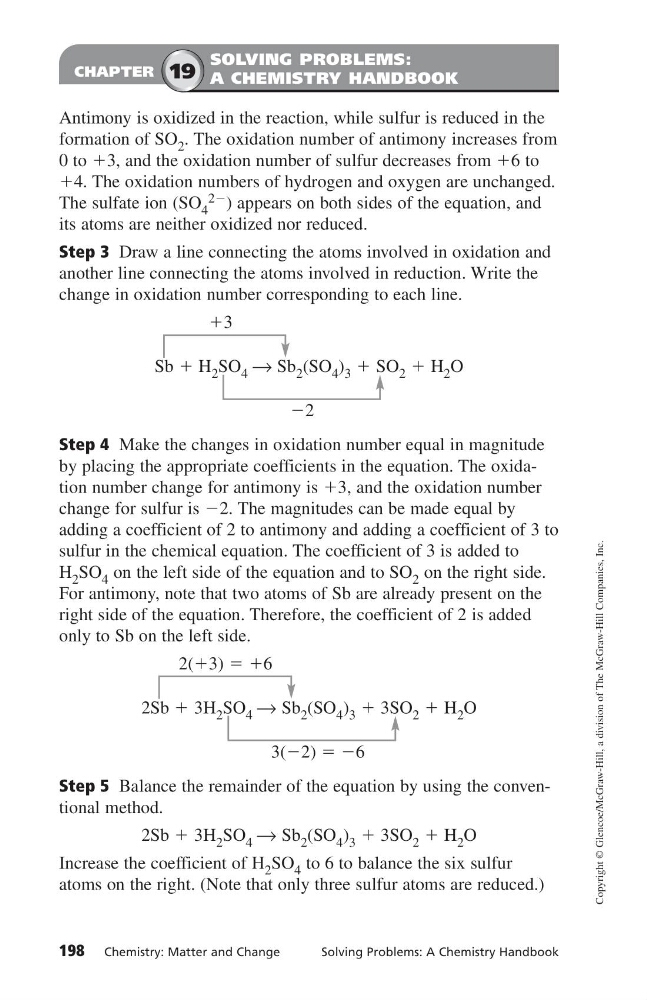
Step 3 Draw a line connecting the atoms involved in oxidation and
another line connecting the atoms involved in reduction. Write the
change in oxidation number corresponding to each line.
ϩ3
Sb ϩ H 2 SO 4 0 Sb 2 (SO 4 ) 3 ϩ SO 2 ϩ H 2 O
Ϫ2
Step 4 Make the changes in oxidation number equal in magnitude
by placing the appropriate coefficients in the equation. The oxidation number change for antimony is ϩ3, and the oxidation number
change for sulfur is Ϫ2. The magnitudes can be made equal by
adding a coefficient of 2 to antimony and adding a coefficient of 3 to
sulfur in the chemical equation. The coefficient of 3 is added to
H 2 SO 4 on the left side of the equation and to SO 2 on the right side.
For antimony, note that two atoms of Sb are already present on the
right side of the equation. Therefore, the coefficient of 2 is added
only to Sb on the left side.
2(ϩ3) ϭ ϩ6
2Sb ϩ 3H 2 SO 4 0 Sb 2 (SO 4 ) 3 ϩ 3SO 2 ϩ H 2 O
3(Ϫ2) ϭ Ϫ6
Step 5 Balance the remainder of the equation by using the conventional method.
2Sb ϩ 3H 2 SO 4 0 Sb 2 (SO 4 ) 3 ϩ 3SO 2 ϩ H 2 O
Increase the coefficient of H 2 SO 4 to 6 to balance the six sulfur
atoms on the right. (Note that only three sulfur atoms are reduced.)
198 Chemistry: Matter and Change
Solving Problems: A Chemistry Handbook
SOLVING PROBLEMS:
A CHEMISTRY HANDBOOK
CHAPTER 19
Antimony is oxidized in the reaction, while sulfur is reduced in the
formation of SO 2 . The oxidation number of antimony increases from
0 to ϩ3, and the oxidation number of sulfur decreases from ϩ6 to
ϩ4. The oxidation numbers of hydrogen and oxygen are unchanged.
The sulfate ion (SO 4
2Ϫ ) appears on both sides of the equation, and
its atoms are neither oxidized nor reduced.
Step 3 Draw a line connecting the atoms involved in oxidation and
another line connecting the atoms involved in reduction. Write the
change in oxidation number corresponding to each line.
ϩ3
Sb ϩ H 2 SO 4 0 Sb 2 (SO 4 ) 3 ϩ SO 2 ϩ H 2 O
Ϫ2
Step 4 Make the changes in oxidation number equal in magnitude
by placing the appropriate coefficients in the equation. The oxidation number change for antimony is ϩ3, and the oxidation number
change for sulfur is Ϫ2. The magnitudes can be made equal by
adding a coefficient of 2 to antimony and adding a coefficient of 3 to
sulfur in the chemical equation. The coefficient of 3 is added to
H 2 SO 4 on the left side of the equation and to SO 2 on the right side.
For antimony, note that two atoms of Sb are already present on the
right side of the equation. Therefore, the coefficient of 2 is added
only to Sb on the left side.
2(ϩ3) ϭ ϩ6
2Sb ϩ 3H 2 SO 4 0 Sb 2 (SO 4 ) 3 ϩ 3SO 2 ϩ H 2 O
3(Ϫ2) ϭ Ϫ6
Step 5 Balance the remainder of the equation by using the conventional method.
2Sb ϩ 3H 2 SO 4 0 Sb 2 (SO 4 ) 3 ϩ 3SO 2 ϩ H 2 O
Increase the coefficient of H 2 SO 4 to 6 to balance the six sulfur
atoms on the right. (Note that only three sulfur atoms are reduced.)