

Copyright © Glencoe/McGraw-Hill, a division of The McGraw-Hill Companies, Inc.
Solving Problems: A Chemistry Handbook
Chemistry: Matter and Change
197
SOLVING PROBLEMS:
A CHEMISTRY HANDBOOK
CHAPTER 19
19.2 Balancing Redox Equations
Chemists use a technique for balancing redox equations that is based
on the fact that the total increase in oxidation numbers resulting
from oxidation must equal the total decrease in oxidation numbers
resulting from reduction. The technique, called the oxidationnumber method, consists of five steps.
Step 1 Assign oxidation numbers to all atoms in the equation.
Step 2 Identify the atoms that are oxidized and the atoms that are
reduced.
Step 3 Determine the change in oxidation number for the atoms
that are oxidized and for the atoms that are reduced.
Step 4 Make the changes in oxidation number equal in magnitude
by adjusting coefficients in the equation.
Step 5 If necessary, use the conventional method to balance the
remainder of the equation.
The following example problem shows you how to use the
oxidation-number method to balance a redox equation.
Example Problem 19-2
Balancing a Redox Equation by the Oxidation-Number
Method
The reaction of antimony with hot sulfuric acid produces
antimony(III) sulfate, sulfur dioxide gas, and water, as shown in this
unbalanced equation.
Sb(s) ϩ H 2 SO 4 (aq) 0 Sb 2 (SO 4 ) 3 (aq) ϩ SO 2 (g) ϩ H 2 O(l)
Balance this redox equation using the oxidation-number method.
Step 1 Assign oxidation numbers to all of the atoms in the equation, using the rules in Section 20.1.
0
ϩ1 ϩ6 Ϫ2
ϩ3 ϩ6 Ϫ2
ϩ4 Ϫ2
ϩ1 Ϫ2
Sb ϩ H 2 SO 4 0 Sb 2 (SO 4 ) 3 ϩ SO 2 ϩ H 2 O
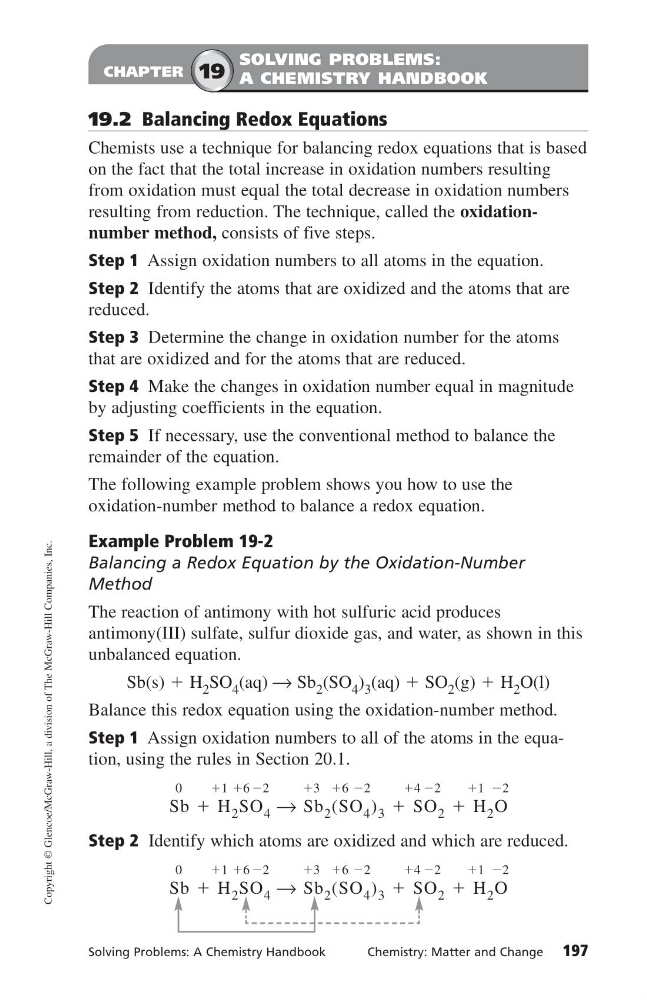
Step 2 Identify which atoms are oxidized and which are reduced.
0
ϩ1 ϩ6 Ϫ2
ϩ3 ϩ6 Ϫ2
ϩ4 Ϫ2
ϩ1 Ϫ2
Sb ϩ H 2 SO 4 0 Sb 2 (SO 4 ) 3 ϩ SO 2 ϩ H 2 O
Solving Problems: A Chemistry Handbook
Chemistry: Matter and Change
197
SOLVING PROBLEMS:
A CHEMISTRY HANDBOOK
CHAPTER 19
19.2 Balancing Redox Equations
Chemists use a technique for balancing redox equations that is based
on the fact that the total increase in oxidation numbers resulting
from oxidation must equal the total decrease in oxidation numbers
resulting from reduction. The technique, called the oxidationnumber method, consists of five steps.
Step 1 Assign oxidation numbers to all atoms in the equation.
Step 2 Identify the atoms that are oxidized and the atoms that are
reduced.
Step 3 Determine the change in oxidation number for the atoms
that are oxidized and for the atoms that are reduced.
Step 4 Make the changes in oxidation number equal in magnitude
by adjusting coefficients in the equation.
Step 5 If necessary, use the conventional method to balance the
remainder of the equation.
The following example problem shows you how to use the
oxidation-number method to balance a redox equation.
Example Problem 19-2
Balancing a Redox Equation by the Oxidation-Number
Method
The reaction of antimony with hot sulfuric acid produces
antimony(III) sulfate, sulfur dioxide gas, and water, as shown in this
unbalanced equation.
Sb(s) ϩ H 2 SO 4 (aq) 0 Sb 2 (SO 4 ) 3 (aq) ϩ SO 2 (g) ϩ H 2 O(l)
Balance this redox equation using the oxidation-number method.
Step 1 Assign oxidation numbers to all of the atoms in the equation, using the rules in Section 20.1.
0
ϩ1 ϩ6 Ϫ2
ϩ3 ϩ6 Ϫ2
ϩ4 Ϫ2
ϩ1 Ϫ2
Sb ϩ H 2 SO 4 0 Sb 2 (SO 4 ) 3 ϩ SO 2 ϩ H 2 O
Step 2 Identify which atoms are oxidized and which are reduced.
0
ϩ1 ϩ6 Ϫ2
ϩ3 ϩ6 Ϫ2
ϩ4 Ϫ2
ϩ1 Ϫ2
Sb ϩ H 2 SO 4 0 Sb 2 (SO 4 ) 3 ϩ SO 2 ϩ H 2 O