

Copyright © Glencoe/McGraw-Hill, a division of The McGraw-Hill Companies, Inc.
Solving Problems: A Chemistry Handbook
Chemistry: Matter and Change
201
SOLVING PROBLEMS:
A CHEMISTRY HANDBOOK
CHAPTER 19
ϩ1
MnO 4
Ϫ (aq) ϩ Cl Ϫ (aq) 0 Mn 2ϩ (aq) ϩ Cl 2 (g) (in acid solution)
Ϫ5
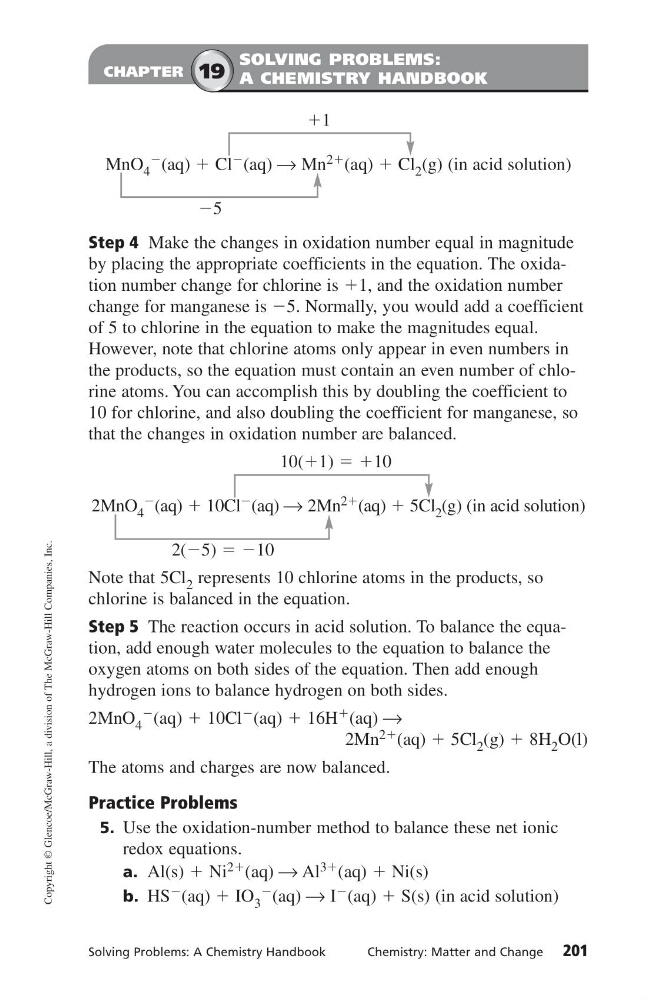
Step 4 Make the changes in oxidation number equal in magnitude
by placing the appropriate coefficients in the equation. The oxidation number change for chlorine is ϩ1, and the oxidation number
change for manganese is Ϫ5. Normally, you would add a coefficient
of 5 to chlorine in the equation to make the magnitudes equal.
However, note that chlorine atoms only appear in even numbers in
the products, so the equation must contain an even number of chlorine atoms. You can accomplish this by doubling the coefficient to
10 for chlorine, and also doubling the coefficient for manganese, so
that the changes in oxidation number are balanced.
10(ϩ1) ϭ ϩ10
2MnO 4
Ϫ (aq) ϩ 10Cl Ϫ (aq) 0 2Mn 2ϩ (aq) ϩ 5Cl 2 (g) (in acid solution)
2(Ϫ5) ϭ Ϫ10
Note that 5Cl 2 represents 10 chlorine atoms in the products, so
chlorine is balanced in the equation.
Step 5 The reaction occurs in acid solution. To balance the equation, add enough water molecules to the equation to balance the
oxygen atoms on both sides of the equation. Then add enough
hydrogen ions to balance hydrogen on both sides.
2MnO 4
Ϫ (aq) ϩ 10Cl Ϫ (aq) ϩ 16H ϩ (aq) 0
2Mn 2ϩ (aq) ϩ 5Cl 2 (g) ϩ 8H 2 O(l)
The atoms and charges are now balanced.
Practice Problems
5. Use the oxidation-number method to balance these net ionic
redox equations.
a. Al(s) ϩ Ni 2ϩ (aq) 0 Al 3ϩ (aq) ϩ Ni(s)
b. HS Ϫ (aq) ϩ IO 3
Ϫ (aq) 0 I Ϫ (aq) ϩ S(s) (in acid solution)
Solving Problems: A Chemistry Handbook
Chemistry: Matter and Change
201
SOLVING PROBLEMS:
A CHEMISTRY HANDBOOK
CHAPTER 19
ϩ1
MnO 4
Ϫ (aq) ϩ Cl Ϫ (aq) 0 Mn 2ϩ (aq) ϩ Cl 2 (g) (in acid solution)
Ϫ5
Step 4 Make the changes in oxidation number equal in magnitude
by placing the appropriate coefficients in the equation. The oxidation number change for chlorine is ϩ1, and the oxidation number
change for manganese is Ϫ5. Normally, you would add a coefficient
of 5 to chlorine in the equation to make the magnitudes equal.
However, note that chlorine atoms only appear in even numbers in
the products, so the equation must contain an even number of chlorine atoms. You can accomplish this by doubling the coefficient to
10 for chlorine, and also doubling the coefficient for manganese, so
that the changes in oxidation number are balanced.
10(ϩ1) ϭ ϩ10
2MnO 4
Ϫ (aq) ϩ 10Cl Ϫ (aq) 0 2Mn 2ϩ (aq) ϩ 5Cl 2 (g) (in acid solution)
2(Ϫ5) ϭ Ϫ10
Note that 5Cl 2 represents 10 chlorine atoms in the products, so
chlorine is balanced in the equation.
Step 5 The reaction occurs in acid solution. To balance the equation, add enough water molecules to the equation to balance the
oxygen atoms on both sides of the equation. Then add enough
hydrogen ions to balance hydrogen on both sides.
2MnO 4
Ϫ (aq) ϩ 10Cl Ϫ (aq) ϩ 16H ϩ (aq) 0
2Mn 2ϩ (aq) ϩ 5Cl 2 (g) ϩ 8H 2 O(l)
The atoms and charges are now balanced.
Practice Problems
5. Use the oxidation-number method to balance these net ionic
redox equations.
a. Al(s) ϩ Ni 2ϩ (aq) 0 Al 3ϩ (aq) ϩ Ni(s)
b. HS Ϫ (aq) ϩ IO 3
Ϫ (aq) 0 I Ϫ (aq) ϩ S(s) (in acid solution)