

Copyright © Glencoe/McGraw-Hill, a division of The McGraw-Hill Companies, Inc.
Solving Problems: A Chemistry Handbook
Chemistry: Matter and Change
133
SOLVING PROBLEMS:
A CHEMISTRY HANDBOOK
CHAPTER 13
of particles. An extension of Avogadro’s principle is that one mole
(6.02 ϫ 10 23 particles) of any gas at standard temperature and pressure (0°C and 1.00 atm pressure, STP) occupies a volume of 22.4 L.
Given that the mass of a mole of any gas is the molecular mass of
the gas expressed in grams, Avogadro’s principle allows you to
interrelate mass, moles, pressure, volume, and temperature for any
sample of gas.
Example Problem 13-4
Applying Avogadro’s Principle
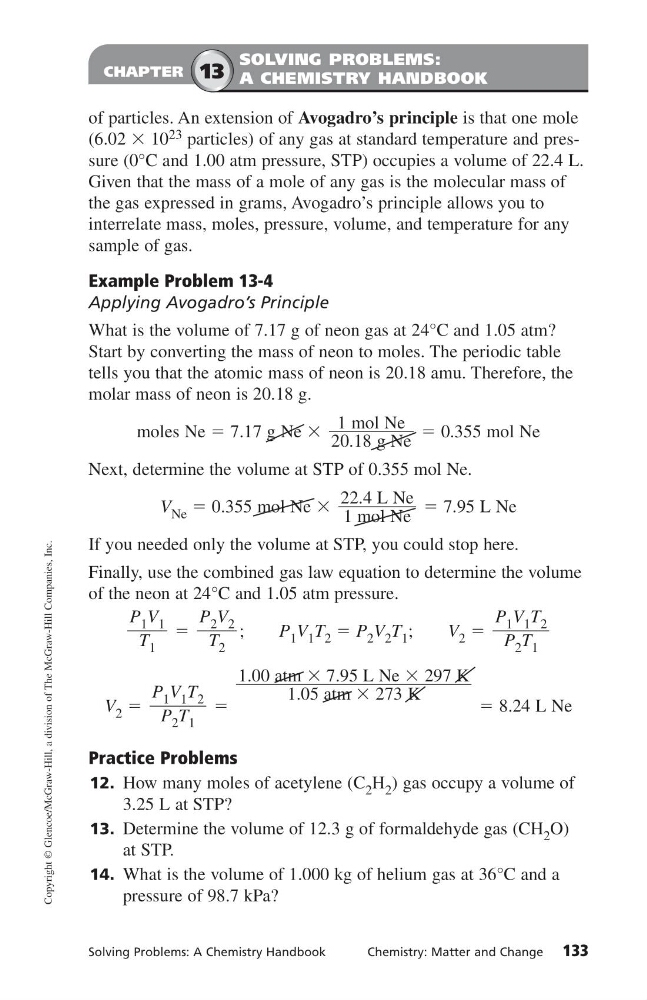
What is the volume of 7.17 g of neon gas at 24°C and 1.05 atm?
Start by converting the mass of neon to moles. The periodic table
tells you that the atomic mass of neon is 20.18 amu. Therefore, the
molar mass of neon is 20.18 g.
moles Ne ϭ 7.17 g Ne ϫ
ϭ0.355 mol Ne
Next, determine the volume at STP of 0.355 mol Ne.
V Ne ϭ 0.355 mol Ne ϫ
ϭ7.95 L Ne
If you needed only the volume at STP, you could stop here.
Finally, use the combined gas law equation to determine the volume
of the neon at 24°C and 1.05 atm pressure.
ϭ
;
P 1 V 1 T 2 ϭ P 2 V 2 T 1 ;
V 2 ϭ
V 2 ϭ
ϭ
ϭ8.24 L Ne
Practice Problems
12. How many moles of acetylene (C 2 H 2 ) gas occupy a volume of
3.25 L at STP?
13. Determine the volume of 12.3 g of formaldehyde gas (CH 2 O)
at STP.
14. What is the volume of 1.000 kg of helium gas at 36°C and a
pressure of 98.7 kPa?
1.00 atm ϫ 7.95 L Ne ϫ 297 K
ᎏᎏᎏᎏ
1.05 atm ϫ 273 K
P 1 V 1 T 2
ᎏ
P 2 T 1
P 1 V 1 T 2
ᎏ
P 2 T 1
P 2 V 2
ᎏ
T 2
P 1 V 1
ᎏ
T 1
22.4 L Ne
ᎏᎏ
1 mol Ne
1 mol Ne
ᎏᎏ
20.18 g Ne
Solving Problems: A Chemistry Handbook
Chemistry: Matter and Change
133
SOLVING PROBLEMS:
A CHEMISTRY HANDBOOK
CHAPTER 13
of particles. An extension of Avogadro’s principle is that one mole
(6.02 ϫ 10 23 particles) of any gas at standard temperature and pressure (0°C and 1.00 atm pressure, STP) occupies a volume of 22.4 L.
Given that the mass of a mole of any gas is the molecular mass of
the gas expressed in grams, Avogadro’s principle allows you to
interrelate mass, moles, pressure, volume, and temperature for any
sample of gas.
Example Problem 13-4
Applying Avogadro’s Principle
What is the volume of 7.17 g of neon gas at 24°C and 1.05 atm?
Start by converting the mass of neon to moles. The periodic table
tells you that the atomic mass of neon is 20.18 amu. Therefore, the
molar mass of neon is 20.18 g.
moles Ne ϭ 7.17 g Ne ϫ
ϭ0.355 mol Ne
Next, determine the volume at STP of 0.355 mol Ne.
V Ne ϭ 0.355 mol Ne ϫ
ϭ7.95 L Ne
If you needed only the volume at STP, you could stop here.
Finally, use the combined gas law equation to determine the volume
of the neon at 24°C and 1.05 atm pressure.
ϭ
;
P 1 V 1 T 2 ϭ P 2 V 2 T 1 ;
V 2 ϭ
V 2 ϭ
ϭ
ϭ8.24 L Ne
Practice Problems
12. How many moles of acetylene (C 2 H 2 ) gas occupy a volume of
3.25 L at STP?
13. Determine the volume of 12.3 g of formaldehyde gas (CH 2 O)
at STP.
14. What is the volume of 1.000 kg of helium gas at 36°C and a
pressure of 98.7 kPa?
1.00 atm ϫ 7.95 L Ne ϫ 297 K
ᎏᎏᎏᎏ
1.05 atm ϫ 273 K
P 1 V 1 T 2
ᎏ
P 2 T 1
P 1 V 1 T 2
ᎏ
P 2 T 1
P 2 V 2
ᎏ
T 2
P 1 V 1
ᎏ
T 1
22.4 L Ne
ᎏᎏ
1 mol Ne
1 mol Ne
ᎏᎏ
20.18 g Ne