

Copyright © Glencoe/McGraw-Hill, a division of The McGraw-Hill Companies, Inc.
134 Chemistry: Matter and Change
Solving Problems: A Chemistry Handbook
SOLVING PROBLEMS:
A CHEMISTRY HANDBOOK
CHAPTER 13
15. What is the mass of 187 L of CO 2 gas? The volume is measured at STP. (Hint: Start by determining the number of moles of
gas present.)
16. How many moles of silane gas (SiH 4 ) are present in 8.68 mL
measured at 18°C and 1.50 atm? (Hint: First determine the volume of the silane at STP.)
13.3 The Ideal Gas Law
The pressure, volume, temperature, and number of moles of gas can
be related in a simpler, more convenient way by using the ideal gas
law. The following is the law’s mathematical expression,
PV ϭ nRT,
where n represents the number of moles. The ideal gas constant, R,
already contains the molar volume of a gas at STP along with the
standard temperature and pressure conditions. The constant R does
the job of correcting conditions to STP. You do not have to correct to
STP in a separate step as in Example Problem 14-4. The value of R
depends on the units in which the pressure of the gas is measured, as
shown below.
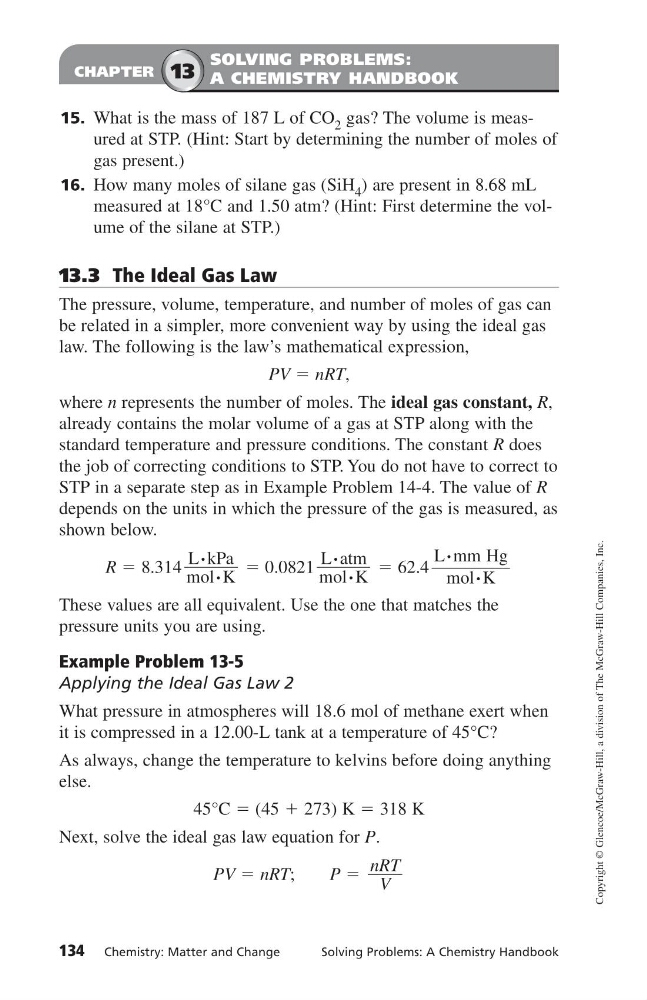
R ϭ 8.314
ϭ 0.0821
ϭ 62.4
These values are all equivalent. Use the one that matches the
pressure units you are using.
Example Problem 13-5
Applying the Ideal Gas Law 2
What pressure in atmospheres will 18.6 mol of methane exert when
it is compressed in a 12.00-L tank at a temperature of 45°C?
As always, change the temperature to kelvins before doing anything
else.
45°C ϭ (45 ϩ 273) K ϭ 318 K
Next, solve the ideal gas law equation for P.
PV ϭ nRT;
P ϭ nRT
ᎏ
V
L и mm Hg
ᎏᎏ
mol и K
L и atm
ᎏ
mol и K
L и kPa
ᎏ
mol и K
134 Chemistry: Matter and Change
Solving Problems: A Chemistry Handbook
SOLVING PROBLEMS:
A CHEMISTRY HANDBOOK
CHAPTER 13
15. What is the mass of 187 L of CO 2 gas? The volume is measured at STP. (Hint: Start by determining the number of moles of
gas present.)
16. How many moles of silane gas (SiH 4 ) are present in 8.68 mL
measured at 18°C and 1.50 atm? (Hint: First determine the volume of the silane at STP.)
13.3 The Ideal Gas Law
The pressure, volume, temperature, and number of moles of gas can
be related in a simpler, more convenient way by using the ideal gas
law. The following is the law’s mathematical expression,
PV ϭ nRT,
where n represents the number of moles. The ideal gas constant, R,
already contains the molar volume of a gas at STP along with the
standard temperature and pressure conditions. The constant R does
the job of correcting conditions to STP. You do not have to correct to
STP in a separate step as in Example Problem 14-4. The value of R
depends on the units in which the pressure of the gas is measured, as
shown below.
R ϭ 8.314
ϭ 0.0821
ϭ 62.4
These values are all equivalent. Use the one that matches the
pressure units you are using.
Example Problem 13-5
Applying the Ideal Gas Law 2
What pressure in atmospheres will 18.6 mol of methane exert when
it is compressed in a 12.00-L tank at a temperature of 45°C?
As always, change the temperature to kelvins before doing anything
else.
45°C ϭ (45 ϩ 273) K ϭ 318 K
Next, solve the ideal gas law equation for P.
PV ϭ nRT;
P ϭ nRT
ᎏ
V
L и mm Hg
ᎏᎏ
mol и K
L и atm
ᎏ
mol и K
L и kPa
ᎏ
mol и K