

Copyright © Glencoe/McGraw-Hill, a division of The McGraw-Hill Companies, Inc.
132 Chemistry: Matter and Change
Solving Problems: A Chemistry Handbook
SOLVING PROBLEMS:
A CHEMISTRY HANDBOOK
CHAPTER 13
Example Problem 13-3
Applying the Combined Gas Law
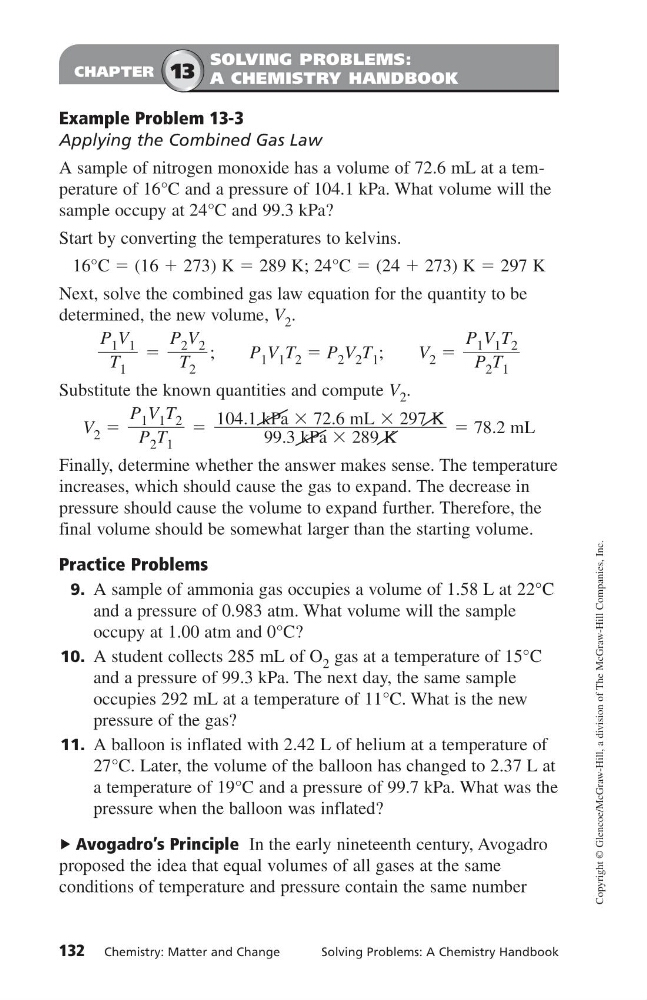
A sample of nitrogen monoxide has a volume of 72.6 mL at a temperature of 16°C and a pressure of 104.1 kPa. What volume will the
sample occupy at 24°C and 99.3 kPa?
Start by converting the temperatures to kelvins.
16°C ϭ (16 ϩ 273) K ϭ 289 K; 24°C ϭ (24 ϩ 273) K ϭ 297 K
Next, solve the combined gas law equation for the quantity to be
determined, the new volume, V 2 .
ϭ
;
P 1 V 1 T 2 ϭ P 2 V 2 T 1 ;
V 2 ϭ
Substitute the known quantities and compute V 2 .
V 2 ϭ
ϭ
ϭ78.2 mL
Finally, determine whether the answer makes sense. The temperature
increases, which should cause the gas to expand. The decrease in
pressure should cause the volume to expand further. Therefore, the
final volume should be somewhat larger than the starting volume.
Practice Problems
9. A sample of ammonia gas occupies a volume of 1.58 L at 22°C
and a pressure of 0.983 atm. What volume will the sample
occupy at 1.00 atm and 0°C?
10. A student collects 285 mL of O 2 gas at a temperature of 15°C
and a pressure of 99.3 kPa. The next day, the same sample
occupies 292 mL at a temperature of 11°C. What is the new
pressure of the gas?
11. A balloon is inflated with 2.42 L of helium at a temperature of
27°C. Later, the volume of the balloon has changed to 2.37 L at
a temperature of 19°C and a pressure of 99.7 kPa. What was the
pressure when the balloon was inflated?
Avogadro’s Principle In the early nineteenth century, Avogadro
proposed the idea that equal volumes of all gases at the same
conditions of temperature and pressure contain the same number
▲
104.1 kPa ϫ 72.6 mL ϫ 297 K
ᎏᎏᎏᎏ
99.3 kPa ϫ 289 K
P 1 V 1 T 2
ᎏ
P 2 T 1
P 1 V 1 T 2
ᎏ
P 2 T 1
P 2 V 2
ᎏ
T 2
P 1 V 1
ᎏ
T 1
132 Chemistry: Matter and Change
Solving Problems: A Chemistry Handbook
SOLVING PROBLEMS:
A CHEMISTRY HANDBOOK
CHAPTER 13
Example Problem 13-3
Applying the Combined Gas Law
A sample of nitrogen monoxide has a volume of 72.6 mL at a temperature of 16°C and a pressure of 104.1 kPa. What volume will the
sample occupy at 24°C and 99.3 kPa?
Start by converting the temperatures to kelvins.
16°C ϭ (16 ϩ 273) K ϭ 289 K; 24°C ϭ (24 ϩ 273) K ϭ 297 K
Next, solve the combined gas law equation for the quantity to be
determined, the new volume, V 2 .
ϭ
;
P 1 V 1 T 2 ϭ P 2 V 2 T 1 ;
V 2 ϭ
Substitute the known quantities and compute V 2 .
V 2 ϭ
ϭ
ϭ78.2 mL
Finally, determine whether the answer makes sense. The temperature
increases, which should cause the gas to expand. The decrease in
pressure should cause the volume to expand further. Therefore, the
final volume should be somewhat larger than the starting volume.
Practice Problems
9. A sample of ammonia gas occupies a volume of 1.58 L at 22°C
and a pressure of 0.983 atm. What volume will the sample
occupy at 1.00 atm and 0°C?
10. A student collects 285 mL of O 2 gas at a temperature of 15°C
and a pressure of 99.3 kPa. The next day, the same sample
occupies 292 mL at a temperature of 11°C. What is the new
pressure of the gas?
11. A balloon is inflated with 2.42 L of helium at a temperature of
27°C. Later, the volume of the balloon has changed to 2.37 L at
a temperature of 19°C and a pressure of 99.7 kPa. What was the
pressure when the balloon was inflated?
Avogadro’s Principle In the early nineteenth century, Avogadro
proposed the idea that equal volumes of all gases at the same
conditions of temperature and pressure contain the same number
▲
104.1 kPa ϫ 72.6 mL ϫ 297 K
ᎏᎏᎏᎏ
99.3 kPa ϫ 289 K
P 1 V 1 T 2
ᎏ
P 2 T 1
P 1 V 1 T 2
ᎏ
P 2 T 1
P 2 V 2
ᎏ
T 2
P 1 V 1
ᎏ
T 1