

mixing devices using the solvent jump method in which the composition of the solvent is abruptly changed by mixing two solutions
at equilibrium in different solvents, or a solution at equilibrium
with another solvent. Analysis of kinetic traces using Eq. 1 does not
give the individual rate constants but if the equilibrium constant
K is known then they can be calculated using:
k À1 ¼
k obs
1 þ K
k 1 ¼
K Á k obs
1 þ K
ð3Þ
Reversible binding reactions, such as those in which a ligand
associates with a protein, have a second-order association process,
and a first-order dissociation process and are described by:
Here k 1 is the second-order association rate constant (units:
M
À1 s
À1
), and k À1 is the first-order dissociation rate constant
(units: s
À1 ). The equilibrium dissociation constant for this reaction,
K d , is equal to k À1 /k 1 (units: M), whereas the equilibrium association constant, K a , is its reciprocal k 1 /k À1 (units: M
À1 ). There is no
simple general analytical solution for the differential rate equation
(see Subheading 3.5) that describes the change in [PL] with time.
However, if one of the reactants is in large excess over the other
([L tot ] ) [P tot ] or [P tot ] ) [L tot ]), the concentration of the component in large excess remains effectively constant during the reaction because [X tot ] À [PL] % [X tot ], where [X tot ] is the total
concentration of the component (P or L) present in excess. The
formation of PL is then said to follow pseudo-first-order kinetics,
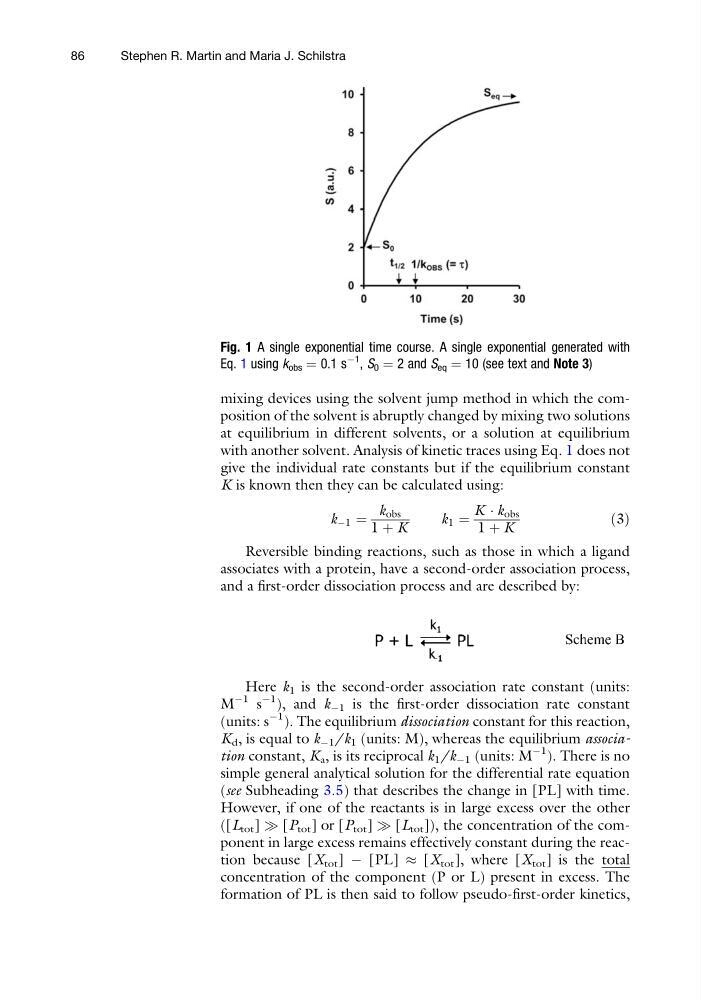
Fig. 1 A single exponential time course. A single exponential generated with
Eq. 1 using k obs ¼ 0.1 s
À1
, S 0 ¼ 2 and S eq ¼ 10 (see text and Note 3)
86
Stephen R. Martin and Maria J. Schilstra
at equilibrium in different solvents, or a solution at equilibrium
with another solvent. Analysis of kinetic traces using Eq. 1 does not
give the individual rate constants but if the equilibrium constant
K is known then they can be calculated using:
k À1 ¼
k obs
1 þ K
k 1 ¼
K Á k obs
1 þ K
ð3Þ
Reversible binding reactions, such as those in which a ligand
associates with a protein, have a second-order association process,
and a first-order dissociation process and are described by:
Here k 1 is the second-order association rate constant (units:
M
À1 s
À1
), and k À1 is the first-order dissociation rate constant
(units: s
À1 ). The equilibrium dissociation constant for this reaction,
K d , is equal to k À1 /k 1 (units: M), whereas the equilibrium association constant, K a , is its reciprocal k 1 /k À1 (units: M
À1 ). There is no
simple general analytical solution for the differential rate equation
(see Subheading 3.5) that describes the change in [PL] with time.
However, if one of the reactants is in large excess over the other
([L tot ] ) [P tot ] or [P tot ] ) [L tot ]), the concentration of the component in large excess remains effectively constant during the reaction because [X tot ] À [PL] % [X tot ], where [X tot ] is the total
concentration of the component (P or L) present in excess. The
formation of PL is then said to follow pseudo-first-order kinetics,
Fig. 1 A single exponential time course. A single exponential generated with
Eq. 1 using k obs ¼ 0.1 s
À1
, S 0 ¼ 2 and S eq ¼ 10 (see text and Note 3)
86
Stephen R. Martin and Maria J. Schilstra