

3.6.2 SPR Measurement
1. Wash the reference channel (FC1) and all channels containing
immobilized HEWL in standard assay buffer to establish a
stable baseline; a washing time of 30 min at a flow rate of
10 μL/min should be sufficient.
2. Make 400 μL of a 400-μM solution of NAG3 in standard assay
buffer, and then make a 12-point 1:1 serial dilution in the range
0.2–400 μM with a final volume of 200 μL for each point. Degas
the solutions for 3–5 min under a weak vacuum before use.
3. Perform a series of injections of the serial dilution of NAG3,
from the lowest to the highest concentration. Injections should
be made to the reference channel (FC1) and to all channels
with immobilized HEWL.
4. The contact time for each injection should be 10 min at a flow
rate of 10 μL/min (total injection volume of 100 μL). This
should be sufficient to establish a stable equilibrium (steadystate) response at that concentration. After each injection, flow
standard assay buffer across all the relevant flow channels for
20 min at 10 μL/min so that any bound NAG3 is completely
dissociated and the response returns to the pre-injection baseline.
3.6.3 SPR Data Analysis
and Typical Results
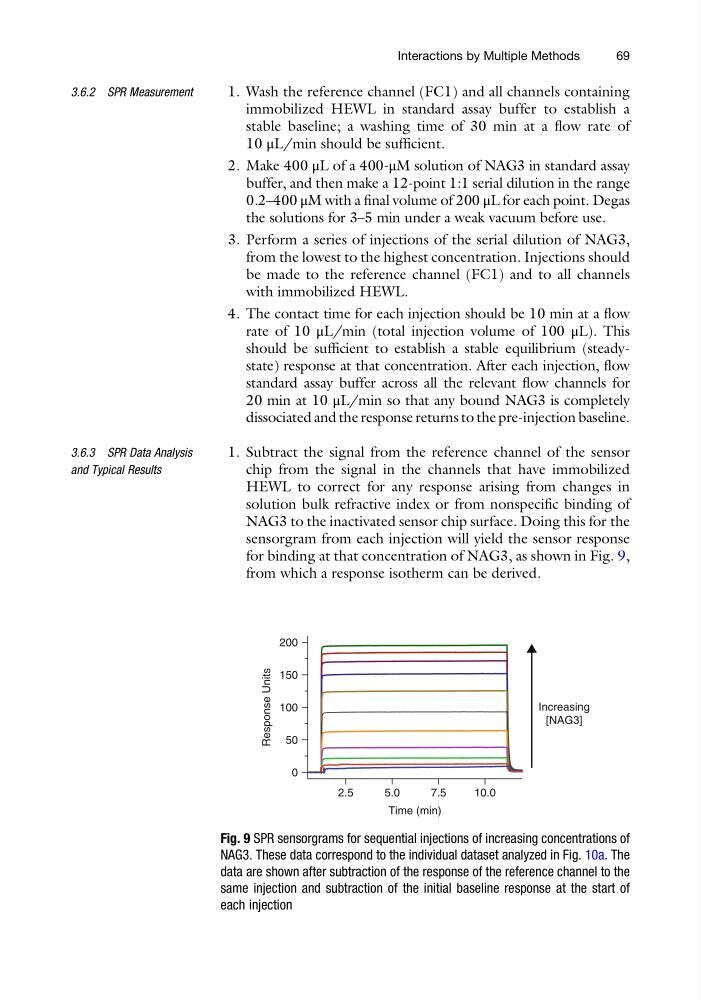
1. Subtract the signal from the reference channel of the sensor
chip from the signal in the channels that have immobilized
HEWL to correct for any response arising from changes in
solution bulk refractive index or from nonspecific binding of
NAG3 to the inactivated sensor chip surface. Doing this for the
sensorgram from each injection will yield the sensor response
for binding at that concentration of NAG3, as shown in Fig. 9,
from which a response isotherm can be derived.
2.5
5.0
7.5
10.0
0
50
100
150
200
Time (min)
Response Units
Increasing
[NAG3]
Fig. 9 SPR sensorgrams for sequential injections of increasing concentrations of
NAG3. These data correspond to the individual dataset analyzed in Fig. 10a. The
data are shown after subtraction of the response of the reference channel to the
same injection and subtraction of the initial baseline response at the start of
each injection
Interactions by Multiple Methods
69
1. Wash the reference channel (FC1) and all channels containing
immobilized HEWL in standard assay buffer to establish a
stable baseline; a washing time of 30 min at a flow rate of
10 μL/min should be sufficient.
2. Make 400 μL of a 400-μM solution of NAG3 in standard assay
buffer, and then make a 12-point 1:1 serial dilution in the range
0.2–400 μM with a final volume of 200 μL for each point. Degas
the solutions for 3–5 min under a weak vacuum before use.
3. Perform a series of injections of the serial dilution of NAG3,
from the lowest to the highest concentration. Injections should
be made to the reference channel (FC1) and to all channels
with immobilized HEWL.
4. The contact time for each injection should be 10 min at a flow
rate of 10 μL/min (total injection volume of 100 μL). This
should be sufficient to establish a stable equilibrium (steadystate) response at that concentration. After each injection, flow
standard assay buffer across all the relevant flow channels for
20 min at 10 μL/min so that any bound NAG3 is completely
dissociated and the response returns to the pre-injection baseline.
3.6.3 SPR Data Analysis
and Typical Results
1. Subtract the signal from the reference channel of the sensor
chip from the signal in the channels that have immobilized
HEWL to correct for any response arising from changes in
solution bulk refractive index or from nonspecific binding of
NAG3 to the inactivated sensor chip surface. Doing this for the
sensorgram from each injection will yield the sensor response
for binding at that concentration of NAG3, as shown in Fig. 9,
from which a response isotherm can be derived.
2.5
5.0
7.5
10.0
0
50
100
150
200
Time (min)
Response Units
Increasing
[NAG3]
Fig. 9 SPR sensorgrams for sequential injections of increasing concentrations of
NAG3. These data correspond to the individual dataset analyzed in Fig. 10a. The
data are shown after subtraction of the response of the reference channel to the
same injection and subtraction of the initial baseline response at the start of
each injection
Interactions by Multiple Methods
69