

ester on the chip surface, which is reactive toward lysine sidechains (and the protein N-terminal amine group).
4. One channel on the sensor chip should be inactivated for use as
a reference surface to evaluate nonspecific binding. To achieve
this, it can be exposed to an excess of a soluble reactive amine.
Inject 1 M ethanolamine at pH 8.5 for 7 min at a flow rate of
2 μL/min.
5. Expose the other channels on the sensor chip that you intend
to use for binding experiments to the 4-mg/mL HEWL solution in SPR immobilization buffer for 20 min at a flow rate of
2 μL/min.
6. Wash with immobilization buffer until the signal reaches a
stable baseline.
7. After washing the sensor chip, you should determine the
amount of immobilized HEWL by comparison with the activated surface before application of the HEWL solution. In five
replicates, using a CM5 sensor chip in a Biacore T200, we
typically obtained 4000–7000 RU of immobilized HEWL (see
Note 36).
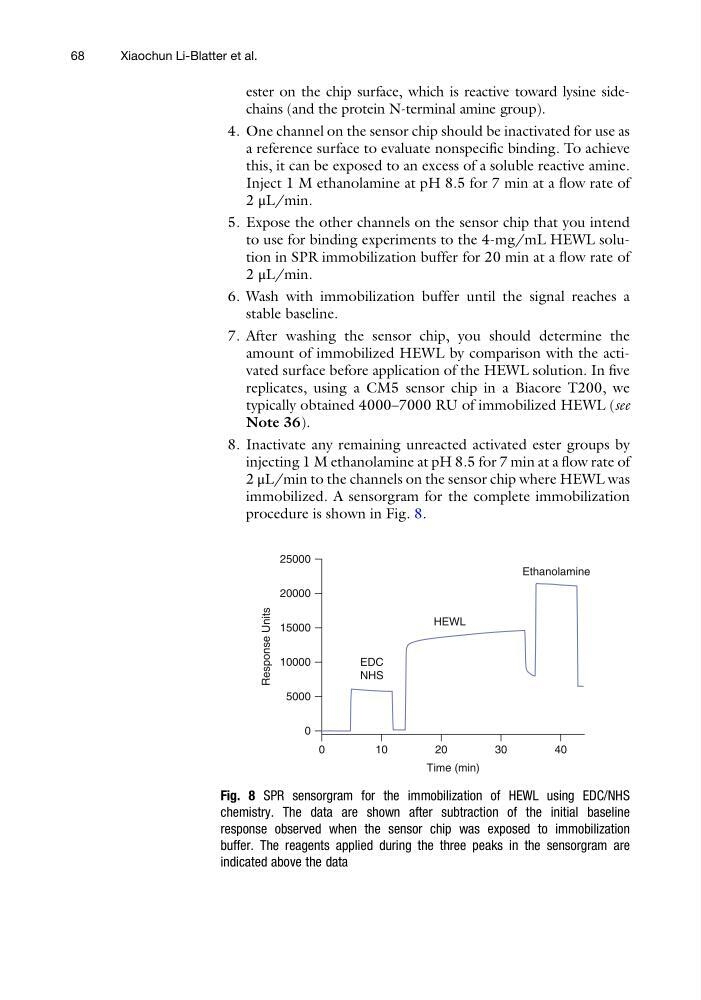
8. Inactivate any remaining unreacted activated ester groups by
injecting 1 M ethanolamine at pH 8.5 for 7 min at a flow rate of
2 μL/min to the channels on the sensor chip where HEWL was
immobilized. A sensorgram for the complete immobilization
procedure is shown in Fig. 8.
0
1 0
2 0
3 0
4 0
0
5000
10000
15000
20000
25000
Time (min)
Response Units
EDC
NHS
HEWL
Ethanolamine
Fig. 8 SPR sensorgram for the immobilization of HEWL using EDC/NHS
chemistry. The data are shown after subtraction of the initial baseline
response observed when the sensor chip was exposed to immobilization
buffer. The reagents applied during the three peaks in the sensorgram are
indicated above the data
68
Xiaochun Li-Blatter et al.
4. One channel on the sensor chip should be inactivated for use as
a reference surface to evaluate nonspecific binding. To achieve
this, it can be exposed to an excess of a soluble reactive amine.
Inject 1 M ethanolamine at pH 8.5 for 7 min at a flow rate of
2 μL/min.
5. Expose the other channels on the sensor chip that you intend
to use for binding experiments to the 4-mg/mL HEWL solution in SPR immobilization buffer for 20 min at a flow rate of
2 μL/min.
6. Wash with immobilization buffer until the signal reaches a
stable baseline.
7. After washing the sensor chip, you should determine the
amount of immobilized HEWL by comparison with the activated surface before application of the HEWL solution. In five
replicates, using a CM5 sensor chip in a Biacore T200, we
typically obtained 4000–7000 RU of immobilized HEWL (see
Note 36).
8. Inactivate any remaining unreacted activated ester groups by
injecting 1 M ethanolamine at pH 8.5 for 7 min at a flow rate of
2 μL/min to the channels on the sensor chip where HEWL was
immobilized. A sensorgram for the complete immobilization
procedure is shown in Fig. 8.
0
1 0
2 0
3 0
4 0
0
5000
10000
15000
20000
25000
Time (min)
Response Units
EDC
NHS
HEWL
Ethanolamine
Fig. 8 SPR sensorgram for the immobilization of HEWL using EDC/NHS
chemistry. The data are shown after subtraction of the initial baseline
response observed when the sensor chip was exposed to immobilization
buffer. The reagents applied during the three peaks in the sensorgram are
indicated above the data
68
Xiaochun Li-Blatter et al.