

increase from the s-value of free B (s B ) to the s-value of the complex
(s AB ). The s-value s rb reflects the fractional time B spends on average
in the complex during sedimentation [19]. Such a titration can also
be used to quantitatively determine the binding constant of the
interaction. This requires fitting of a binding isotherm to the
sedimentation coefficient of the reaction boundary as a function
of the concentration of the slower sedimenting interaction partner
(Fig. 5b).
For a simple interaction, where one molecule of the slower
sedimenting interaction partner A interacts with one molecule of
B to form a complex AB, the sedimentation coefficient of the
reaction boundary s rb in an excess of A is given both in the constant
bath approximation [20] and in EPT [22] by
s rb ¼
B
½ Á s B þ AB
½ Á s AB
B
½ þ AB
½
¼
s B þ s AB Á
A
½
K D
1 þ
A
½
K D
ð1Þ
where
K D ¼
1
K A
¼
A
½ Á B
½
AB
½
ð2Þ
K D and K A are the dissociation and association constants, respectively, and [A], [B], and [AB] are the equilibrium concentrations
of A, B, and AB, respectively, which can be calculated from the total
concentrations of A (A 0 ) and B (B 0 ) as follows:
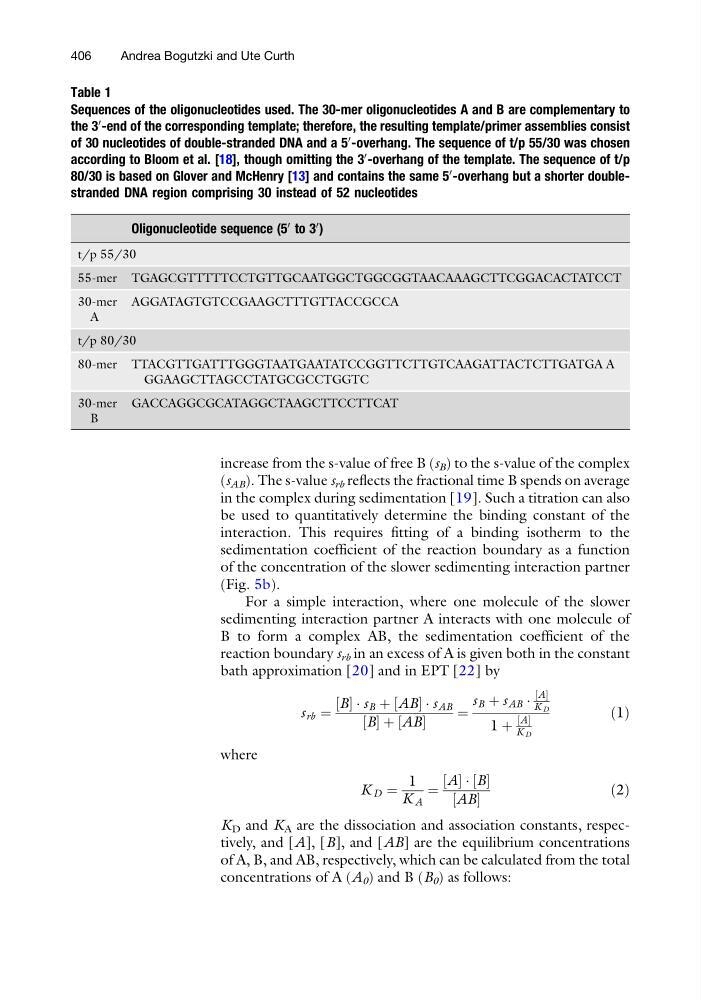
Table 1
Sequences of the oligonucleotides used. The 30-mer oligonucleotides A and B are complementary to
the 3
0 -end of the corresponding template; therefore, the resulting template/primer assemblies consist
of 30 nucleotides of double-stranded DNA and a 5
0 -overhang. The sequence of t/p 55/30 was chosen
according to Bloom et al. [18], though omitting the 3
0 -overhang of the template. The sequence of t/p
80/30 is based on Glover and McHenry [13] and contains the same 5
0 -overhang but a shorter doublestranded DNA region comprising 30 instead of 52 nucleotides
Oligonucleotide sequence (5
0 to 3
0 )
t/p 55/30
55-mer TGAGCGTTTTTCCTGTTGCAATGGCTGGCGGTAACAAAGCTTCGGACACTATCCT
30-mer
A
AGGATAGTGTCCGAAGCTTTGTTACCGCCA
t/p 80/30
80-mer TTACGTTGATTTGGGTAATGAATATCCGGTTCTTGTCAAGATTACTCTTGATGA A
GGAAGCTTAGCCTATGCGCCTGGTC
30-mer
B
GACCAGGCGCATAGGCTAAGCTTCCTTCAT
406
Andrea Bogutzki and Ute Curth
(s AB ). The s-value s rb reflects the fractional time B spends on average
in the complex during sedimentation [19]. Such a titration can also
be used to quantitatively determine the binding constant of the
interaction. This requires fitting of a binding isotherm to the
sedimentation coefficient of the reaction boundary as a function
of the concentration of the slower sedimenting interaction partner
(Fig. 5b).
For a simple interaction, where one molecule of the slower
sedimenting interaction partner A interacts with one molecule of
B to form a complex AB, the sedimentation coefficient of the
reaction boundary s rb in an excess of A is given both in the constant
bath approximation [20] and in EPT [22] by
s rb ¼
B
½ Á s B þ AB
½ Á s AB
B
½ þ AB
½
¼
s B þ s AB Á
A
½
K D
1 þ
A
½
K D
ð1Þ
where
K D ¼
1
K A
¼
A
½ Á B
½
AB
½
ð2Þ
K D and K A are the dissociation and association constants, respectively, and [A], [B], and [AB] are the equilibrium concentrations
of A, B, and AB, respectively, which can be calculated from the total
concentrations of A (A 0 ) and B (B 0 ) as follows:
Table 1
Sequences of the oligonucleotides used. The 30-mer oligonucleotides A and B are complementary to
the 3
0 -end of the corresponding template; therefore, the resulting template/primer assemblies consist
of 30 nucleotides of double-stranded DNA and a 5
0 -overhang. The sequence of t/p 55/30 was chosen
according to Bloom et al. [18], though omitting the 3
0 -overhang of the template. The sequence of t/p
80/30 is based on Glover and McHenry [13] and contains the same 5
0 -overhang but a shorter doublestranded DNA region comprising 30 instead of 52 nucleotides
Oligonucleotide sequence (5
0 to 3
0 )
t/p 55/30
55-mer TGAGCGTTTTTCCTGTTGCAATGGCTGGCGGTAACAAAGCTTCGGACACTATCCT
30-mer
A
AGGATAGTGTCCGAAGCTTTGTTACCGCCA
t/p 80/30
80-mer TTACGTTGATTTGGGTAATGAATATCCGGTTCTTGTCAAGATTACTCTTGATGA A
GGAAGCTTAGCCTATGCGCCTGGTC
30-mer
B
GACCAGGCGCATAGGCTAAGCTTCCTTCAT
406
Andrea Bogutzki and Ute Curth