

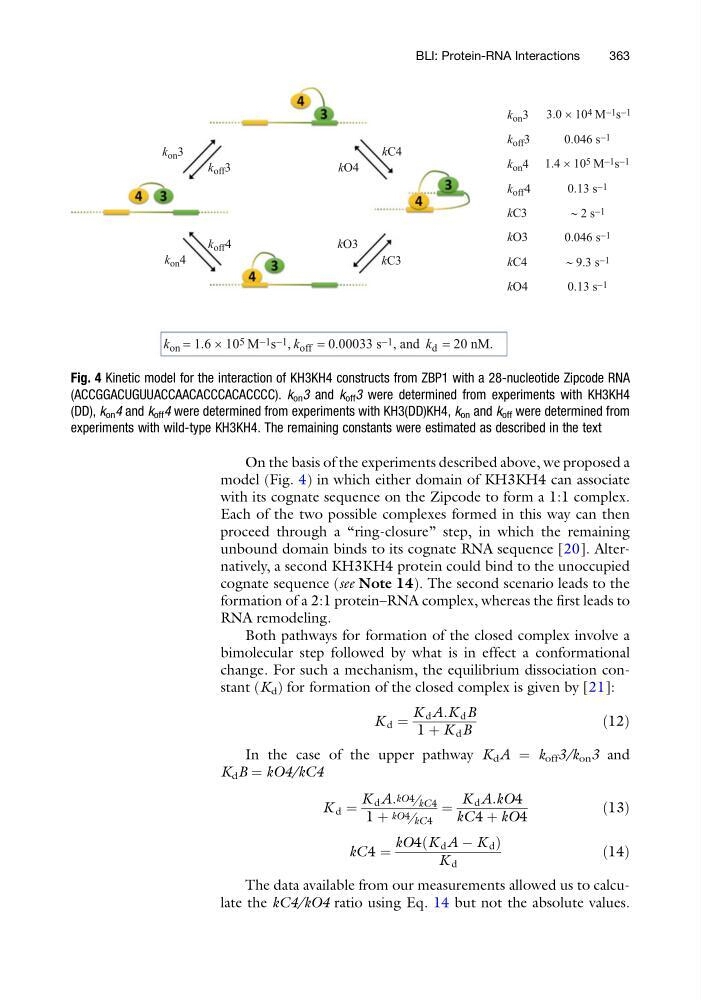
On the basis of the experiments described above, we proposed a
model (Fig. 4) in which either domain of KH3KH4 can associate
with its cognate sequence on the Zipcode to form a 1:1 complex.
Each of the two possible complexes formed in this way can then
proceed through a “ring-closure” step, in which the remaining
unbound domain binds to its cognate RNA sequence [20]. Alternatively, a second KH3KH4 protein could bind to the unoccupied
cognate sequence (see Note 14). The second scenario leads to the
formation of a 2:1 protein–RNA complex, whereas the first leads to
RNA remodeling.
Both pathways for formation of the closed complex involve a
bimolecular step followed by what is in effect a conformational
change. For such a mechanism, the equilibrium dissociation constant (K d ) for formation of the closed complex is given by [21]:
K d ¼
K d A:K d B
1 þ K d B
ð12Þ
In the case of the upper pathway K d A ¼ k off 3/k on 3 and
K d B ¼ kO4/kC4
K d ¼
K d A: kO4 = kC4
1 þ kO4 = kC4
¼
K d A:kO4
kC4 þ kO4
ð13Þ
kC4 ¼
kO4 K d A À K d
ð
Þ
K d
ð14Þ
The data available from our measurements allowed us to calculate the kC4/kO4 ratio using Eq. 14 but not the absolute values.
k on 3
k on 3 3.0 ´ 10 4 M -1 s -1
k on = 1.6 ´ 10 5 M -1 s -1 , k off = 0.00033 s -1 , and k d = 20 nM.
1.4 ´ 10 5 M -1 s -1
0.046 s -1
0.13 s -1
0.13 s -1
0.046 s -1
~ 2 s -1
~ 9.3 s -1
k off 3
k off 3
kO4
kC4
kO3
kC3
kO4
kC4
kO3
kC3
k off 4
k off 4
k on 4
k on 4
Fig. 4 Kinetic model for the interaction of KH3KH4 constructs from ZBP1 with a 28-nucleotide Zipcode RNA
(ACCGGACUGUUACCAACACCCACACCCC). k on 3 and k off 3 were determined from experiments with KH3KH4
(DD), k on 4 and k off 4 were determined from experiments with KH3(DD)KH4, k on and k off were determined from
experiments with wild-type KH3KH4. The remaining constants were estimated as described in the text
BLI: Protein-RNA Interactions
363
model (Fig. 4) in which either domain of KH3KH4 can associate
with its cognate sequence on the Zipcode to form a 1:1 complex.
Each of the two possible complexes formed in this way can then
proceed through a “ring-closure” step, in which the remaining
unbound domain binds to its cognate RNA sequence [20]. Alternatively, a second KH3KH4 protein could bind to the unoccupied
cognate sequence (see Note 14). The second scenario leads to the
formation of a 2:1 protein–RNA complex, whereas the first leads to
RNA remodeling.
Both pathways for formation of the closed complex involve a
bimolecular step followed by what is in effect a conformational
change. For such a mechanism, the equilibrium dissociation constant (K d ) for formation of the closed complex is given by [21]:
K d ¼
K d A:K d B
1 þ K d B
ð12Þ
In the case of the upper pathway K d A ¼ k off 3/k on 3 and
K d B ¼ kO4/kC4
K d ¼
K d A: kO4 = kC4
1 þ kO4 = kC4
¼
K d A:kO4
kC4 þ kO4
ð13Þ
kC4 ¼
kO4 K d A À K d
ð
Þ
K d
ð14Þ
The data available from our measurements allowed us to calculate the kC4/kO4 ratio using Eq. 14 but not the absolute values.
k on 3
k on 3 3.0 ´ 10 4 M -1 s -1
k on = 1.6 ´ 10 5 M -1 s -1 , k off = 0.00033 s -1 , and k d = 20 nM.
1.4 ´ 10 5 M -1 s -1
0.046 s -1
0.13 s -1
0.13 s -1
0.046 s -1
~ 2 s -1
~ 9.3 s -1
k off 3
k off 3
kO4
kC4
kO3
kC3
kO4
kC4
kO3
kC3
k off 4
k off 4
k on 4
k on 4
Fig. 4 Kinetic model for the interaction of KH3KH4 constructs from ZBP1 with a 28-nucleotide Zipcode RNA
(ACCGGACUGUUACCAACACCCACACCCC). k on 3 and k off 3 were determined from experiments with KH3KH4
(DD), k on 4 and k off 4 were determined from experiments with KH3(DD)KH4, k on and k off were determined from
experiments with wild-type KH3KH4. The remaining constants were estimated as described in the text
BLI: Protein-RNA Interactions
363