

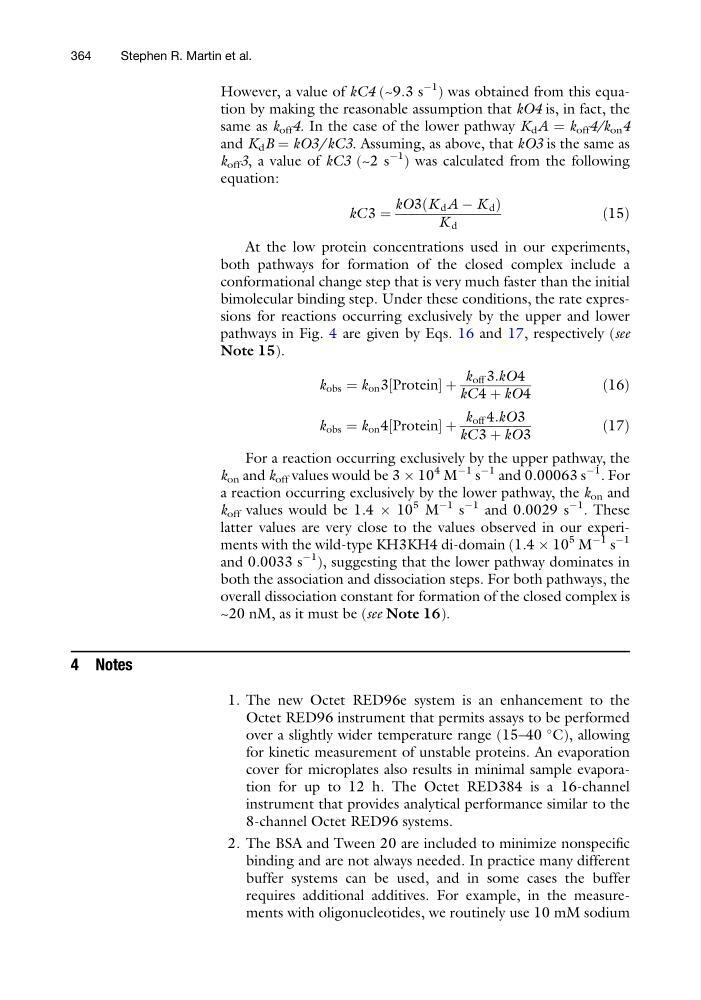
However, a value of kC4 (~9.3 s
À1 ) was obtained from this equation by making the reasonable assumption that kO4 is, in fact, the
same as k off 4. In the case of the lower pathway K d A ¼ k off 4/k on 4
and K d B ¼ kO3/kC3. Assuming, as above, that kO3 is the same as
k off 3, a value of kC3 (~2 s
À1 ) was calculated from the following
equation:
kC3 ¼
kO3 K d A À K d
ð
Þ
K d
ð15Þ
At the low protein concentrations used in our experiments,
both pathways for formation of the closed complex include a
conformational change step that is very much faster than the initial
bimolecular binding step. Under these conditions, the rate expressions for reactions occurring exclusively by the upper and lower
pathways in Fig. 4 are given by Eqs. 16 and 17, respectively (see
Note 15).
k obs ¼ k on 3 Protein
½
þ
k off 3:kO4
kC4 þ kO4
ð16Þ
k obs ¼ k on 4 Protein
½
þ
k off 4:kO3
kC3 þ kO3
ð17Þ
For a reaction occurring exclusively by the upper pathway, the
k on and k off values would be 3 Â 10
4 M
À1 s
À1 and 0.00063 s
À1 . For
a reaction occurring exclusively by the lower pathway, the k on and
k off values would be 1.4 Â 10
5 M
À1 s
À1 and 0.0029 s
À1
. These
latter values are very close to the values observed in our experiments with the wild-type KH3KH4 di-domain (1.4 Â 10
5 M
À1 s
À1
and 0.0033 s
À1 ), suggesting that the lower pathway dominates in
both the association and dissociation steps. For both pathways, the
overall dissociation constant for formation of the closed complex is
~20 nM, as it must be (see Note 16).
4 Notes
1. The new Octet RED96e system is an enhancement to the
Octet RED96 instrument that permits assays to be performed
over a slightly wider temperature range (15–40
C), allowing
for kinetic measurement of unstable proteins. An evaporation
cover for microplates also results in minimal sample evaporation for up to 12 h. The Octet RED384 is a 16-channel
instrument that provides analytical performance similar to the
8-channel Octet RED96 systems.
2. The BSA and Tween 20 are included to minimize nonspecific
binding and are not always needed. In practice many different
buffer systems can be used, and in some cases the buffer
requires additional additives. For example, in the measurements with oligonucleotides, we routinely use 10 mM sodium
364
Stephen R. Martin et al.
À1 ) was obtained from this equation by making the reasonable assumption that kO4 is, in fact, the
same as k off 4. In the case of the lower pathway K d A ¼ k off 4/k on 4
and K d B ¼ kO3/kC3. Assuming, as above, that kO3 is the same as
k off 3, a value of kC3 (~2 s
À1 ) was calculated from the following
equation:
kC3 ¼
kO3 K d A À K d
ð
Þ
K d
ð15Þ
At the low protein concentrations used in our experiments,
both pathways for formation of the closed complex include a
conformational change step that is very much faster than the initial
bimolecular binding step. Under these conditions, the rate expressions for reactions occurring exclusively by the upper and lower
pathways in Fig. 4 are given by Eqs. 16 and 17, respectively (see
Note 15).
k obs ¼ k on 3 Protein
½
þ
k off 3:kO4
kC4 þ kO4
ð16Þ
k obs ¼ k on 4 Protein
½
þ
k off 4:kO3
kC3 þ kO3
ð17Þ
For a reaction occurring exclusively by the upper pathway, the
k on and k off values would be 3 Â 10
4 M
À1 s
À1 and 0.00063 s
À1 . For
a reaction occurring exclusively by the lower pathway, the k on and
k off values would be 1.4 Â 10
5 M
À1 s
À1 and 0.0029 s
À1
. These
latter values are very close to the values observed in our experiments with the wild-type KH3KH4 di-domain (1.4 Â 10
5 M
À1 s
À1
and 0.0033 s
À1 ), suggesting that the lower pathway dominates in
both the association and dissociation steps. For both pathways, the
overall dissociation constant for formation of the closed complex is
~20 nM, as it must be (see Note 16).
4 Notes
1. The new Octet RED96e system is an enhancement to the
Octet RED96 instrument that permits assays to be performed
over a slightly wider temperature range (15–40
C), allowing
for kinetic measurement of unstable proteins. An evaporation
cover for microplates also results in minimal sample evaporation for up to 12 h. The Octet RED384 is a 16-channel
instrument that provides analytical performance similar to the
8-channel Octet RED96 systems.
2. The BSA and Tween 20 are included to minimize nonspecific
binding and are not always needed. In practice many different
buffer systems can be used, and in some cases the buffer
requires additional additives. For example, in the measurements with oligonucleotides, we routinely use 10 mM sodium
364
Stephen R. Martin et al.