

The
association
rate
constant
for
KH3(DD)KH4
(1.4 Â 10
5 M
À1 s
À1 ) is five times faster than for KH3KH4
(DD) (3.0 Â 10
4 M
À1 s
À1 ). Conversely, the dissociation rate constant for the KH3KH4(DD):RNA complex (0.046 s
À1 ) is three
times slower than that for the KH3(DD)KH4 complex (0.13 s
À1 ).
The wild-type construct (KH3KH4) in which both domains
can engage in the interaction binds to the RNA with an association
rate constant (1.6 Â 10
5 M
À1 s
À1 ) that is similar to that for KH4
but the dissociation rate constant is very much smaller
(0.0033 s
À1
). The ratio of these constants gives a K d of ~20 nM,
indicating that the coupling of KH3 and KH4 binding is relatively
weak, increasing the affinity of the individual interactions by only a
factor of ~50 (see Note 13).
5’
3’
RNA
KH1
KH2
KH3
KH4
RRM 1 RRM 2
a
b
IMP1/ZBP1
KH4
KH3
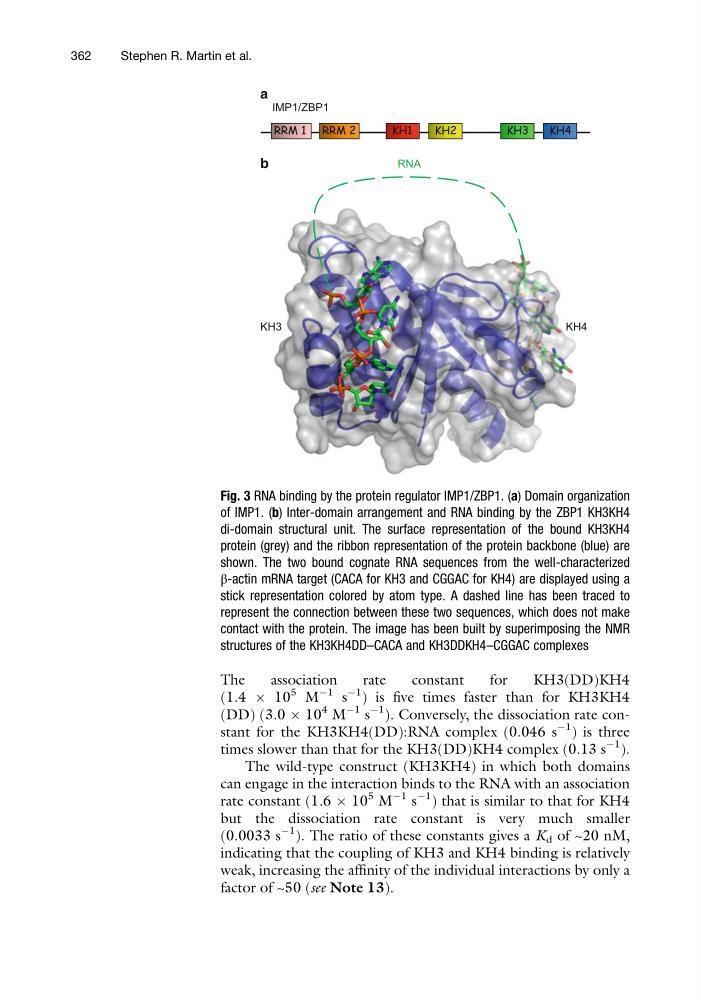
Fig. 3 RNA binding by the protein regulator IMP1/ZBP1. (a) Domain organization
of IMP1. (b) Inter-domain arrangement and RNA binding by the ZBP1 KH3KH4
di-domain structural unit. The surface representation of the bound KH3KH4
protein (grey) and the ribbon representation of the protein backbone (blue) are
shown. The two bound cognate RNA sequences from the well-characterized
β-actin mRNA target (CACA for KH3 and CGGAC for KH4) are displayed using a
stick representation colored by atom type. A dashed line has been traced to
represent the connection between these two sequences, which does not make
contact with the protein. The image has been built by superimposing the NMR
structures of the KH3KH4DD–CACA and KH3DDKH4–CGGAC complexes
362
Stephen R. Martin et al.
association
rate
constant
for
KH3(DD)KH4
(1.4 Â 10
5 M
À1 s
À1 ) is five times faster than for KH3KH4
(DD) (3.0 Â 10
4 M
À1 s
À1 ). Conversely, the dissociation rate constant for the KH3KH4(DD):RNA complex (0.046 s
À1 ) is three
times slower than that for the KH3(DD)KH4 complex (0.13 s
À1 ).
The wild-type construct (KH3KH4) in which both domains
can engage in the interaction binds to the RNA with an association
rate constant (1.6 Â 10
5 M
À1 s
À1 ) that is similar to that for KH4
but the dissociation rate constant is very much smaller
(0.0033 s
À1
). The ratio of these constants gives a K d of ~20 nM,
indicating that the coupling of KH3 and KH4 binding is relatively
weak, increasing the affinity of the individual interactions by only a
factor of ~50 (see Note 13).
5’
3’
RNA
KH1
KH2
KH3
KH4
RRM 1 RRM 2
a
b
IMP1/ZBP1
KH4
KH3
Fig. 3 RNA binding by the protein regulator IMP1/ZBP1. (a) Domain organization
of IMP1. (b) Inter-domain arrangement and RNA binding by the ZBP1 KH3KH4
di-domain structural unit. The surface representation of the bound KH3KH4
protein (grey) and the ribbon representation of the protein backbone (blue) are
shown. The two bound cognate RNA sequences from the well-characterized
β-actin mRNA target (CACA for KH3 and CGGAC for KH4) are displayed using a
stick representation colored by atom type. A dashed line has been traced to
represent the connection between these two sequences, which does not make
contact with the protein. The image has been built by superimposing the NMR
structures of the KH3KH4DD–CACA and KH3DDKH4–CGGAC complexes
362
Stephen R. Martin et al.