

bound molecule completely dissociates in step (e). In the case of
incomplete dissociation, the sensors can sometimes be regenerated
and used in subsequent experiments (see Note 9).
Two common problems that may be encountered are nonspecific binding of the protein to the sensor surface and instrument
drift, which may be a problem in those experiments which are
designed to run for a long time. In initial experiments, we routinely
include two controls. We check for nonspecific binding of the
protein to the sensor surface using steps (a)–(e) above but using a
reference biosensor with no oligonucleotide loaded in step (b).
Instrument drift problems can be identified by using a reference biosensor with no immobilized oligonucleotide in step (b)
and no protein present in step (d).
The inclusion of BSA and Tween 20 will generally reduce
nonspecific binding but will not always eliminate it completely (see
Notes 10 and 11). In principle a small amount of nonspecific
binding can be corrected for by including reference sensors where
no oligonucleotide is bound in step (b) but because the amount of
nonspecific binding will depend on the protein concentration, this
requires a separate reference sensor for each protein
concentration used.
3.2 Ternary
Complexes
More complex experimental designs are, of course, possible and are
often very informative. For example, it is possible to study the
formation of ternary complexes where two molecules can bind to
different sites on an immobilized molecule [11]. This would be
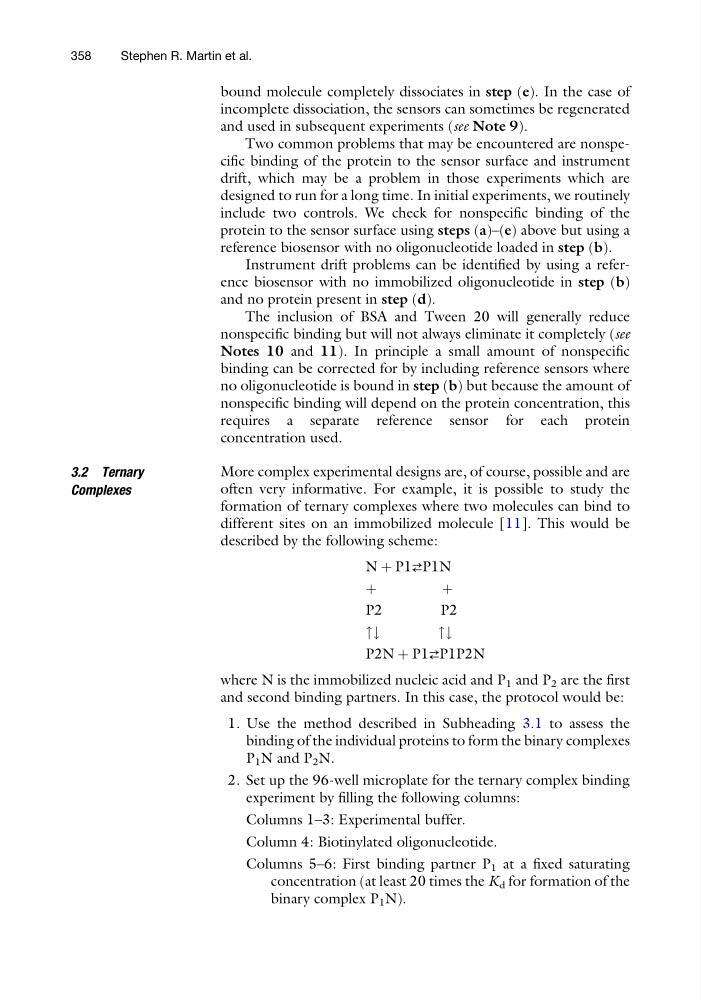
described by the following scheme:
N þ P1⇄P1N
þ
þ
P2
P2
"#
"#
P2N þ P1⇄P1P2N
where N is the immobilized nucleic acid and P 1 and P 2 are the first
and second binding partners. In this case, the protocol would be:
1. Use the method described in Subheading 3.1 to assess the
binding of the individual proteins to form the binary complexes
P 1 N and P 2 N.
2. Set up the 96-well microplate for the ternary complex binding
experiment by filling the following columns:
Columns 1–3: Experimental buffer.
Column 4: Biotinylated oligonucleotide.
Columns 5–6: First binding partner P 1 at a fixed saturating
concentration (at least 20 times the K d for formation of the
binary complex P 1 N).
358
Stephen R. Martin et al.
incomplete dissociation, the sensors can sometimes be regenerated
and used in subsequent experiments (see Note 9).
Two common problems that may be encountered are nonspecific binding of the protein to the sensor surface and instrument
drift, which may be a problem in those experiments which are
designed to run for a long time. In initial experiments, we routinely
include two controls. We check for nonspecific binding of the
protein to the sensor surface using steps (a)–(e) above but using a
reference biosensor with no oligonucleotide loaded in step (b).
Instrument drift problems can be identified by using a reference biosensor with no immobilized oligonucleotide in step (b)
and no protein present in step (d).
The inclusion of BSA and Tween 20 will generally reduce
nonspecific binding but will not always eliminate it completely (see
Notes 10 and 11). In principle a small amount of nonspecific
binding can be corrected for by including reference sensors where
no oligonucleotide is bound in step (b) but because the amount of
nonspecific binding will depend on the protein concentration, this
requires a separate reference sensor for each protein
concentration used.
3.2 Ternary
Complexes
More complex experimental designs are, of course, possible and are
often very informative. For example, it is possible to study the
formation of ternary complexes where two molecules can bind to
different sites on an immobilized molecule [11]. This would be
described by the following scheme:
N þ P1⇄P1N
þ
þ
P2
P2
"#
"#
P2N þ P1⇄P1P2N
where N is the immobilized nucleic acid and P 1 and P 2 are the first
and second binding partners. In this case, the protocol would be:
1. Use the method described in Subheading 3.1 to assess the
binding of the individual proteins to form the binary complexes
P 1 N and P 2 N.
2. Set up the 96-well microplate for the ternary complex binding
experiment by filling the following columns:
Columns 1–3: Experimental buffer.
Column 4: Biotinylated oligonucleotide.
Columns 5–6: First binding partner P 1 at a fixed saturating
concentration (at least 20 times the K d for formation of the
binary complex P 1 N).
358
Stephen R. Martin et al.