

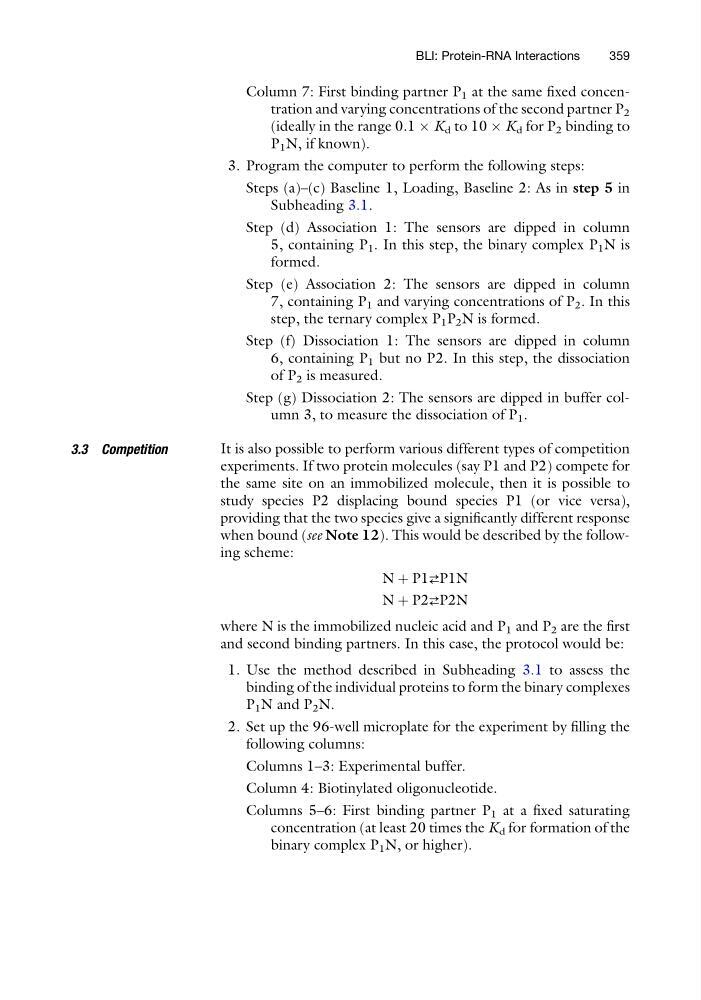
Column 7: First binding partner P 1 at the same fixed concentration and varying concentrations of the second partner P 2
(ideally in the range 0.1 Â K d to 10 Â K d for P 2 binding to
P 1 N, if known).
3. Program the computer to perform the following steps:
Steps (a)–(c) Baseline 1, Loading, Baseline 2: As in step 5 in
Subheading 3.1.
Step (d) Association 1: The sensors are dipped in column
5, containing P 1 . In this step, the binary complex P 1 N is
formed.
Step (e) Association 2: The sensors are dipped in column
7, containing P 1 and varying concentrations of P 2 . In this
step, the ternary complex P 1 P 2 N is formed.
Step (f) Dissociation 1: The sensors are dipped in column
6, containing P 1 but no P2. In this step, the dissociation
of P 2 is measured.
Step (g) Dissociation 2: The sensors are dipped in buffer column 3, to measure the dissociation of P 1 .
3.3 Competition
It is also possible to perform various different types of competition
experiments. If two protein molecules (say P1 and P2) compete for
the same site on an immobilized molecule, then it is possible to
study species P2 displacing bound species P1 (or vice versa),
providing that the two species give a significantly different response
when bound (see Note 12). This would be described by the following scheme:
N þ P1⇄P1N
N þ P2⇄P2N
where N is the immobilized nucleic acid and P 1 and P 2 are the first
and second binding partners. In this case, the protocol would be:
1. Use the method described in Subheading 3.1 to assess the
binding of the individual proteins to form the binary complexes
P 1 N and P 2 N.
2. Set up the 96-well microplate for the experiment by filling the
following columns:
Columns 1–3: Experimental buffer.
Column 4: Biotinylated oligonucleotide.
Columns 5–6: First binding partner P 1 at a fixed saturating
concentration (at least 20 times the K d for formation of the
binary complex P 1 N, or higher).
BLI: Protein-RNA Interactions
359
(ideally in the range 0.1 Â K d to 10 Â K d for P 2 binding to
P 1 N, if known).
3. Program the computer to perform the following steps:
Steps (a)–(c) Baseline 1, Loading, Baseline 2: As in step 5 in
Subheading 3.1.
Step (d) Association 1: The sensors are dipped in column
5, containing P 1 . In this step, the binary complex P 1 N is
formed.
Step (e) Association 2: The sensors are dipped in column
7, containing P 1 and varying concentrations of P 2 . In this
step, the ternary complex P 1 P 2 N is formed.
Step (f) Dissociation 1: The sensors are dipped in column
6, containing P 1 but no P2. In this step, the dissociation
of P 2 is measured.
Step (g) Dissociation 2: The sensors are dipped in buffer column 3, to measure the dissociation of P 1 .
3.3 Competition
It is also possible to perform various different types of competition
experiments. If two protein molecules (say P1 and P2) compete for
the same site on an immobilized molecule, then it is possible to
study species P2 displacing bound species P1 (or vice versa),
providing that the two species give a significantly different response
when bound (see Note 12). This would be described by the following scheme:
N þ P1⇄P1N
N þ P2⇄P2N
where N is the immobilized nucleic acid and P 1 and P 2 are the first
and second binding partners. In this case, the protocol would be:
1. Use the method described in Subheading 3.1 to assess the
binding of the individual proteins to form the binary complexes
P 1 N and P 2 N.
2. Set up the 96-well microplate for the experiment by filling the
following columns:
Columns 1–3: Experimental buffer.
Column 4: Biotinylated oligonucleotide.
Columns 5–6: First binding partner P 1 at a fixed saturating
concentration (at least 20 times the K d for formation of the
binary complex P 1 N, or higher).
BLI: Protein-RNA Interactions
359