

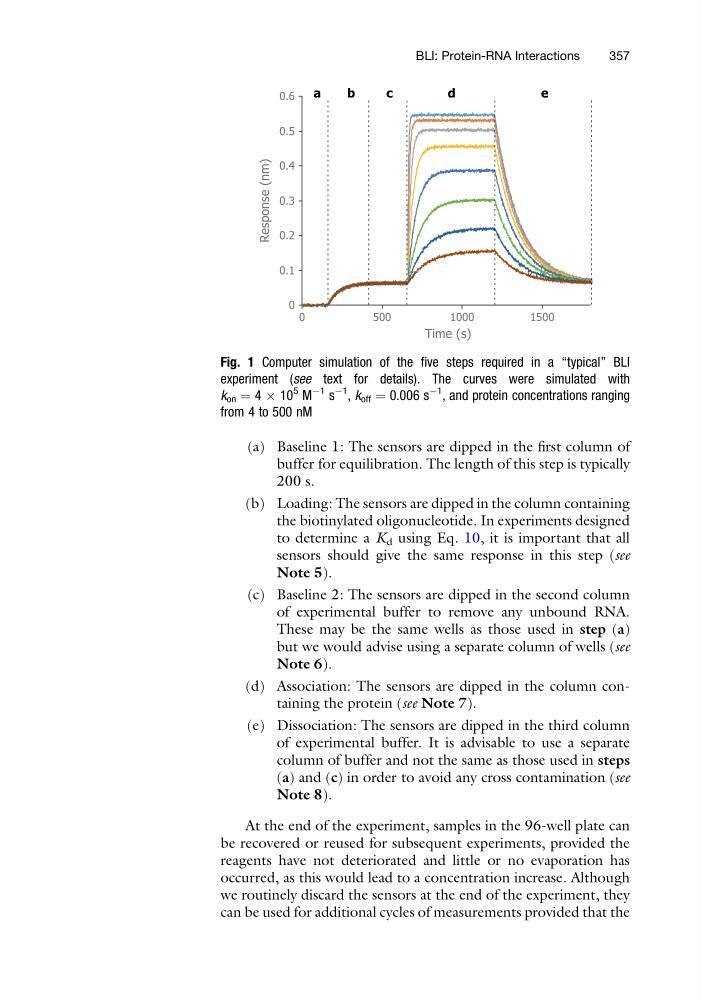
(a) Baseline 1: The sensors are dipped in the first column of
buffer for equilibration. The length of this step is typically
200 s.
(b) Loading: The sensors are dipped in the column containing
the biotinylated oligonucleotide. In experiments designed
to determine a K d using Eq. 10, it is important that all
sensors should give the same response in this step (see
Note 5).
(c) Baseline 2: The sensors are dipped in the second column
of experimental buffer to remove any unbound RNA.
These may be the same wells as those used in step (a)
but we would advise using a separate column of wells (see
Note 6).
(d) Association: The sensors are dipped in the column containing the protein (see Note 7).
(e) Dissociation: The sensors are dipped in the third column
of experimental buffer. It is advisable to use a separate
column of buffer and not the same as those used in steps
(a) and (c) in order to avoid any cross contamination (see
Note 8).
At the end of the experiment, samples in the 96-well plate can
be recovered or reused for subsequent experiments, provided the
reagents have not deteriorated and little or no evaporation has
occurred, as this would lead to a concentration increase. Although
we routinely discard the sensors at the end of the experiment, they
can be used for additional cycles of measurements provided that the
0
0.1
0.2
0.3
0.4
0.5
0.6
0
500
1000
1500
Time (s)
Response (nm)
a
b
c
d
e
Fig. 1 Computer simulation of the five steps required in a “typical” BLI
experiment (see text for details). The curves were simulated with
k on ¼ 4 Â 10
5
M
À1
s
À1
, k off ¼ 0.006 s
À1
, and protein concentrations ranging
from 4 to 500 nM
BLI: Protein-RNA Interactions
357
buffer for equilibration. The length of this step is typically
200 s.
(b) Loading: The sensors are dipped in the column containing
the biotinylated oligonucleotide. In experiments designed
to determine a K d using Eq. 10, it is important that all
sensors should give the same response in this step (see
Note 5).
(c) Baseline 2: The sensors are dipped in the second column
of experimental buffer to remove any unbound RNA.
These may be the same wells as those used in step (a)
but we would advise using a separate column of wells (see
Note 6).
(d) Association: The sensors are dipped in the column containing the protein (see Note 7).
(e) Dissociation: The sensors are dipped in the third column
of experimental buffer. It is advisable to use a separate
column of buffer and not the same as those used in steps
(a) and (c) in order to avoid any cross contamination (see
Note 8).
At the end of the experiment, samples in the 96-well plate can
be recovered or reused for subsequent experiments, provided the
reagents have not deteriorated and little or no evaporation has
occurred, as this would lead to a concentration increase. Although
we routinely discard the sensors at the end of the experiment, they
can be used for additional cycles of measurements provided that the
0
0.1
0.2
0.3
0.4
0.5
0.6
0
500
1000
1500
Time (s)
Response (nm)
a
b
c
d
e
Fig. 1 Computer simulation of the five steps required in a “typical” BLI
experiment (see text for details). The curves were simulated with
k on ¼ 4 Â 10
5
M
À1
s
À1
, k off ¼ 0.006 s
À1
, and protein concentrations ranging
from 4 to 500 nM
BLI: Protein-RNA Interactions
357