

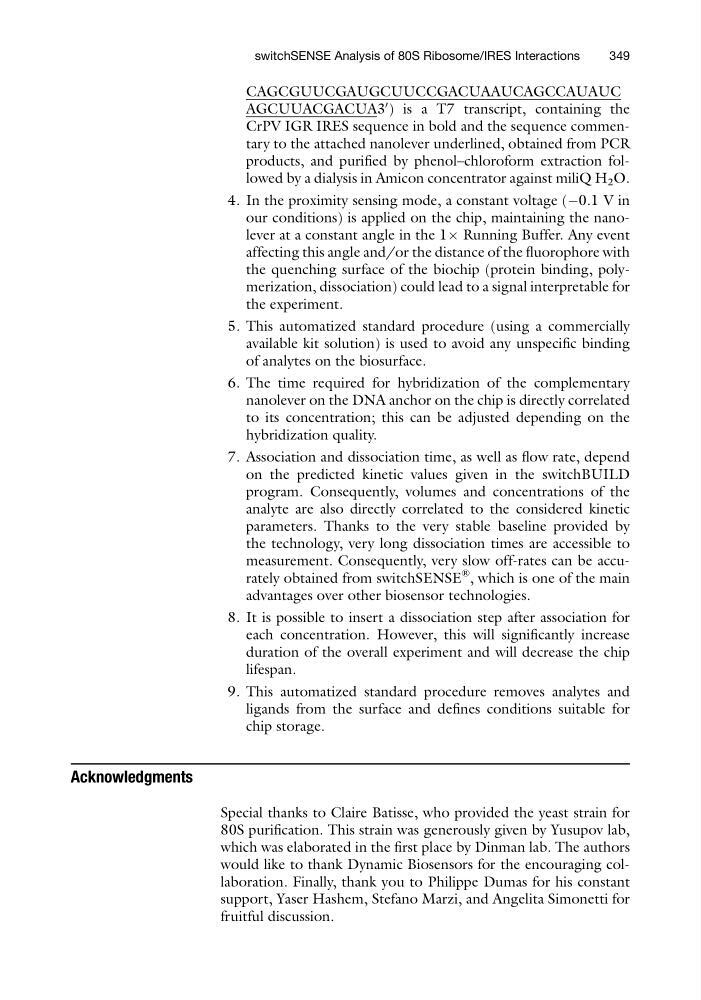
CAGCGUUCGAUGCUUCCGACUAAUCAGCCAUAUC
AGCUUACGACUA3
0 ) is a T7 transcript, containing the
CrPV IGR IRES sequence in bold and the sequence commentary to the attached nanolever underlined, obtained from PCR
products, and purified by phenol–chloroform extraction followed by a dialysis in Amicon concentrator against miliQ H 2 O.
4. In the proximity sensing mode, a constant voltage (À0.1 V in
our conditions) is applied on the chip, maintaining the nanolever at a constant angle in the 1Â Running Buffer. Any event
affecting this angle and/or the distance of the fluorophore with
the quenching surface of the biochip (protein binding, polymerization, dissociation) could lead to a signal interpretable for
the experiment.
5. This automatized standard procedure (using a commercially
available kit solution) is used to avoid any unspecific binding
of analytes on the biosurface.
6. The time required for hybridization of the complementary
nanolever on the DNA anchor on the chip is directly correlated
to its concentration; this can be adjusted depending on the
hybridization quality.
7. Association and dissociation time, as well as flow rate, depend
on the predicted kinetic values given in the switchBUILD
program. Consequently, volumes and concentrations of the
analyte are also directly correlated to the considered kinetic
parameters. Thanks to the very stable baseline provided by
the technology, very long dissociation times are accessible to
measurement. Consequently, very slow off-rates can be accurately obtained from switchSENSE
® , which is one of the main
advantages over other biosensor technologies.
8. It is possible to insert a dissociation step after association for
each concentration. However, this will significantly increase
duration of the overall experiment and will decrease the chip
lifespan.
9. This automatized standard procedure removes analytes and
ligands from the surface and defines conditions suitable for
chip storage.
Acknowledgments
Special thanks to Claire Batisse, who provided the yeast strain for
80S purification. This strain was generously given by Yusupov lab,
which was elaborated in the first place by Dinman lab. The authors
would like to thank Dynamic Biosensors for the encouraging collaboration. Finally, thank you to Philippe Dumas for his constant
support, Yaser Hashem, Stefano Marzi, and Angelita Simonetti for
fruitful discussion.
switchSENSE Analysis of 80S Ribosome/IRES Interactions
349
AGCUUACGACUA3
0 ) is a T7 transcript, containing the
CrPV IGR IRES sequence in bold and the sequence commentary to the attached nanolever underlined, obtained from PCR
products, and purified by phenol–chloroform extraction followed by a dialysis in Amicon concentrator against miliQ H 2 O.
4. In the proximity sensing mode, a constant voltage (À0.1 V in
our conditions) is applied on the chip, maintaining the nanolever at a constant angle in the 1Â Running Buffer. Any event
affecting this angle and/or the distance of the fluorophore with
the quenching surface of the biochip (protein binding, polymerization, dissociation) could lead to a signal interpretable for
the experiment.
5. This automatized standard procedure (using a commercially
available kit solution) is used to avoid any unspecific binding
of analytes on the biosurface.
6. The time required for hybridization of the complementary
nanolever on the DNA anchor on the chip is directly correlated
to its concentration; this can be adjusted depending on the
hybridization quality.
7. Association and dissociation time, as well as flow rate, depend
on the predicted kinetic values given in the switchBUILD
program. Consequently, volumes and concentrations of the
analyte are also directly correlated to the considered kinetic
parameters. Thanks to the very stable baseline provided by
the technology, very long dissociation times are accessible to
measurement. Consequently, very slow off-rates can be accurately obtained from switchSENSE
® , which is one of the main
advantages over other biosensor technologies.
8. It is possible to insert a dissociation step after association for
each concentration. However, this will significantly increase
duration of the overall experiment and will decrease the chip
lifespan.
9. This automatized standard procedure removes analytes and
ligands from the surface and defines conditions suitable for
chip storage.
Acknowledgments
Special thanks to Claire Batisse, who provided the yeast strain for
80S purification. This strain was generously given by Yusupov lab,
which was elaborated in the first place by Dinman lab. The authors
would like to thank Dynamic Biosensors for the encouraging collaboration. Finally, thank you to Philippe Dumas for his constant
support, Yaser Hashem, Stefano Marzi, and Angelita Simonetti for
fruitful discussion.
switchSENSE Analysis of 80S Ribosome/IRES Interactions
349