

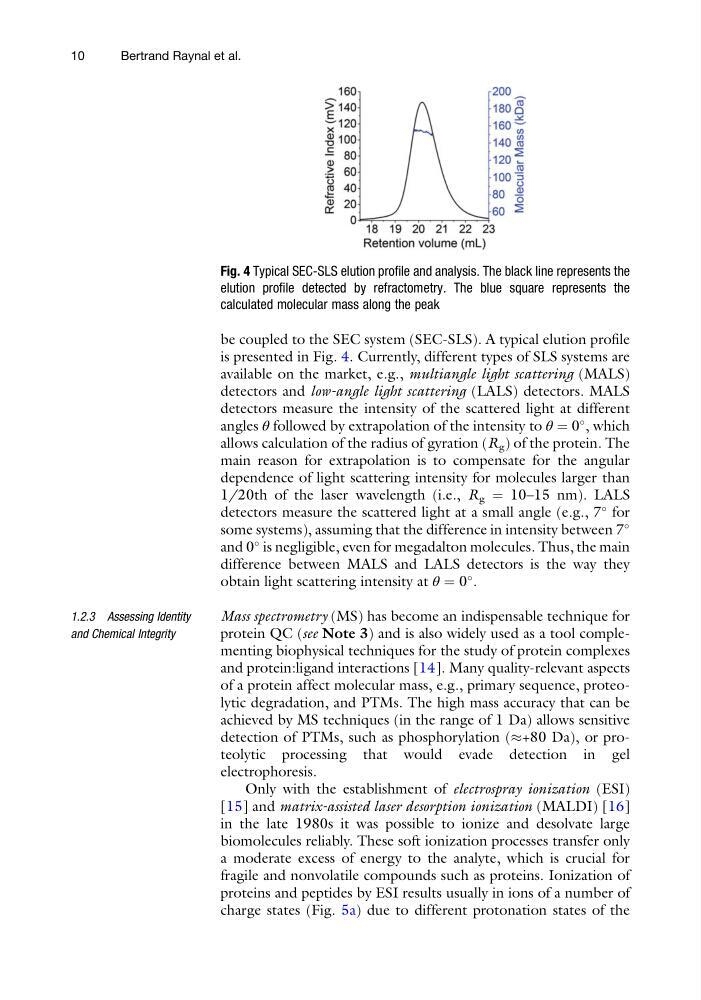
be coupled to the SEC system (SEC-SLS). A typical elution profile
is presented in Fig. 4. Currently, different types of SLS systems are
available on the market, e.g., multiangle light scattering (MALS)
detectors and low-angle light scattering (LALS) detectors. MALS
detectors measure the intensity of the scattered light at different
angles θ followed by extrapolation of the intensity to θ ¼ 0
, which
allows calculation of the radius of gyration (R g ) of the protein. The
main reason for extrapolation is to compensate for the angular
dependence of light scattering intensity for molecules larger than
1/20th of the laser wavelength (i.e., R g ¼ 10–15 nm). LALS
detectors measure the scattered light at a small angle (e.g., 7
for
some systems), assuming that the difference in intensity between 7
and 0
is negligible, even for megadalton molecules. Thus, the main
difference between MALS and LALS detectors is the way they
obtain light scattering intensity at θ ¼ 0
.
1.2.3 Assessing Identity
and Chemical Integrity
Mass spectrometry (MS) has become an indispensable technique for
protein QC (see Note 3) and is also widely used as a tool complementing biophysical techniques for the study of protein complexes
and protein:ligand interactions [14]. Many quality-relevant aspects
of a protein affect molecular mass, e.g., primary sequence, proteolytic degradation, and PTMs. The high mass accuracy that can be
achieved by MS techniques (in the range of 1 Da) allows sensitive
detection of PTMs, such as phosphorylation (%+80 Da), or proteolytic processing that would evade detection in gel
electrophoresis.
Only with the establishment of electrospray ionization (ESI)
[15] and matrix-assisted laser desorption ionization (MALDI) [16]
in the late 1980s it was possible to ionize and desolvate large
biomolecules reliably. These soft ionization processes transfer only
a moderate excess of energy to the analyte, which is crucial for
fragile and nonvolatile compounds such as proteins. Ionization of
proteins and peptides by ESI results usually in ions of a number of
charge states (Fig. 5a) due to different protonation states of the
Fig. 4 Typical SEC-SLS elution profile and analysis. The black line represents the
elution profile detected by refractometry. The blue square represents the
calculated molecular mass along the peak
10
Bertrand Raynal et al.
is presented in Fig. 4. Currently, different types of SLS systems are
available on the market, e.g., multiangle light scattering (MALS)
detectors and low-angle light scattering (LALS) detectors. MALS
detectors measure the intensity of the scattered light at different
angles θ followed by extrapolation of the intensity to θ ¼ 0
, which
allows calculation of the radius of gyration (R g ) of the protein. The
main reason for extrapolation is to compensate for the angular
dependence of light scattering intensity for molecules larger than
1/20th of the laser wavelength (i.e., R g ¼ 10–15 nm). LALS
detectors measure the scattered light at a small angle (e.g., 7
for
some systems), assuming that the difference in intensity between 7
and 0
is negligible, even for megadalton molecules. Thus, the main
difference between MALS and LALS detectors is the way they
obtain light scattering intensity at θ ¼ 0
.
1.2.3 Assessing Identity
and Chemical Integrity
Mass spectrometry (MS) has become an indispensable technique for
protein QC (see Note 3) and is also widely used as a tool complementing biophysical techniques for the study of protein complexes
and protein:ligand interactions [14]. Many quality-relevant aspects
of a protein affect molecular mass, e.g., primary sequence, proteolytic degradation, and PTMs. The high mass accuracy that can be
achieved by MS techniques (in the range of 1 Da) allows sensitive
detection of PTMs, such as phosphorylation (%+80 Da), or proteolytic processing that would evade detection in gel
electrophoresis.
Only with the establishment of electrospray ionization (ESI)
[15] and matrix-assisted laser desorption ionization (MALDI) [16]
in the late 1980s it was possible to ionize and desolvate large
biomolecules reliably. These soft ionization processes transfer only
a moderate excess of energy to the analyte, which is crucial for
fragile and nonvolatile compounds such as proteins. Ionization of
proteins and peptides by ESI results usually in ions of a number of
charge states (Fig. 5a) due to different protonation states of the
Fig. 4 Typical SEC-SLS elution profile and analysis. The black line represents the
elution profile detected by refractometry. The blue square represents the
calculated molecular mass along the peak
10
Bertrand Raynal et al.