

buffer but can also be determined during a protein–ligand interaction experiment if a sufficient excess of ligand is used, so that
saturation of the protein is achieved before the end of the titration
and the final few injections correspond to the ligand being injected
into the buffer without any binding occurring.
Other sources of heat may arise from “indirectly” coupled
events such as buffer ionization that occurs if there is a net proton
flux associated with the protein–ligand interaction. A change in
protonation will occur whenever there is a shift in pK a of groups
in the protein or ligand as a result of complex formation: obviously
a common feature where ionizable groups participate in the interaction providing favorable or unfavorable contributions (see Notes
8 and 14). Similarly, there are more “directly” coupled events such
as the displacement of the majority or all solvent from the protein–
ligand interface. This produces heat effects because water and ions
that are solvating the surfaces of protein and ligand end up displaced from the interface into bulk solvent upon formation of the
complex where they have different interaction partners. This solvation environment effect can contribute heat to the signal.
Despite all this complexity, the measured ITC heat signal is still
a direct reporter for the extent of protein–ligand interaction under
the conditions of measurement (temperature, buffer, pH, ionic
strength, etc.) and thus can be fit to yield an association constant
(and free energy) for the process. Meanwhile the amplitude of the
ITC signal (ΔH) will vary with conditions depending on the nature
and size of these additional coupled events. It is then difficult to
relate the measured thermodynamic enthalpy and entropy from an
ITC measurement to high-resolution structural information that
may be available for the interacting components or the complex.
These structures are static snapshots that do not inform on the
dynamics of the system nor detail other participants in the binding
event, such as the solvent, both of which contribute to the energetics of binding seen by ITC.
3.8 Measurement
and Temperature: The
Heat Capacity
for Binding
ITC experiments are performed at a specific temperature but modern instrumentation can measure over a wide range of conditions
(~4–70
C) giving scope to probe the temperature dependence of
binding. There is normally a significant decrease in the constant
pressure heat capacity (ΔC P ) between free components and their
complexes in protein–ligand interactions that is largely a product of
changes in the solvation of the interacting surfaces. This ΔC P of
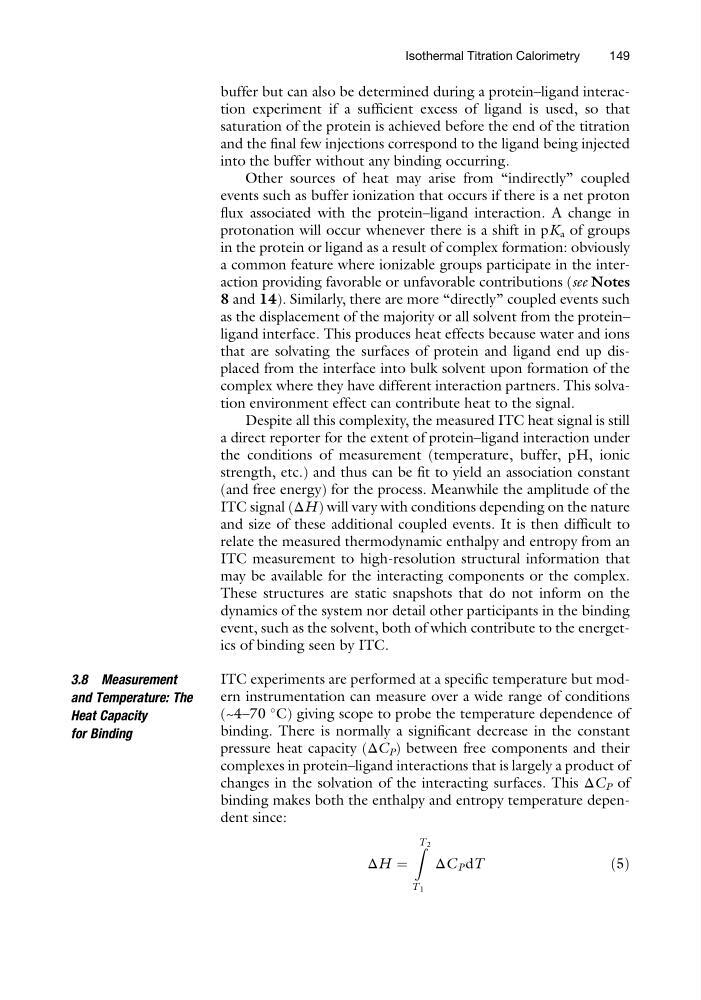
binding makes both the enthalpy and entropy temperature dependent since:
ΔH ¼
Z T 2
T 1
ΔC P dT
ð5Þ
Isothermal Titration Calorimetry
149
saturation of the protein is achieved before the end of the titration
and the final few injections correspond to the ligand being injected
into the buffer without any binding occurring.
Other sources of heat may arise from “indirectly” coupled
events such as buffer ionization that occurs if there is a net proton
flux associated with the protein–ligand interaction. A change in
protonation will occur whenever there is a shift in pK a of groups
in the protein or ligand as a result of complex formation: obviously
a common feature where ionizable groups participate in the interaction providing favorable or unfavorable contributions (see Notes
8 and 14). Similarly, there are more “directly” coupled events such
as the displacement of the majority or all solvent from the protein–
ligand interface. This produces heat effects because water and ions
that are solvating the surfaces of protein and ligand end up displaced from the interface into bulk solvent upon formation of the
complex where they have different interaction partners. This solvation environment effect can contribute heat to the signal.
Despite all this complexity, the measured ITC heat signal is still
a direct reporter for the extent of protein–ligand interaction under
the conditions of measurement (temperature, buffer, pH, ionic
strength, etc.) and thus can be fit to yield an association constant
(and free energy) for the process. Meanwhile the amplitude of the
ITC signal (ΔH) will vary with conditions depending on the nature
and size of these additional coupled events. It is then difficult to
relate the measured thermodynamic enthalpy and entropy from an
ITC measurement to high-resolution structural information that
may be available for the interacting components or the complex.
These structures are static snapshots that do not inform on the
dynamics of the system nor detail other participants in the binding
event, such as the solvent, both of which contribute to the energetics of binding seen by ITC.
3.8 Measurement
and Temperature: The
Heat Capacity
for Binding
ITC experiments are performed at a specific temperature but modern instrumentation can measure over a wide range of conditions
(~4–70
C) giving scope to probe the temperature dependence of
binding. There is normally a significant decrease in the constant
pressure heat capacity (ΔC P ) between free components and their
complexes in protein–ligand interactions that is largely a product of
changes in the solvation of the interacting surfaces. This ΔC P of
binding makes both the enthalpy and entropy temperature dependent since:
ΔH ¼
Z T 2
T 1
ΔC P dT
ð5Þ
Isothermal Titration Calorimetry
149