

In the absence of any such constraints, it is possible to perform
ITC experiments in either configuration, say with the protein in the
cell and the reverse titration with the protein in the syringe since
ITC is directly measuring the heat of the non-covalent interactions
that are involved. Indeed, it can be highly informative to perform
experiments in both orientations since it can help to dissect the
mechanism of more complex interactions as well as confirm reactant concentrations. For example, if a protein has two independent
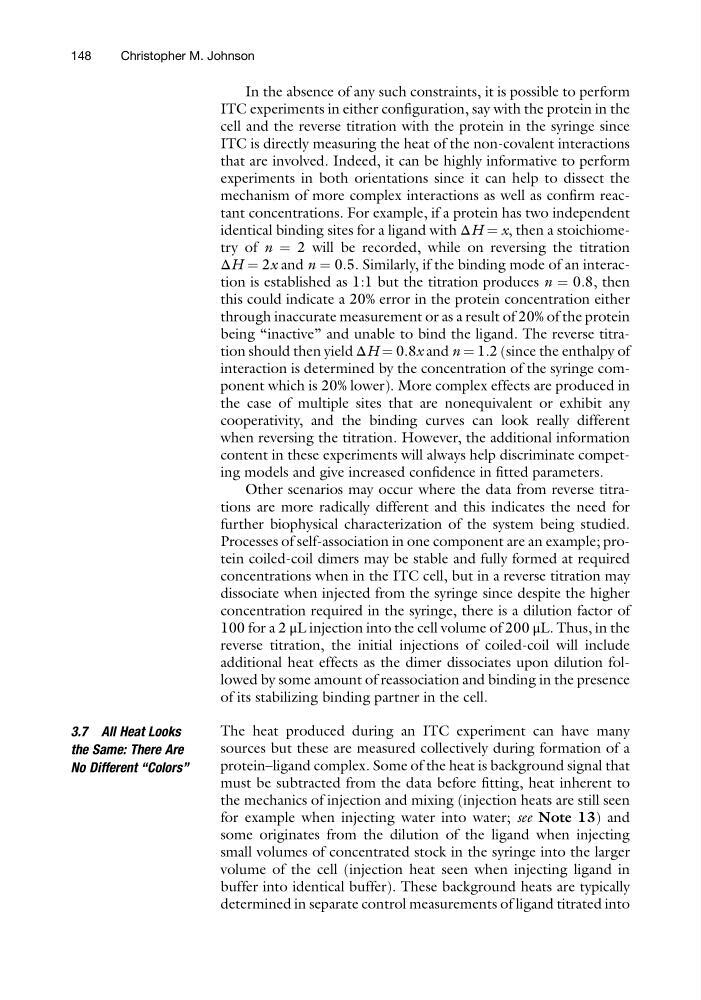
identical binding sites for a ligand with ΔH ¼ x, then a stoichiometry of n ¼ 2 will be recorded, while on reversing the titration
ΔH ¼ 2x and n ¼ 0.5. Similarly, if the binding mode of an interaction is established as 1:1 but the titration produces n ¼ 0.8, then
this could indicate a 20% error in the protein concentration either
through inaccurate measurement or as a result of 20% of the protein
being “inactive” and unable to bind the ligand. The reverse titration should then yield ΔH ¼ 0.8x and n ¼ 1.2 (since the enthalpy of
interaction is determined by the concentration of the syringe component which is 20% lower). More complex effects are produced in
the case of multiple sites that are nonequivalent or exhibit any
cooperativity, and the binding curves can look really different
when reversing the titration. However, the additional information
content in these experiments will always help discriminate competing models and give increased confidence in fitted parameters.
Other scenarios may occur where the data from reverse titrations are more radically different and this indicates the need for
further biophysical characterization of the system being studied.
Processes of self-association in one component are an example; protein coiled-coil dimers may be stable and fully formed at required
concentrations when in the ITC cell, but in a reverse titration may
dissociate when injected from the syringe since despite the higher
concentration required in the syringe, there is a dilution factor of
100 for a 2 μL injection into the cell volume of 200 μL. Thus, in the
reverse titration, the initial injections of coiled-coil will include
additional heat effects as the dimer dissociates upon dilution followed by some amount of reassociation and binding in the presence
of its stabilizing binding partner in the cell.
3.7 All Heat Looks
the Same: There Are
No Different “Colors”
The heat produced during an ITC experiment can have many
sources but these are measured collectively during formation of a
protein–ligand complex. Some of the heat is background signal that
must be subtracted from the data before fitting, heat inherent to
the mechanics of injection and mixing (injection heats are still seen
for example when injecting water into water; see Note 13) and
some originates from the dilution of the ligand when injecting
small volumes of concentrated stock in the syringe into the larger
volume of the cell (injection heat seen when injecting ligand in
buffer into identical buffer). These background heats are typically
determined in separate control measurements of ligand titrated into
148
Christopher M. Johnson
ITC experiments in either configuration, say with the protein in the
cell and the reverse titration with the protein in the syringe since
ITC is directly measuring the heat of the non-covalent interactions
that are involved. Indeed, it can be highly informative to perform
experiments in both orientations since it can help to dissect the
mechanism of more complex interactions as well as confirm reactant concentrations. For example, if a protein has two independent
identical binding sites for a ligand with ΔH ¼ x, then a stoichiometry of n ¼ 2 will be recorded, while on reversing the titration
ΔH ¼ 2x and n ¼ 0.5. Similarly, if the binding mode of an interaction is established as 1:1 but the titration produces n ¼ 0.8, then
this could indicate a 20% error in the protein concentration either
through inaccurate measurement or as a result of 20% of the protein
being “inactive” and unable to bind the ligand. The reverse titration should then yield ΔH ¼ 0.8x and n ¼ 1.2 (since the enthalpy of
interaction is determined by the concentration of the syringe component which is 20% lower). More complex effects are produced in
the case of multiple sites that are nonequivalent or exhibit any
cooperativity, and the binding curves can look really different
when reversing the titration. However, the additional information
content in these experiments will always help discriminate competing models and give increased confidence in fitted parameters.
Other scenarios may occur where the data from reverse titrations are more radically different and this indicates the need for
further biophysical characterization of the system being studied.
Processes of self-association in one component are an example; protein coiled-coil dimers may be stable and fully formed at required
concentrations when in the ITC cell, but in a reverse titration may
dissociate when injected from the syringe since despite the higher
concentration required in the syringe, there is a dilution factor of
100 for a 2 μL injection into the cell volume of 200 μL. Thus, in the
reverse titration, the initial injections of coiled-coil will include
additional heat effects as the dimer dissociates upon dilution followed by some amount of reassociation and binding in the presence
of its stabilizing binding partner in the cell.
3.7 All Heat Looks
the Same: There Are
No Different “Colors”
The heat produced during an ITC experiment can have many
sources but these are measured collectively during formation of a
protein–ligand complex. Some of the heat is background signal that
must be subtracted from the data before fitting, heat inherent to
the mechanics of injection and mixing (injection heats are still seen
for example when injecting water into water; see Note 13) and
some originates from the dilution of the ligand when injecting
small volumes of concentrated stock in the syringe into the larger
volume of the cell (injection heat seen when injecting ligand in
buffer into identical buffer). These background heats are typically
determined in separate control measurements of ligand titrated into
148
Christopher M. Johnson