

A + B
AB AB
∗
k 1
k –1
k 2
k –2
Scheme 2
A + B
A + B
∗
AB
∗
k 1
k –1
k 2
k –2
Scheme 3
While this relationship between number of states and theoretical number of kinetic phases is clear, there are complicating factors
facing the experimentalist in the real laboratory world when they
attempt to reverse this argument by inferring mechanism from the
number of kinetic phases. Except for the simplest one-step binding
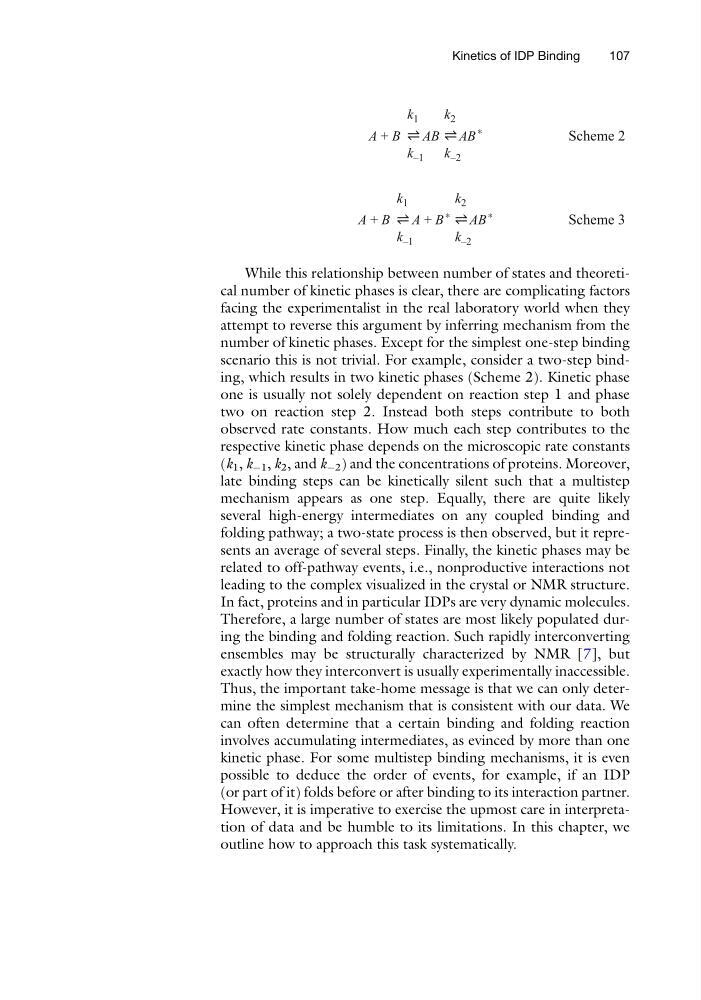
scenario this is not trivial. For example, consider a two-step binding, which results in two kinetic phases (Scheme 2). Kinetic phase
one is usually not solely dependent on reaction step 1 and phase
two on reaction step 2. Instead both steps contribute to both
observed rate constants. How much each step contributes to the
respective kinetic phase depends on the microscopic rate constants
(k 1 , k À1 , k 2 , and k À2 ) and the concentrations of proteins. Moreover,
late binding steps can be kinetically silent such that a multistep
mechanism appears as one step. Equally, there are quite likely
several high-energy intermediates on any coupled binding and
folding pathway; a two-state process is then observed, but it represents an average of several steps. Finally, the kinetic phases may be
related to off-pathway events, i.e., nonproductive interactions not
leading to the complex visualized in the crystal or NMR structure.
In fact, proteins and in particular IDPs are very dynamic molecules.
Therefore, a large number of states are most likely populated during the binding and folding reaction. Such rapidly interconverting
ensembles may be structurally characterized by NMR [7], but
exactly how they interconvert is usually experimentally inaccessible.
Thus, the important take-home message is that we can only determine the simplest mechanism that is consistent with our data. We
can often determine that a certain binding and folding reaction
involves accumulating intermediates, as evinced by more than one
kinetic phase. For some multistep binding mechanisms, it is even
possible to deduce the order of events, for example, if an IDP
(or part of it) folds before or after binding to its interaction partner.
However, it is imperative to exercise the upmost care in interpretation of data and be humble to its limitations. In this chapter, we
outline how to approach this task systematically.
Kinetics of IDP Binding
107
AB AB
∗
k 1
k –1
k 2
k –2
Scheme 2
A + B
A + B
∗
AB
∗
k 1
k –1
k 2
k –2
Scheme 3
While this relationship between number of states and theoretical number of kinetic phases is clear, there are complicating factors
facing the experimentalist in the real laboratory world when they
attempt to reverse this argument by inferring mechanism from the
number of kinetic phases. Except for the simplest one-step binding
scenario this is not trivial. For example, consider a two-step binding, which results in two kinetic phases (Scheme 2). Kinetic phase
one is usually not solely dependent on reaction step 1 and phase
two on reaction step 2. Instead both steps contribute to both
observed rate constants. How much each step contributes to the
respective kinetic phase depends on the microscopic rate constants
(k 1 , k À1 , k 2 , and k À2 ) and the concentrations of proteins. Moreover,
late binding steps can be kinetically silent such that a multistep
mechanism appears as one step. Equally, there are quite likely
several high-energy intermediates on any coupled binding and
folding pathway; a two-state process is then observed, but it represents an average of several steps. Finally, the kinetic phases may be
related to off-pathway events, i.e., nonproductive interactions not
leading to the complex visualized in the crystal or NMR structure.
In fact, proteins and in particular IDPs are very dynamic molecules.
Therefore, a large number of states are most likely populated during the binding and folding reaction. Such rapidly interconverting
ensembles may be structurally characterized by NMR [7], but
exactly how they interconvert is usually experimentally inaccessible.
Thus, the important take-home message is that we can only determine the simplest mechanism that is consistent with our data. We
can often determine that a certain binding and folding reaction
involves accumulating intermediates, as evinced by more than one
kinetic phase. For some multistep binding mechanisms, it is even
possible to deduce the order of events, for example, if an IDP
(or part of it) folds before or after binding to its interaction partner.
However, it is imperative to exercise the upmost care in interpretation of data and be humble to its limitations. In this chapter, we
outline how to approach this task systematically.
Kinetics of IDP Binding
107