

Classically, techniques such as stopped-flow, continuous-flow,
quenched-flow, pressure jump, and temperature jump were used to
measure pre-equilibrium kinetics of chemical reactions. More
recently, sensor-based technologies such as surface plasmon resonance, NMR, and the emerging field of single-molecule experiments provide an expanded toolbox for the kinetic
experimentalist. Out of these methods, stopped flow is the simplest
and arguably the most robust method to measure kinetics for
biomolecules. Much of the basics of protein–ligand interactions
were covered by Williams [8] and rapid mixing techniques by
Martin and Schilstra [9]. We will cover some basic kinetic concepts
here to facilitate discussion but for a more comprehensive description of biomolecular kinetics, we recommend the excellent book
from Bagshaw [10].
In the simplest case, a one-step binding between proteins A
and B, we can determine the association rate constant k on and the
dissociation rate constant k off (Scheme 1). The ratio of the rate
constants is the equilibrium dissociation constant K d (K d ¼ 1/K a ).
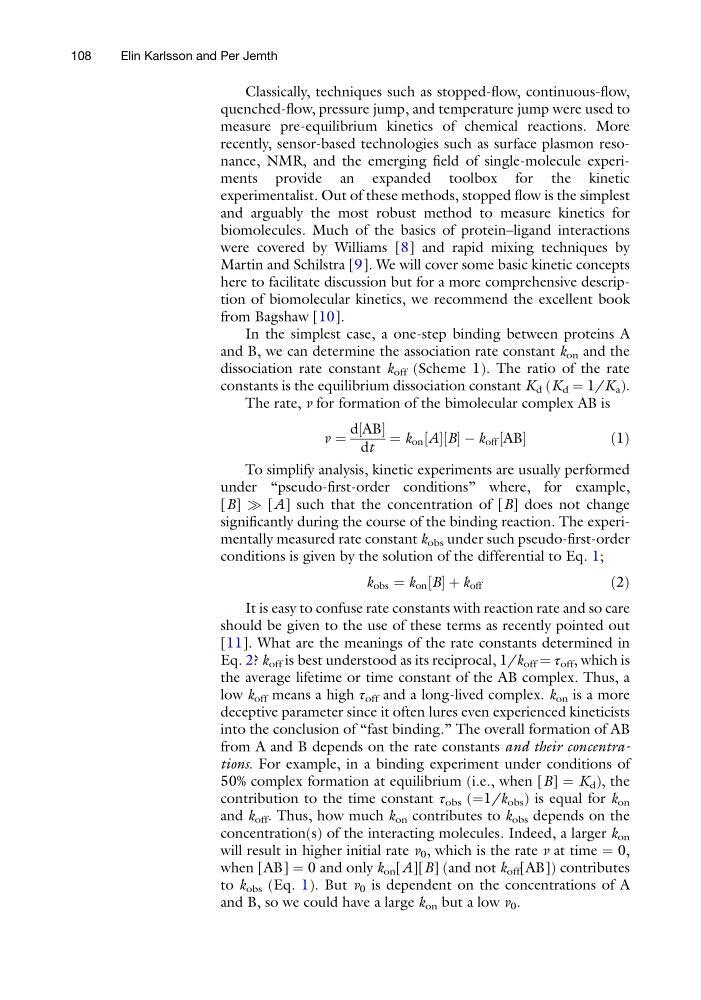
The rate, v for formation of the bimolecular complex AB is
v ¼
d AB
½
dt
¼ k on A
½ B
½ À k off AB
½
ð1Þ
To simplify analysis, kinetic experiments are usually performed
under “pseudo-first-order conditions” where, for example,
[B] ) [A] such that the concentration of [B] does not change
significantly during the course of the binding reaction. The experimentally measured rate constant k obs under such pseudo-first-order
conditions is given by the solution of the differential to Eq. 1;
k obs ¼ k on B
½ þ k off
ð2Þ
It is easy to confuse rate constants with reaction rate and so care
should be given to the use of these terms as recently pointed out
[11]. What are the meanings of the rate constants determined in
Eq. 2? k off is best understood as its reciprocal, 1/k off ¼ τ off , which is
the average lifetime or time constant of the AB complex. Thus, a
low k off means a high τ off and a long-lived complex. k on is a more
deceptive parameter since it often lures even experienced kineticists
into the conclusion of “fast binding.” The overall formation of AB
from A and B depends on the rate constants and their concentrations. For example, in a binding experiment under conditions of
50% complex formation at equilibrium (i.e., when [B] ¼ K d ), the
contribution to the time constant τ obs (¼1/k obs ) is equal for k on
and k off . Thus, how much k on contributes to k obs depends on the
concentration(s) of the interacting molecules. Indeed, a larger k on
will result in higher initial rate v 0 , which is the rate v at time ¼ 0,
when [AB] ¼ 0 and only k on [A][B] (and not k off [AB]) contributes
to k obs (Eq. 1). But v 0 is dependent on the concentrations of A
and B, so we could have a large k on but a low v 0 .
108
Elin Karlsson and Per Jemth
quenched-flow, pressure jump, and temperature jump were used to
measure pre-equilibrium kinetics of chemical reactions. More
recently, sensor-based technologies such as surface plasmon resonance, NMR, and the emerging field of single-molecule experiments provide an expanded toolbox for the kinetic
experimentalist. Out of these methods, stopped flow is the simplest
and arguably the most robust method to measure kinetics for
biomolecules. Much of the basics of protein–ligand interactions
were covered by Williams [8] and rapid mixing techniques by
Martin and Schilstra [9]. We will cover some basic kinetic concepts
here to facilitate discussion but for a more comprehensive description of biomolecular kinetics, we recommend the excellent book
from Bagshaw [10].
In the simplest case, a one-step binding between proteins A
and B, we can determine the association rate constant k on and the
dissociation rate constant k off (Scheme 1). The ratio of the rate
constants is the equilibrium dissociation constant K d (K d ¼ 1/K a ).
The rate, v for formation of the bimolecular complex AB is
v ¼
d AB
½
dt
¼ k on A
½ B
½ À k off AB
½
ð1Þ
To simplify analysis, kinetic experiments are usually performed
under “pseudo-first-order conditions” where, for example,
[B] ) [A] such that the concentration of [B] does not change
significantly during the course of the binding reaction. The experimentally measured rate constant k obs under such pseudo-first-order
conditions is given by the solution of the differential to Eq. 1;
k obs ¼ k on B
½ þ k off
ð2Þ
It is easy to confuse rate constants with reaction rate and so care
should be given to the use of these terms as recently pointed out
[11]. What are the meanings of the rate constants determined in
Eq. 2? k off is best understood as its reciprocal, 1/k off ¼ τ off , which is
the average lifetime or time constant of the AB complex. Thus, a
low k off means a high τ off and a long-lived complex. k on is a more
deceptive parameter since it often lures even experienced kineticists
into the conclusion of “fast binding.” The overall formation of AB
from A and B depends on the rate constants and their concentrations. For example, in a binding experiment under conditions of
50% complex formation at equilibrium (i.e., when [B] ¼ K d ), the
contribution to the time constant τ obs (¼1/k obs ) is equal for k on
and k off . Thus, how much k on contributes to k obs depends on the
concentration(s) of the interacting molecules. Indeed, a larger k on
will result in higher initial rate v 0 , which is the rate v at time ¼ 0,
when [AB] ¼ 0 and only k on [A][B] (and not k off [AB]) contributes
to k obs (Eq. 1). But v 0 is dependent on the concentrations of A
and B, so we could have a large k on but a low v 0 .
108
Elin Karlsson and Per Jemth