

1997). They thrive well in water-saturated soils; and they support prolonged total
submersion (Bill et al. 1997; Lavaine et al. 2011a). In addition, T. gallica has a great
root density in the first few centimeters, so they can effectively protect the soil
(Lavaine et al. 2011b), which suggest the plantation of this species in the riverbank
protection program (Lavaine et al. 2011a, b).
14.3.2.3 Anatomical Adaptation to Saline Stress
As same to all Tamaricaceae species T. gallica has good salt tolerance (Lavaine et al.
2011b). It was recorded that Na
+ levels was about 23,419 μg.g
À1 T. gallica dray
weight in saline conditions and can reach 28,199 μg.g
À1 in case of combined stresses
(saline + other toxic compounds) while keeping a good growth, which confirms its
halophytic character (Belhadj-Sgheir et al. 2019). In addition, high salinity caused
marked anatomical in the structure of leaves, such as organization and distance
among the vascular bundles, diameter, and number of xylems vessels (Rancic et al.
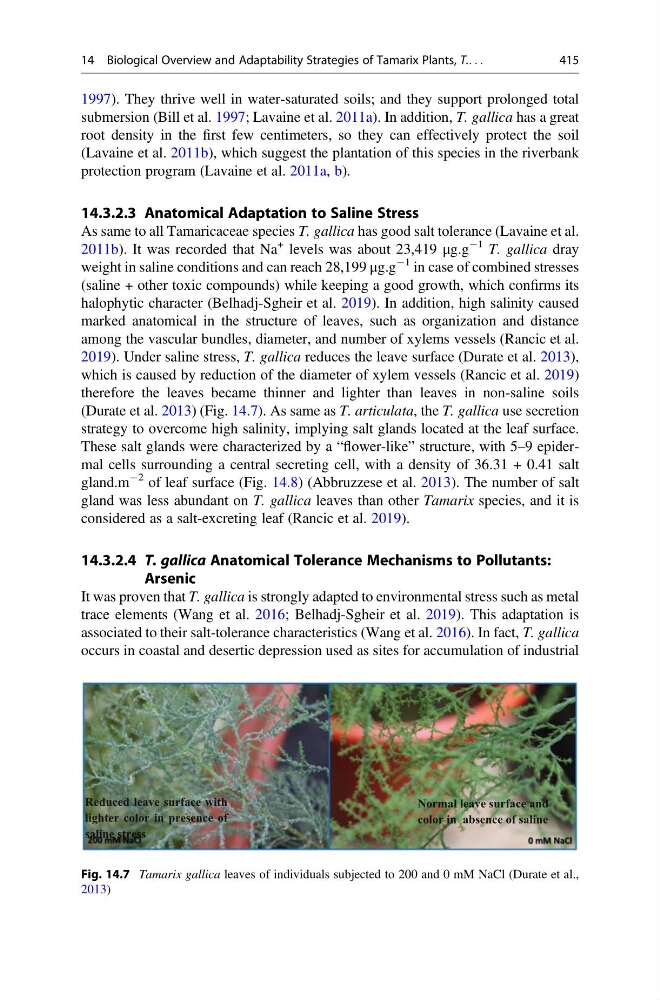
2019). Under saline stress, T. gallica reduces the leave surface (Durate et al. 2013),
which is caused by reduction of the diameter of xylem vessels (Rancic et al. 2019)
therefore the leaves became thinner and lighter than leaves in non-saline soils
(Durate et al. 2013) (Fig. 14.7). As same as T. articulata, the T. gallica use secretion
strategy to overcome high salinity, implying salt glands located at the leaf surface.
These salt glands were characterized by a “flower-like” structure, with 5–9 epidermal cells surrounding a central secreting cell, with a density of 36.31 + 0.41 salt
gland.m
À2 of leaf surface (Fig. 14.8) (Abbruzzese et al. 2013). The number of salt
gland was less abundant on T. gallica leaves than other Tamarix species, and it is
considered as a salt-excreting leaf (Rancic et al. 2019).
14.3.2.4 T. gallica Anatomical Tolerance Mechanisms to Pollutants:
Arsenic
It was proven that T. gallica is strongly adapted to environmental stress such as metal
trace elements (Wang et al. 2016; Belhadj-Sgheir et al. 2019). This adaptation is
associated to their salt-tolerance characteristics (Wang et al. 2016). In fact, T. gallica
occurs in coastal and desertic depression used as sites for accumulation of industrial
Normal leave surface and
color in absence of saline
Reduced leave surface with
lighter color in presence of
saline stress
Fig. 14.7 Tamarix gallica leaves of individuals subjected to 200 and 0 mM NaCl (Durate et al.,
2013)
14 Biological Overview and Adaptability Strategies of Tamarix Plants, T.. . .
415
submersion (Bill et al. 1997; Lavaine et al. 2011a). In addition, T. gallica has a great
root density in the first few centimeters, so they can effectively protect the soil
(Lavaine et al. 2011b), which suggest the plantation of this species in the riverbank
protection program (Lavaine et al. 2011a, b).
14.3.2.3 Anatomical Adaptation to Saline Stress
As same to all Tamaricaceae species T. gallica has good salt tolerance (Lavaine et al.
2011b). It was recorded that Na
+ levels was about 23,419 μg.g
À1 T. gallica dray
weight in saline conditions and can reach 28,199 μg.g
À1 in case of combined stresses
(saline + other toxic compounds) while keeping a good growth, which confirms its
halophytic character (Belhadj-Sgheir et al. 2019). In addition, high salinity caused
marked anatomical in the structure of leaves, such as organization and distance
among the vascular bundles, diameter, and number of xylems vessels (Rancic et al.
2019). Under saline stress, T. gallica reduces the leave surface (Durate et al. 2013),
which is caused by reduction of the diameter of xylem vessels (Rancic et al. 2019)
therefore the leaves became thinner and lighter than leaves in non-saline soils
(Durate et al. 2013) (Fig. 14.7). As same as T. articulata, the T. gallica use secretion
strategy to overcome high salinity, implying salt glands located at the leaf surface.
These salt glands were characterized by a “flower-like” structure, with 5–9 epidermal cells surrounding a central secreting cell, with a density of 36.31 + 0.41 salt
gland.m
À2 of leaf surface (Fig. 14.8) (Abbruzzese et al. 2013). The number of salt
gland was less abundant on T. gallica leaves than other Tamarix species, and it is
considered as a salt-excreting leaf (Rancic et al. 2019).
14.3.2.4 T. gallica Anatomical Tolerance Mechanisms to Pollutants:
Arsenic
It was proven that T. gallica is strongly adapted to environmental stress such as metal
trace elements (Wang et al. 2016; Belhadj-Sgheir et al. 2019). This adaptation is
associated to their salt-tolerance characteristics (Wang et al. 2016). In fact, T. gallica
occurs in coastal and desertic depression used as sites for accumulation of industrial
Normal leave surface and
color in absence of saline
Reduced leave surface with
lighter color in presence of
saline stress
Fig. 14.7 Tamarix gallica leaves of individuals subjected to 200 and 0 mM NaCl (Durate et al.,
2013)
14 Biological Overview and Adaptability Strategies of Tamarix Plants, T.. . .
415