

and urban effluents contaminated by metals (Ghnaya et al. 2007), where it has the
mechanisms to regulate internal and cell wall metal concentration that determine
their survival (Belhadj-Sgheir et al. 2019). Sookbirsingh et al. (2010) explained that
glandular structures of T. gallica are not specific to Na
+ , they have the ability to
uptake a high concentration of ions and concentrate them in their shoots to be
excreted at a later stage. Moreover, exposition to trace element stress leads
T. gallica to show some morphological modification with a decline in total
biomasses. The performance of T. gallica and its capacity to accumulate amounts
greater than 7834 μg.g
À1 Dry Weight of aluminum toxic metal (Al), leads to classify
it among the hyper-accumulator species of Aluminum (Al) (Belhadj-Sgheir et al.
2019). Based on that, Newete et al. (2020) explained that the native genotype of
Tamarix species such native T. gallica is the preferred plant choice for
phytoremediation programs in South Africa, which confirm its interest in
phytoremediation programs.
14.4 Biochemical Adaptation of Tamarix to Abiotic Stress
Biochemical adaptation is reflected by plant excretion of the specific chemical
compounds under abiotic stress. However, in addition to the sodium chloride
(NaCl) predominantly secreted by most halophytes, Tamarix species can transport,
sequester, or secrete ions (Weasel 1961; Berry 1970; Sookbirsingh et al. 2010),
heavy metals (Conesa et al. 2006; Kadukova and Kalogerakis 2007), and even
pollutants (Dreesen and Wangen 1981; Urbansky et al. 2000; Sorensen et al.
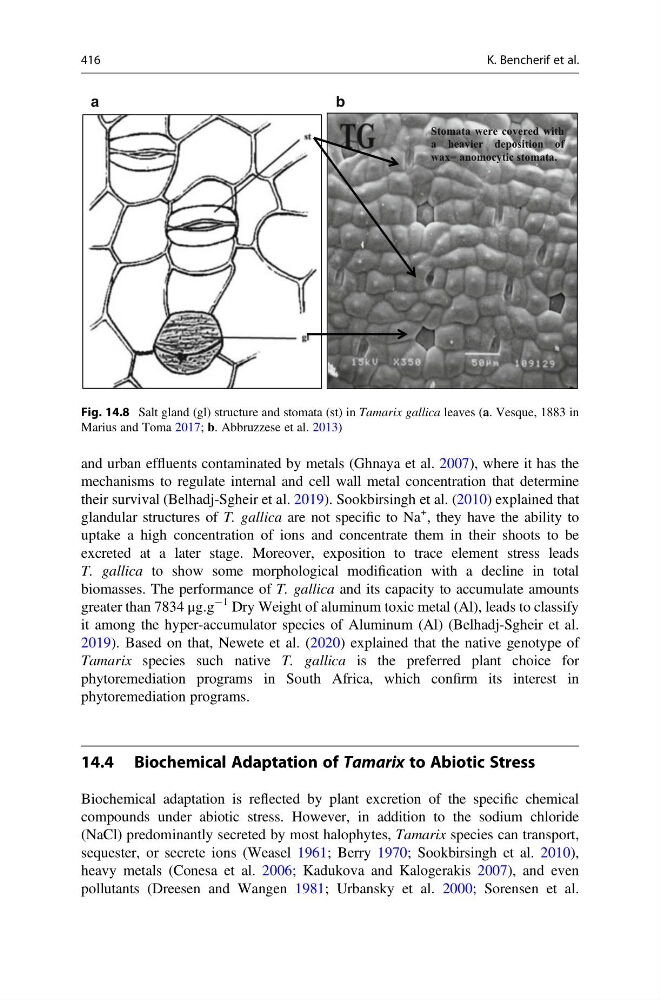
Stomata were covered with
a heavier deposition of
wax= anomocytic stomata.
a
b
Fig. 14.8 Salt gland (gl) structure and stomata (st) in Tamarix gallica leaves (a. Vesque, 1883 in
Marius and Toma 2017; b. Abbruzzese et al. 2013)
416
K. Bencherif et al.
mechanisms to regulate internal and cell wall metal concentration that determine
their survival (Belhadj-Sgheir et al. 2019). Sookbirsingh et al. (2010) explained that
glandular structures of T. gallica are not specific to Na
+ , they have the ability to
uptake a high concentration of ions and concentrate them in their shoots to be
excreted at a later stage. Moreover, exposition to trace element stress leads
T. gallica to show some morphological modification with a decline in total
biomasses. The performance of T. gallica and its capacity to accumulate amounts
greater than 7834 μg.g
À1 Dry Weight of aluminum toxic metal (Al), leads to classify
it among the hyper-accumulator species of Aluminum (Al) (Belhadj-Sgheir et al.
2019). Based on that, Newete et al. (2020) explained that the native genotype of
Tamarix species such native T. gallica is the preferred plant choice for
phytoremediation programs in South Africa, which confirm its interest in
phytoremediation programs.
14.4 Biochemical Adaptation of Tamarix to Abiotic Stress
Biochemical adaptation is reflected by plant excretion of the specific chemical
compounds under abiotic stress. However, in addition to the sodium chloride
(NaCl) predominantly secreted by most halophytes, Tamarix species can transport,
sequester, or secrete ions (Weasel 1961; Berry 1970; Sookbirsingh et al. 2010),
heavy metals (Conesa et al. 2006; Kadukova and Kalogerakis 2007), and even
pollutants (Dreesen and Wangen 1981; Urbansky et al. 2000; Sorensen et al.
Stomata were covered with
a heavier deposition of
wax= anomocytic stomata.
a
b
Fig. 14.8 Salt gland (gl) structure and stomata (st) in Tamarix gallica leaves (a. Vesque, 1883 in
Marius and Toma 2017; b. Abbruzzese et al. 2013)
416
K. Bencherif et al.