

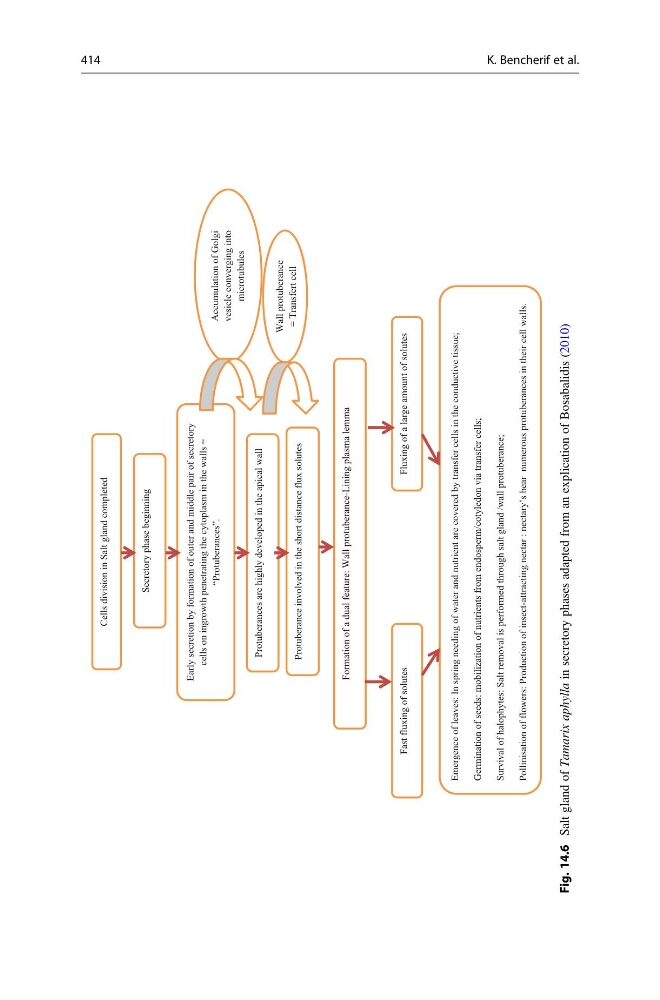
Cells division in Salt gland completed
Secretory phase beginning
Early secretion by formation of outer and middle pair of secretory
cells on ingrowth penetrating the cytoplasm in the walls =
“Protuberances”.
Protuberances are highly developed in the apical wall
Protuberance involved in the short distance flux solutes
Formation of a dual feature: Wall protuberance-Lining plasma lemma
Fast fluxing of solutes
Fluxing of a large amount of solutes
Emergence of leaves: In spring needing of water and nutrient are covered by transfer cells in the conductive tissue;
Germination of seeds: mobilization of nutrients from endosperm/cotyledon via transfer cells;
Survival of halophytes: Salt removal is performed through salt
gland /wall protuberance;
Pollinisation of flowers: Production of insect-attracting nectar : nectary’s bear numerous protuberances in their cell walls.
Accumulation of Golgi
vesicle converging into
microtubules
Wall protuberance
= Transfert cell
Fig. 14.6
Salt gland of Tamarix aphylla
in secretory phases adapted from an explication of Bosabalidis (2010)
414
K. Bencherif et al.
Secretory phase beginning
Early secretion by formation of outer and middle pair of secretory
cells on ingrowth penetrating the cytoplasm in the walls =
“Protuberances”.
Protuberances are highly developed in the apical wall
Protuberance involved in the short distance flux solutes
Formation of a dual feature: Wall protuberance-Lining plasma lemma
Fast fluxing of solutes
Fluxing of a large amount of solutes
Emergence of leaves: In spring needing of water and nutrient are covered by transfer cells in the conductive tissue;
Germination of seeds: mobilization of nutrients from endosperm/cotyledon via transfer cells;
Survival of halophytes: Salt removal is performed through salt
gland /wall protuberance;
Pollinisation of flowers: Production of insect-attracting nectar : nectary’s bear numerous protuberances in their cell walls.
Accumulation of Golgi
vesicle converging into
microtubules
Wall protuberance
= Transfert cell
Fig. 14.6
Salt gland of Tamarix aphylla
in secretory phases adapted from an explication of Bosabalidis (2010)
414
K. Bencherif et al.