

14.3.1.2 Anatomical Adaptation Strategies to Drought Stress
The difference between the numbers of flowers per kittens is a form of resistance to
abiotic stress. It is decreasing in stressed condition such as high temperature and high
soil salinity, which was proven by Khabtane and Rahmoun (2012). The authors
studied the morphometric difference between Tamarix in three different sites with
various pedoclimatic characteristics and when floristic richness in the undergrowth is
different according to these abiotic characteristics. They recorded 52 flowers per
kitten in the Ouarezne site (Khanechla), which represents a biotope with a permanent
drought. In the two other sites with non-permanent stress, they recorded 84 flowers
per kitten. That indicated that T. articulata reduces flower production as strategies
adaptation to drought stress. In fact, it was proven that under drought stress, all
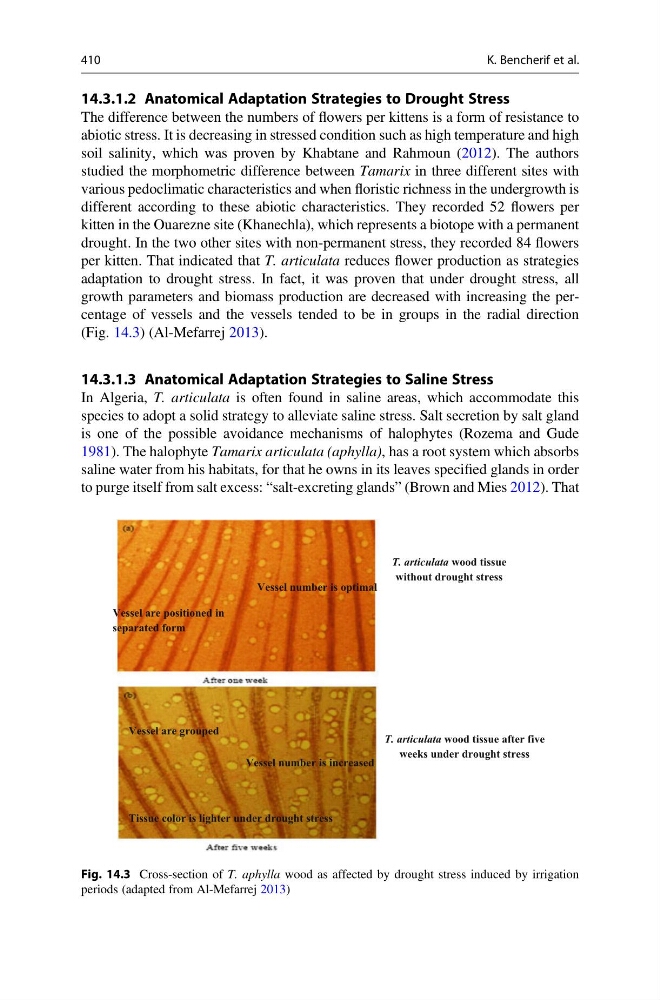
growth parameters and biomass production are decreased with increasing the percentage of vessels and the vessels tended to be in groups in the radial direction
(Fig. 14.3) (Al-Mefarrej 2013).
14.3.1.3 Anatomical Adaptation Strategies to Saline Stress
In Algeria, T. articulata is often found in saline areas, which accommodate this
species to adopt a solid strategy to alleviate saline stress. Salt secretion by salt gland
is one of the possible avoidance mechanisms of halophytes (Rozema and Gude
1981). The halophyte Tamarix articulata (aphylla), has a root system which absorbs
saline water from his habitats, for that he owns in its leaves specified glands in order
to purge itself from salt excess: “salt-excreting glands” (Brown and Mies 2012). That
Vessel number is optimal
Vessel are positioned in
separated form
Vessel number is increased
Vessel are grouped
Tissue color is lighter under drought stress
T. articulata wood tissue
without drought stress
T. articulata wood tissue after five
weeks under drought stress
Fig. 14.3 Cross-section of T. aphylla wood as affected by drought stress induced by irrigation
periods (adapted from Al-Mefarrej 2013)
410
K. Bencherif et al.
The difference between the numbers of flowers per kittens is a form of resistance to
abiotic stress. It is decreasing in stressed condition such as high temperature and high
soil salinity, which was proven by Khabtane and Rahmoun (2012). The authors
studied the morphometric difference between Tamarix in three different sites with
various pedoclimatic characteristics and when floristic richness in the undergrowth is
different according to these abiotic characteristics. They recorded 52 flowers per
kitten in the Ouarezne site (Khanechla), which represents a biotope with a permanent
drought. In the two other sites with non-permanent stress, they recorded 84 flowers
per kitten. That indicated that T. articulata reduces flower production as strategies
adaptation to drought stress. In fact, it was proven that under drought stress, all
growth parameters and biomass production are decreased with increasing the percentage of vessels and the vessels tended to be in groups in the radial direction
(Fig. 14.3) (Al-Mefarrej 2013).
14.3.1.3 Anatomical Adaptation Strategies to Saline Stress
In Algeria, T. articulata is often found in saline areas, which accommodate this
species to adopt a solid strategy to alleviate saline stress. Salt secretion by salt gland
is one of the possible avoidance mechanisms of halophytes (Rozema and Gude
1981). The halophyte Tamarix articulata (aphylla), has a root system which absorbs
saline water from his habitats, for that he owns in its leaves specified glands in order
to purge itself from salt excess: “salt-excreting glands” (Brown and Mies 2012). That
Vessel number is optimal
Vessel are positioned in
separated form
Vessel number is increased
Vessel are grouped
Tissue color is lighter under drought stress
T. articulata wood tissue
without drought stress
T. articulata wood tissue after five
weeks under drought stress
Fig. 14.3 Cross-section of T. aphylla wood as affected by drought stress induced by irrigation
periods (adapted from Al-Mefarrej 2013)
410
K. Bencherif et al.