

14.3.1.1 Anatomical Adaptation Strategies to Erosion Stress
Tamarix articulata (aphylla) species are known to be adapted to windy conditions
by evolving extremely effective and robust erosion-resistant characteristics (Han
et al. 2013). In fact, Han et al. (2013) studied the relationships between T. aphylla
surface cracks, the internal histology of plants, and biomechanics principals, in order
to providing information for its protection strategies against wind–sand erosion
stress. They focused on plant histological cracks, their rings, elasticity modulus,
and growth stress. The results of their study revealed that the directionally eccentric
growth rings of T. aphylla, which are attributed to reduced stress and accelerated cell
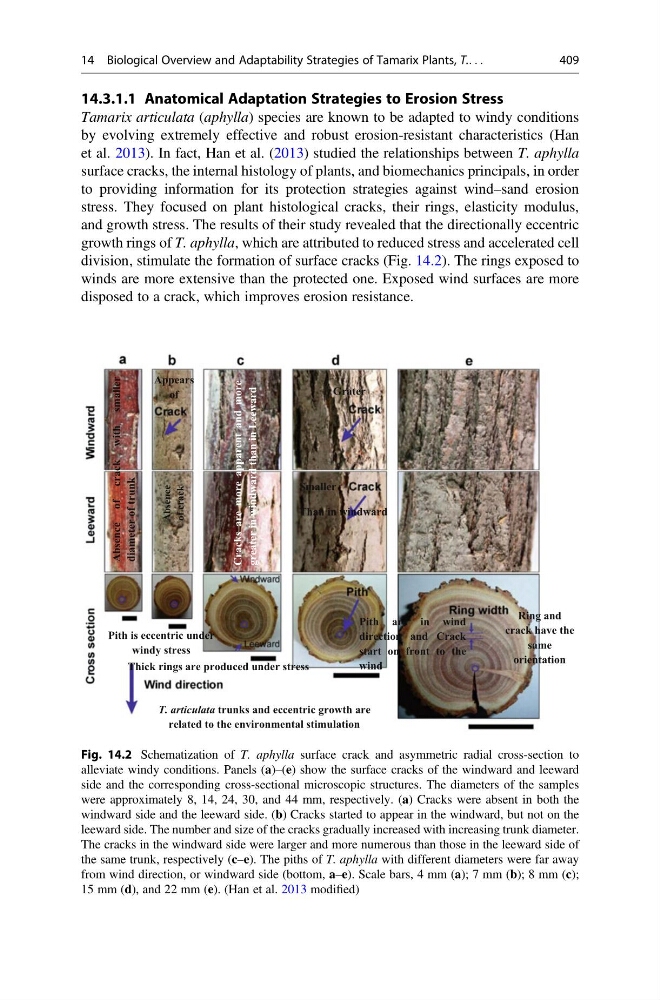
division, stimulate the formation of surface cracks (Fig. 14.2). The rings exposed to
winds are more extensive than the protected one. Exposed wind surfaces are more
disposed to a crack, which improves erosion resistance.
T. articulata trunks and eccentric growth are
related to the environmental stimulation
Absence of crack with smaller
diameter of trunk
Appears
of
Absence
of crack
Cracks are more apparent and more
greater in windward than in Leeward
Grater
Smaller
Than in windward
Thick rings are produced under stress
Ring and
crack have the
same
orientation
Pith is eccentric under
windy stress
Pith are in wind
direction and Crack
start on front to the
wind
Fig. 14.2 Schematization of T. aphylla surface crack and asymmetric radial cross-section to
alleviate windy conditions. Panels (a)–(e) show the surface cracks of the windward and leeward
side and the corresponding cross-sectional microscopic structures. The diameters of the samples
were approximately 8, 14, 24, 30, and 44 mm, respectively. (a) Cracks were absent in both the
windward side and the leeward side. (b) Cracks started to appear in the windward, but not on the
leeward side. The number and size of the cracks gradually increased with increasing trunk diameter.
The cracks in the windward side were larger and more numerous than those in the leeward side of
the same trunk, respectively (c–e). The piths of T. aphylla with different diameters were far away
from wind direction, or windward side (bottom, a–e). Scale bars, 4 mm (a); 7 mm (b); 8 mm (c);
15 mm (d), and 22 mm (e). (Han et al. 2013 modified)
14 Biological Overview and Adaptability Strategies of Tamarix Plants, T.. . .
409
Tamarix articulata (aphylla) species are known to be adapted to windy conditions
by evolving extremely effective and robust erosion-resistant characteristics (Han
et al. 2013). In fact, Han et al. (2013) studied the relationships between T. aphylla
surface cracks, the internal histology of plants, and biomechanics principals, in order
to providing information for its protection strategies against wind–sand erosion
stress. They focused on plant histological cracks, their rings, elasticity modulus,
and growth stress. The results of their study revealed that the directionally eccentric
growth rings of T. aphylla, which are attributed to reduced stress and accelerated cell
division, stimulate the formation of surface cracks (Fig. 14.2). The rings exposed to
winds are more extensive than the protected one. Exposed wind surfaces are more
disposed to a crack, which improves erosion resistance.
T. articulata trunks and eccentric growth are
related to the environmental stimulation
Absence of crack with smaller
diameter of trunk
Appears
of
Absence
of crack
Cracks are more apparent and more
greater in windward than in Leeward
Grater
Smaller
Than in windward
Thick rings are produced under stress
Ring and
crack have the
same
orientation
Pith is eccentric under
windy stress
Pith are in wind
direction and Crack
start on front to the
wind
Fig. 14.2 Schematization of T. aphylla surface crack and asymmetric radial cross-section to
alleviate windy conditions. Panels (a)–(e) show the surface cracks of the windward and leeward
side and the corresponding cross-sectional microscopic structures. The diameters of the samples
were approximately 8, 14, 24, 30, and 44 mm, respectively. (a) Cracks were absent in both the
windward side and the leeward side. (b) Cracks started to appear in the windward, but not on the
leeward side. The number and size of the cracks gradually increased with increasing trunk diameter.
The cracks in the windward side were larger and more numerous than those in the leeward side of
the same trunk, respectively (c–e). The piths of T. aphylla with different diameters were far away
from wind direction, or windward side (bottom, a–e). Scale bars, 4 mm (a); 7 mm (b); 8 mm (c);
15 mm (d), and 22 mm (e). (Han et al. 2013 modified)
14 Biological Overview and Adaptability Strategies of Tamarix Plants, T.. . .
409