

for example, if there is high temperature stress, then the probability of drought and
high salinity is high in that area, due to availability of water at low levels. When such
conditions prevail there is a cascade of effects at molecular, biochemical, and
physiological levels (Mittler 2006).
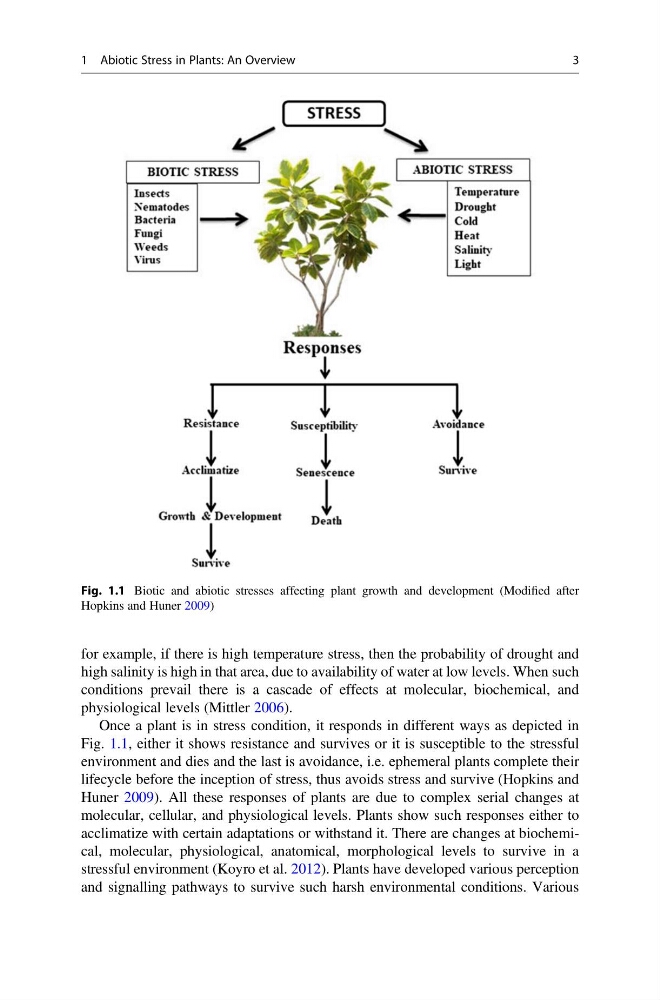
Once a plant is in stress condition, it responds in different ways as depicted in
Fig. 1.1, either it shows resistance and survives or it is susceptible to the stressful
environment and dies and the last is avoidance, i.e. ephemeral plants complete their
lifecycle before the inception of stress, thus avoids stress and survive (Hopkins and
Huner 2009). All these responses of plants are due to complex serial changes at
molecular, cellular, and physiological levels. Plants show such responses either to
acclimatize with certain adaptations or withstand it. There are changes at biochemical, molecular, physiological, anatomical, morphological levels to survive in a
stressful environment (Koyro et al. 2012). Plants have developed various perception
and signalling pathways to survive such harsh environmental conditions. Various
Fig. 1.1 Biotic and abiotic stresses affecting plant growth and development (Modified after
Hopkins and Huner 2009)
1 Abiotic Stress in Plants: An Overview
3
high salinity is high in that area, due to availability of water at low levels. When such
conditions prevail there is a cascade of effects at molecular, biochemical, and
physiological levels (Mittler 2006).
Once a plant is in stress condition, it responds in different ways as depicted in
Fig. 1.1, either it shows resistance and survives or it is susceptible to the stressful
environment and dies and the last is avoidance, i.e. ephemeral plants complete their
lifecycle before the inception of stress, thus avoids stress and survive (Hopkins and
Huner 2009). All these responses of plants are due to complex serial changes at
molecular, cellular, and physiological levels. Plants show such responses either to
acclimatize with certain adaptations or withstand it. There are changes at biochemical, molecular, physiological, anatomical, morphological levels to survive in a
stressful environment (Koyro et al. 2012). Plants have developed various perception
and signalling pathways to survive such harsh environmental conditions. Various
Fig. 1.1 Biotic and abiotic stresses affecting plant growth and development (Modified after
Hopkins and Huner 2009)
1 Abiotic Stress in Plants: An Overview
3