

these requirements are either in limited or in excessive amount, there is stress. The
stress can be defined as any change in environmental condition having undesirable
effects on normal growth and development of plants (Levitt 1980). Stress can also be
defined as a non-ideal condition for survival. The first publication on “General
Adaptation Syndrome” now known as “Biological Stress” was published in Nature
in 1936 by Hans Selye (Lichtenthaler 1998). The concept of stress was originally
developed by him and this term has also been used for unfavourable environmental
constraints in plants. Plants may experience Eu-stress, which is a positive and
growth promoting stress or they may experience De-stress which affects plants
negatively (Lichtenthaler 1998). The biological species flourish best in optimum
conditions and can tolerate the environmental factors as per Law of Limiting factors
(Shelford 1952). Once these factors are in extremes they become a condition which
promotes stress. The stress can be also categorized as natural or anthropogenic and
can also be distinguished into biotic stress and abiotic stress based on which factor is
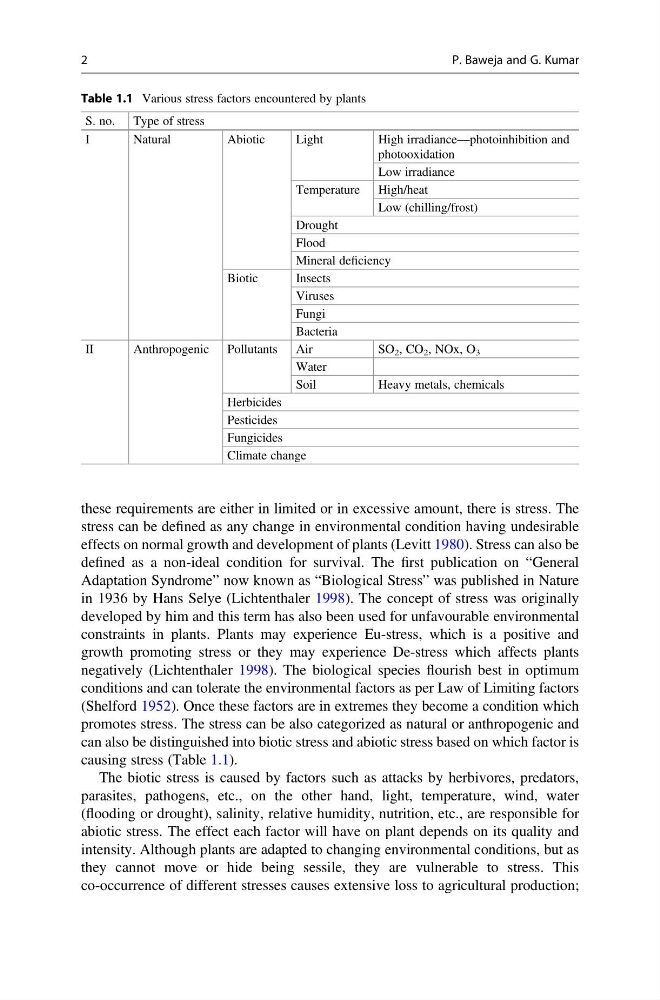
causing stress (Table 1.1).
The biotic stress is caused by factors such as attacks by herbivores, predators,
parasites, pathogens, etc., on the other hand, light, temperature, wind, water
(flooding or drought), salinity, relative humidity, nutrition, etc., are responsible for
abiotic stress. The effect each factor will have on plant depends on its quality and
intensity. Although plants are adapted to changing environmental conditions, but as
they cannot move or hide being sessile, they are vulnerable to stress. This
co-occurrence of different stresses causes extensive loss to agricultural production;
Table 1.1 Various stress factors encountered by plants
S. no. Type of stress
I
Natural
Abiotic
Light
High irradiance—photoinhibition and
photooxidation
Low irradiance
Temperature High/heat
Low (chilling/frost)
Drought
Flood
Mineral deficiency
Biotic
Insects
Viruses
Fungi
Bacteria
II
Anthropogenic Pollutants Air
SO 2 , CO 2 , NOx, O 3
Water
Soil
Heavy metals, chemicals
Herbicides
Pesticides
Fungicides
Climate change
2
P. Baweja and G. Kumar
stress can be defined as any change in environmental condition having undesirable
effects on normal growth and development of plants (Levitt 1980). Stress can also be
defined as a non-ideal condition for survival. The first publication on “General
Adaptation Syndrome” now known as “Biological Stress” was published in Nature
in 1936 by Hans Selye (Lichtenthaler 1998). The concept of stress was originally
developed by him and this term has also been used for unfavourable environmental
constraints in plants. Plants may experience Eu-stress, which is a positive and
growth promoting stress or they may experience De-stress which affects plants
negatively (Lichtenthaler 1998). The biological species flourish best in optimum
conditions and can tolerate the environmental factors as per Law of Limiting factors
(Shelford 1952). Once these factors are in extremes they become a condition which
promotes stress. The stress can be also categorized as natural or anthropogenic and
can also be distinguished into biotic stress and abiotic stress based on which factor is
causing stress (Table 1.1).
The biotic stress is caused by factors such as attacks by herbivores, predators,
parasites, pathogens, etc., on the other hand, light, temperature, wind, water
(flooding or drought), salinity, relative humidity, nutrition, etc., are responsible for
abiotic stress. The effect each factor will have on plant depends on its quality and
intensity. Although plants are adapted to changing environmental conditions, but as
they cannot move or hide being sessile, they are vulnerable to stress. This
co-occurrence of different stresses causes extensive loss to agricultural production;
Table 1.1 Various stress factors encountered by plants
S. no. Type of stress
I
Natural
Abiotic
Light
High irradiance—photoinhibition and
photooxidation
Low irradiance
Temperature High/heat
Low (chilling/frost)
Drought
Flood
Mineral deficiency
Biotic
Insects
Viruses
Fungi
Bacteria
II
Anthropogenic Pollutants Air
SO 2 , CO 2 , NOx, O 3
Water
Soil
Heavy metals, chemicals
Herbicides
Pesticides
Fungicides
Climate change
2
P. Baweja and G. Kumar