

studies are on-going on Arabidopsis thaliana and Oryza sativa (Rice) as model
organisms to understand the insights of plant stress biology.
Amongst various abiotic stresses, heat and drought affect the plant’s growth the
most. Various studies have been carried out on these two factors. Popova et al.
(2013) studied the RNA dependent DNA methylation pathway and concluded that
this pathway is involved in heat stress resistance in Arabidopsis. Lee et al. (2013)
studied the consequences of ABA production during drought conditions. The
responses shown by plants towards stress are dynamic, complex and can be plastic
(irreversible) or elastic (reversible) (Cramer 2010; Skirycz and Inze 2010; Cramer
et al. 2011). Inhibition of protein synthesis, protein folding, processing are one of the
first responses to abiotic stresses at molecular level. Plants also show some responses
due to abiotic stress at hormone level and produce ABA or ethylene (Cramer et al.
2011).
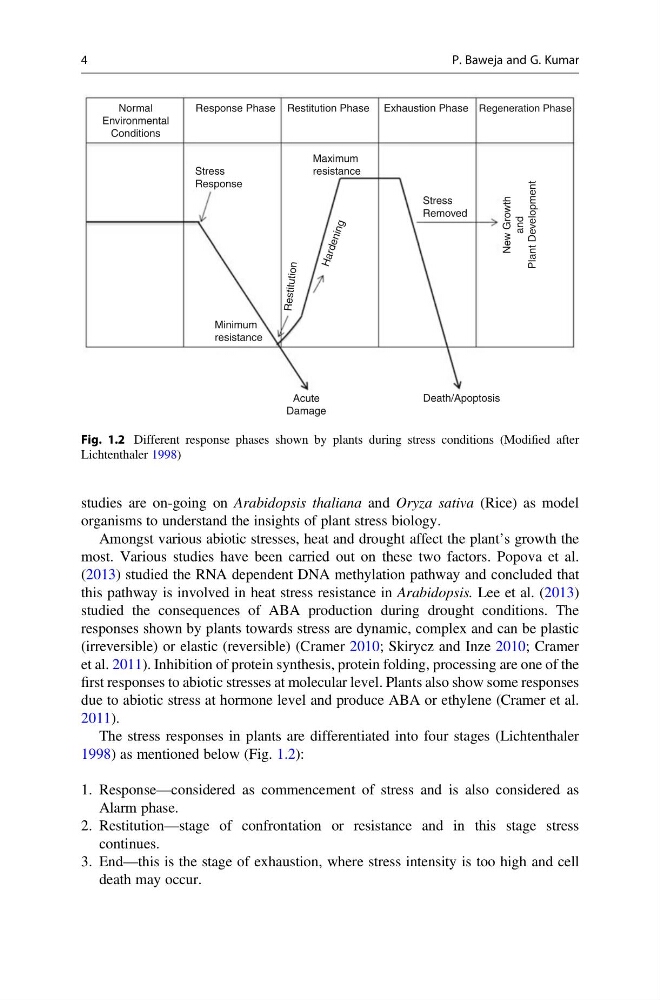
The stress responses in plants are differentiated into four stages (Lichtenthaler
1998) as mentioned below (Fig. 1.2):
1. Response—considered as commencement of stress and is also considered as
Alarm phase.
2. Restitution—stage of confrontation or resistance and in this stage stress
continues.
3. End—this is the stage of exhaustion, where stress intensity is too high and cell
death may occur.
Normal
Environmental
Conditions
Response Phase
Stress
Response
Stress
Removed
Maximum
resistance
Minimum
resistance
Death/Apoptosis
New Growth
and
Plant Development
Acute
Damage
Re stit utio n
H a rd e n in g
Restitution Phase Exhaustion Phase Regeneration Phase
Fig. 1.2 Different response phases shown by plants during stress conditions (Modified after
Lichtenthaler 1998)
4
P. Baweja and G. Kumar
organisms to understand the insights of plant stress biology.
Amongst various abiotic stresses, heat and drought affect the plant’s growth the
most. Various studies have been carried out on these two factors. Popova et al.
(2013) studied the RNA dependent DNA methylation pathway and concluded that
this pathway is involved in heat stress resistance in Arabidopsis. Lee et al. (2013)
studied the consequences of ABA production during drought conditions. The
responses shown by plants towards stress are dynamic, complex and can be plastic
(irreversible) or elastic (reversible) (Cramer 2010; Skirycz and Inze 2010; Cramer
et al. 2011). Inhibition of protein synthesis, protein folding, processing are one of the
first responses to abiotic stresses at molecular level. Plants also show some responses
due to abiotic stress at hormone level and produce ABA or ethylene (Cramer et al.
2011).
The stress responses in plants are differentiated into four stages (Lichtenthaler
1998) as mentioned below (Fig. 1.2):
1. Response—considered as commencement of stress and is also considered as
Alarm phase.
2. Restitution—stage of confrontation or resistance and in this stage stress
continues.
3. End—this is the stage of exhaustion, where stress intensity is too high and cell
death may occur.
Normal
Environmental
Conditions
Response Phase
Stress
Response
Stress
Removed
Maximum
resistance
Minimum
resistance
Death/Apoptosis
New Growth
and
Plant Development
Acute
Damage
Re stit utio n
H a rd e n in g
Restitution Phase Exhaustion Phase Regeneration Phase
Fig. 1.2 Different response phases shown by plants during stress conditions (Modified after
Lichtenthaler 1998)
4
P. Baweja and G. Kumar