

66
3.4 Food System
Food is the necessity for a living organism as it is the most common source for providing energy to human and animals. Different food components, types, and ingredients help in performing natural metabolic reactions. Thus, the food system is a
system integrating several natural and environmental systems, from a simple food
chain supply to the multiple interconnected networks (Hospes and Brons 2016;
Béné et al. 2019). The food system has interconnection with other currently ongoing
challenges that may directly or indirectly affect sustainable agriculture development
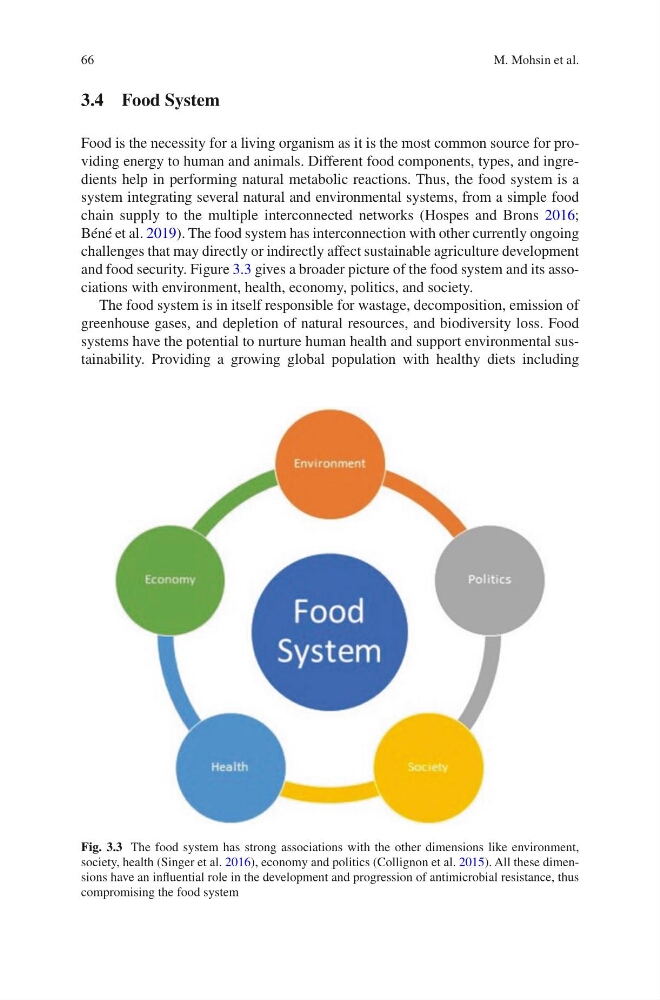
and food security. Figure 3.3 gives a broader picture of the food system and its associations with environment, health, economy, politics, and society.
The food system is in itself responsible for wastage, decomposition, emission of
greenhouse gases, and depletion of natural resources, and biodiversity loss. Food
systems have the potential to nurture human health and support environmental sustainability. Providing a growing global population with healthy diets including
Fig. 3.3 The food system has strong associations with the other dimensions like environment,
society, health (Singer et al. 2016), economy and politics (Collignon et al. 2015). All these dimensions have an influential role in the development and progression of antimicrobial resistance, thus
compromising the food system
M. Mohsin et al.
3.4 Food System
Food is the necessity for a living organism as it is the most common source for providing energy to human and animals. Different food components, types, and ingredients help in performing natural metabolic reactions. Thus, the food system is a
system integrating several natural and environmental systems, from a simple food
chain supply to the multiple interconnected networks (Hospes and Brons 2016;
Béné et al. 2019). The food system has interconnection with other currently ongoing
challenges that may directly or indirectly affect sustainable agriculture development
and food security. Figure 3.3 gives a broader picture of the food system and its associations with environment, health, economy, politics, and society.
The food system is in itself responsible for wastage, decomposition, emission of
greenhouse gases, and depletion of natural resources, and biodiversity loss. Food
systems have the potential to nurture human health and support environmental sustainability. Providing a growing global population with healthy diets including
Fig. 3.3 The food system has strong associations with the other dimensions like environment,
society, health (Singer et al. 2016), economy and politics (Collignon et al. 2015). All these dimensions have an influential role in the development and progression of antimicrobial resistance, thus
compromising the food system
M. Mohsin et al.