

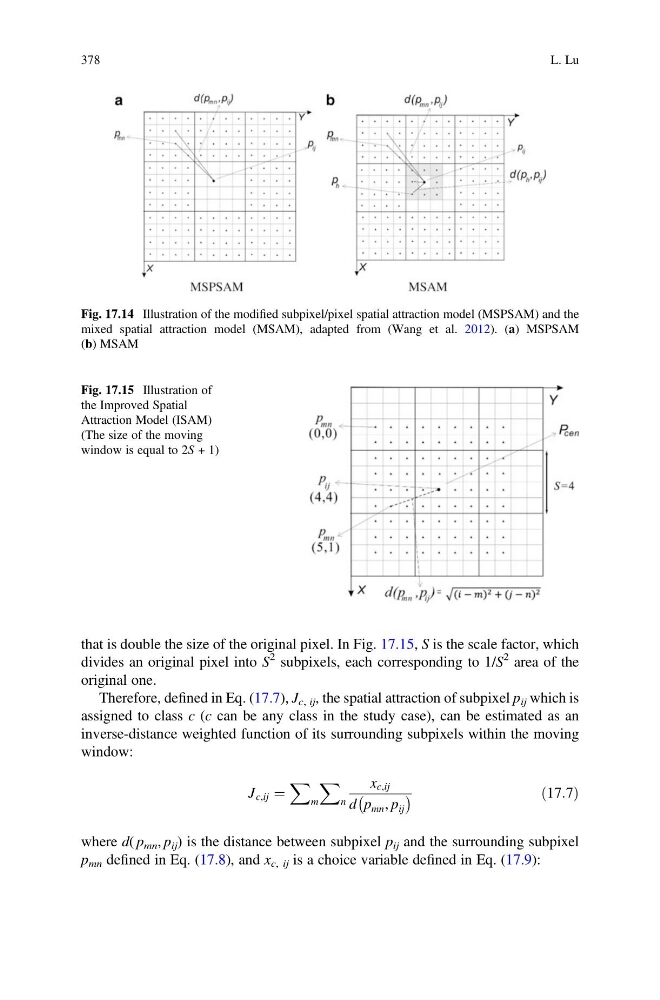
that is double the size of the original pixel. In Fig. 17.15, S is the scale factor, which
divides an original pixel into S
2 subpixels, each corresponding to 1/S
2 area of the
original one.
Therefore, defined in Eq. (17.7), J c, ij , the spatial attraction of subpixel p ij which is
assigned to class c (c can be any class in the study case), can be estimated as an
inverse-distance weighted function of its surrounding subpixels within the moving
window:
J c,ij ¼
X
m
X
n
x c,ij
d p mn , p ij
À
Á
ð17:7Þ
where d( p mn , p ij ) is the distance between subpixel p ij and the surrounding subpixel
p mn defined in Eq. (17.8), and x c, ij is a choice variable defined in Eq. (17.9):
Fig. 17.14 Illustration of the modified subpixel/pixel spatial attraction model (MSPSAM) and the
mixed spatial attraction model (MSAM), adapted from (Wang et al. 2012). (a) MSPSAM
(b) MSAM
Fig. 17.15 Illustration of
the Improved Spatial
Attraction Model (ISAM)
(The size of the moving
window is equal to 2S + 1)
378
L. Lu
divides an original pixel into S
2 subpixels, each corresponding to 1/S
2 area of the
original one.
Therefore, defined in Eq. (17.7), J c, ij , the spatial attraction of subpixel p ij which is
assigned to class c (c can be any class in the study case), can be estimated as an
inverse-distance weighted function of its surrounding subpixels within the moving
window:
J c,ij ¼
X
m
X
n
x c,ij
d p mn , p ij
À
Á
ð17:7Þ
where d( p mn , p ij ) is the distance between subpixel p ij and the surrounding subpixel
p mn defined in Eq. (17.8), and x c, ij is a choice variable defined in Eq. (17.9):
Fig. 17.14 Illustration of the modified subpixel/pixel spatial attraction model (MSPSAM) and the
mixed spatial attraction model (MSAM), adapted from (Wang et al. 2012). (a) MSPSAM
(b) MSAM
Fig. 17.15 Illustration of
the Improved Spatial
Attraction Model (ISAM)
(The size of the moving
window is equal to 2S + 1)
378
L. Lu