

SDV c,ij ¼
X
M
X
N
1
d P MN , p ij
À
ÁF c P MN
ð
Þ
ð17:6Þ
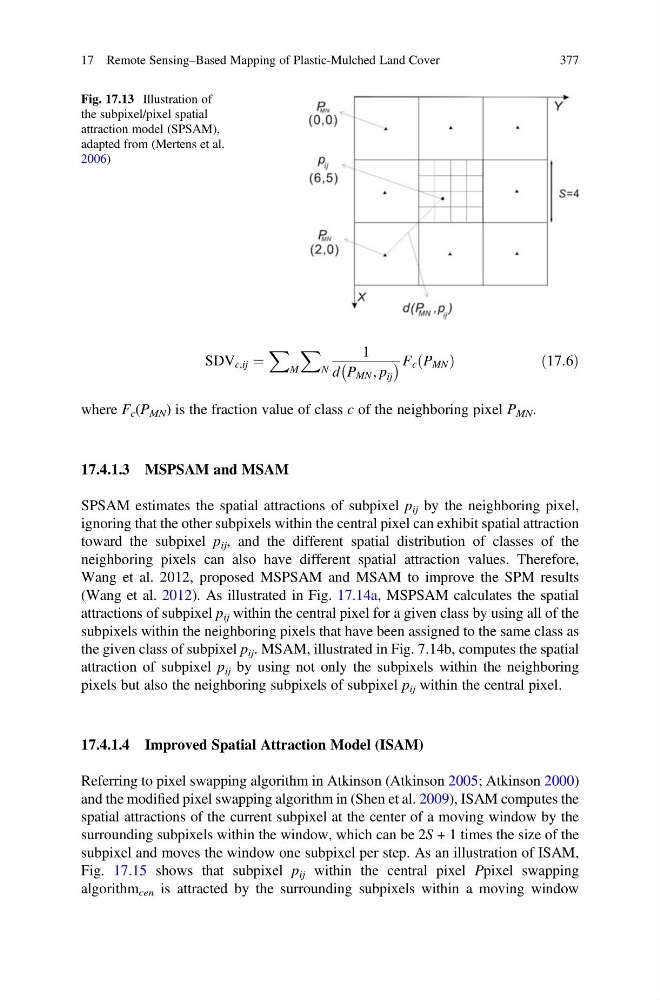
where F c (P MN ) is the fraction value of class c of the neighboring pixel P MN .
17.4.1.3 MSPSAM and MSAM
SPSAM estimates the spatial attractions of subpixel p ij by the neighboring pixel,
ignoring that the other subpixels within the central pixel can exhibit spatial attraction
toward the subpixel p ij , and the different spatial distribution of classes of the
neighboring pixels can also have different spatial attraction values. Therefore,
Wang et al. 2012, proposed MSPSAM and MSAM to improve the SPM results
(Wang et al. 2012). As illustrated in Fig. 17.14a, MSPSAM calculates the spatial
attractions of subpixel p ij within the central pixel for a given class by using all of the
subpixels within the neighboring pixels that have been assigned to the same class as
the given class of subpixel p ij . MSAM, illustrated in Fig. 7.14b, computes the spatial
attraction of subpixel p ij by using not only the subpixels within the neighboring
pixels but also the neighboring subpixels of subpixel p ij within the central pixel.
17.4.1.4 Improved Spatial Attraction Model (ISAM)
Referring to pixel swapping algorithm in Atkinson (Atkinson 2005; Atkinson 2000)
and the modified pixel swapping algorithm in (Shen et al. 2009), ISAM computes the
spatial attractions of the current subpixel at the center of a moving window by the
surrounding subpixels within the window, which can be 2S + 1 times the size of the
subpixel and moves the window one subpixel per step. As an illustration of ISAM,
Fig. 17.15 shows that subpixel p ij within the central pixel Ppixel swapping
algorithm cen is attracted by the surrounding subpixels within a moving window
Fig. 17.13 Illustration of
the subpixel/pixel spatial
attraction model (SPSAM),
adapted from (Mertens et al.
2006)
17 Remote Sensing–Based Mapping of Plastic-Mulched Land Cover
377
X
M
X
N
1
d P MN , p ij
À
ÁF c P MN
ð
Þ
ð17:6Þ
where F c (P MN ) is the fraction value of class c of the neighboring pixel P MN .
17.4.1.3 MSPSAM and MSAM
SPSAM estimates the spatial attractions of subpixel p ij by the neighboring pixel,
ignoring that the other subpixels within the central pixel can exhibit spatial attraction
toward the subpixel p ij , and the different spatial distribution of classes of the
neighboring pixels can also have different spatial attraction values. Therefore,
Wang et al. 2012, proposed MSPSAM and MSAM to improve the SPM results
(Wang et al. 2012). As illustrated in Fig. 17.14a, MSPSAM calculates the spatial
attractions of subpixel p ij within the central pixel for a given class by using all of the
subpixels within the neighboring pixels that have been assigned to the same class as
the given class of subpixel p ij . MSAM, illustrated in Fig. 7.14b, computes the spatial
attraction of subpixel p ij by using not only the subpixels within the neighboring
pixels but also the neighboring subpixels of subpixel p ij within the central pixel.
17.4.1.4 Improved Spatial Attraction Model (ISAM)
Referring to pixel swapping algorithm in Atkinson (Atkinson 2005; Atkinson 2000)
and the modified pixel swapping algorithm in (Shen et al. 2009), ISAM computes the
spatial attractions of the current subpixel at the center of a moving window by the
surrounding subpixels within the window, which can be 2S + 1 times the size of the
subpixel and moves the window one subpixel per step. As an illustration of ISAM,
Fig. 17.15 shows that subpixel p ij within the central pixel Ppixel swapping
algorithm cen is attracted by the surrounding subpixels within a moving window
Fig. 17.13 Illustration of
the subpixel/pixel spatial
attraction model (SPSAM),
adapted from (Mertens et al.
2006)
17 Remote Sensing–Based Mapping of Plastic-Mulched Land Cover
377