

15.3.3 Results
The model outputs were validated at eddy covariance (ECOR) flux towers in two
study areas with different climates across the US. The first site whose ID is US-Skr is
situated in the protected wilderness area of Everglades National Park, Florida,
United States, and registered in the FLUXNET network. Other two ground sites
(i.e., EF-14 and EF-21), which are established under the Department of Energy’s
(DOE) under the Atmospheric Radiation Measurement (ARM) program, are located
in the US Southern Great Plains (SGP), Oklahoma, United States. According to
Köppen-Geiger classification, US-Skr has a humid subtropical climate with a mild
and dry season (October–May) and warm, wet season (June–September), whereas
EF-14 and EF-21 sites are subject to temperate humid climate with hot summers
(Peel et al. 2007). EF and LE estimated by the trapezoid model are compared with
ground EF and LE measured at the flux towers, and comparison results are presented
in the next two sections.
15.3.3.1 Validation at US-Skr
The land cover under and around the US-Skr site is dominated by mangrove forests.
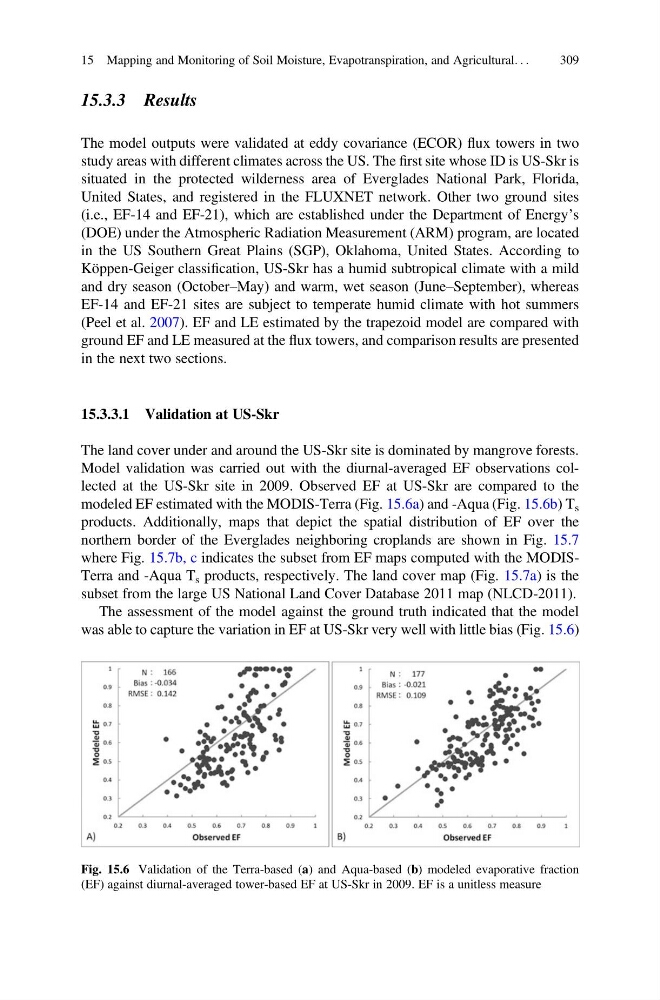
Model validation was carried out with the diurnal-averaged EF observations collected at the US-Skr site in 2009. Observed EF at US-Skr are compared to the
modeled EF estimated with the MODIS-Terra (Fig. 15.6a) and -Aqua (Fig. 15.6b) T s
products. Additionally, maps that depict the spatial distribution of EF over the
northern border of the Everglades neighboring croplands are shown in Fig. 15.7
where Fig. 15.7b, c indicates the subset from EF maps computed with the MODISTerra and -Aqua T s products, respectively. The land cover map (Fig. 15.7a) is the
subset from the large US National Land Cover Database 2011 map (NLCD-2011).
The assessment of the model against the ground truth indicated that the model
was able to capture the variation in EF at US-Skr very well with little bias (Fig. 15.6)
Fig. 15.6 Validation of the Terra-based (a) and Aqua-based (b) modeled evaporative fraction
(EF) against diurnal-averaged tower-based EF at US-Skr in 2009. EF is a unitless measure
15 Mapping and Monitoring of Soil Moisture, Evapotranspiration, and Agricultural. . .
309
The model outputs were validated at eddy covariance (ECOR) flux towers in two
study areas with different climates across the US. The first site whose ID is US-Skr is
situated in the protected wilderness area of Everglades National Park, Florida,
United States, and registered in the FLUXNET network. Other two ground sites
(i.e., EF-14 and EF-21), which are established under the Department of Energy’s
(DOE) under the Atmospheric Radiation Measurement (ARM) program, are located
in the US Southern Great Plains (SGP), Oklahoma, United States. According to
Köppen-Geiger classification, US-Skr has a humid subtropical climate with a mild
and dry season (October–May) and warm, wet season (June–September), whereas
EF-14 and EF-21 sites are subject to temperate humid climate with hot summers
(Peel et al. 2007). EF and LE estimated by the trapezoid model are compared with
ground EF and LE measured at the flux towers, and comparison results are presented
in the next two sections.
15.3.3.1 Validation at US-Skr
The land cover under and around the US-Skr site is dominated by mangrove forests.
Model validation was carried out with the diurnal-averaged EF observations collected at the US-Skr site in 2009. Observed EF at US-Skr are compared to the
modeled EF estimated with the MODIS-Terra (Fig. 15.6a) and -Aqua (Fig. 15.6b) T s
products. Additionally, maps that depict the spatial distribution of EF over the
northern border of the Everglades neighboring croplands are shown in Fig. 15.7
where Fig. 15.7b, c indicates the subset from EF maps computed with the MODISTerra and -Aqua T s products, respectively. The land cover map (Fig. 15.7a) is the
subset from the large US National Land Cover Database 2011 map (NLCD-2011).
The assessment of the model against the ground truth indicated that the model
was able to capture the variation in EF at US-Skr very well with little bias (Fig. 15.6)
Fig. 15.6 Validation of the Terra-based (a) and Aqua-based (b) modeled evaporative fraction
(EF) against diurnal-averaged tower-based EF at US-Skr in 2009. EF is a unitless measure
15 Mapping and Monitoring of Soil Moisture, Evapotranspiration, and Agricultural. . .
309