

merged soil moisture product is a much better product than individual products in
isolation.
The benchmark soil moisture product generated here can be used to assess the
added utility of merged products using different methodologies (least squares, data
assimilation) and products as well as the added utility of error variance information
(that is used to merge different products) obtained using different methodologies
(e.g., triple collocation). Given complex or time-consuming methodologies can be
used to merge different soil moisture products, validation skill comparisons against a
benchmark product would be very helpful in identifying the added utility of the
merged soil moisture products. In case no added utility is found (when compared to
benchmark product), then it is reasonable to use the benchmark soil moisture product
that can be obtained via simple and quick analysis. Given current efforts are focusing
on the combination of modeled and remotely sensed datasets for operational global
drought monitoring, introduced benchmark soil moisture products could be particularly useful in assessing the utility and the skill of the merging methodologies.
Additionally, the soil moisture anomalies (i.e., deviations from the climatology)
obtained in this study can be used as a reliable tool to predict the onset of an
agricultural drought season as well as to monitor and quantify the occurrence of
drought events and their potential impacts, particularly over agricultural lands.
15.3 Evapotranspiration
ET has the largest share in the water balance of many geographical locations and
impacted by the surface available energy, the surface/sub-surface soil moisture, and
the resistances induced by atmosphere and vegetation (Monteith 1965). The most
common method to estimate ET (the abbreviation LE will be used to refer to ET,
hereafter) is through surface energy balance modeling which can be formulated as
follows:
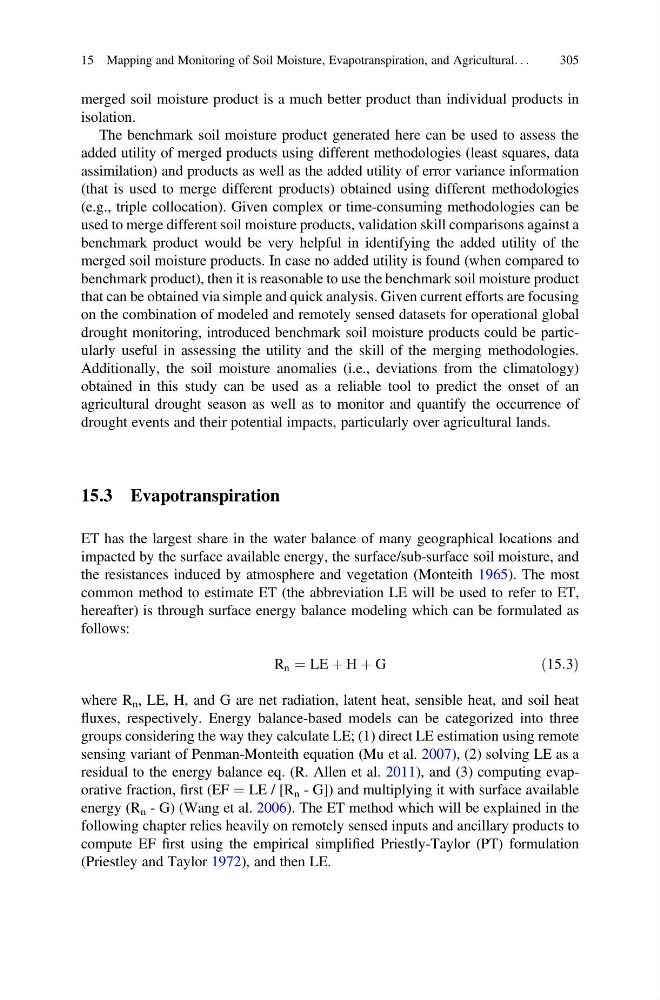
R n ¼ LE þ H þ G
ð15:3Þ
where R n , LE, H, and G are net radiation, latent heat, sensible heat, and soil heat
fluxes, respectively. Energy balance-based models can be categorized into three
groups considering the way they calculate LE; (1) direct LE estimation using remote
sensing variant of Penman-Monteith equation (Mu et al. 2007), (2) solving LE as a
residual to the energy balance eq. (R. Allen et al. 2011), and (3) computing evaporative fraction, first (EF ¼ LE / [R n - G]) and multiplying it with surface available
energy (R n - G) (Wang et al. 2006). The ET method which will be explained in the
following chapter relies heavily on remotely sensed inputs and ancillary products to
compute EF first using the empirical simplified Priestly-Taylor (PT) formulation
(Priestley and Taylor 1972), and then LE.
15 Mapping and Monitoring of Soil Moisture, Evapotranspiration, and Agricultural. . .
305
isolation.
The benchmark soil moisture product generated here can be used to assess the
added utility of merged products using different methodologies (least squares, data
assimilation) and products as well as the added utility of error variance information
(that is used to merge different products) obtained using different methodologies
(e.g., triple collocation). Given complex or time-consuming methodologies can be
used to merge different soil moisture products, validation skill comparisons against a
benchmark product would be very helpful in identifying the added utility of the
merged soil moisture products. In case no added utility is found (when compared to
benchmark product), then it is reasonable to use the benchmark soil moisture product
that can be obtained via simple and quick analysis. Given current efforts are focusing
on the combination of modeled and remotely sensed datasets for operational global
drought monitoring, introduced benchmark soil moisture products could be particularly useful in assessing the utility and the skill of the merging methodologies.
Additionally, the soil moisture anomalies (i.e., deviations from the climatology)
obtained in this study can be used as a reliable tool to predict the onset of an
agricultural drought season as well as to monitor and quantify the occurrence of
drought events and their potential impacts, particularly over agricultural lands.
15.3 Evapotranspiration
ET has the largest share in the water balance of many geographical locations and
impacted by the surface available energy, the surface/sub-surface soil moisture, and
the resistances induced by atmosphere and vegetation (Monteith 1965). The most
common method to estimate ET (the abbreviation LE will be used to refer to ET,
hereafter) is through surface energy balance modeling which can be formulated as
follows:
R n ¼ LE þ H þ G
ð15:3Þ
where R n , LE, H, and G are net radiation, latent heat, sensible heat, and soil heat
fluxes, respectively. Energy balance-based models can be categorized into three
groups considering the way they calculate LE; (1) direct LE estimation using remote
sensing variant of Penman-Monteith equation (Mu et al. 2007), (2) solving LE as a
residual to the energy balance eq. (R. Allen et al. 2011), and (3) computing evaporative fraction, first (EF ¼ LE / [R n - G]) and multiplying it with surface available
energy (R n - G) (Wang et al. 2006). The ET method which will be explained in the
following chapter relies heavily on remotely sensed inputs and ancillary products to
compute EF first using the empirical simplified Priestly-Taylor (PT) formulation
(Priestley and Taylor 1972), and then LE.
15 Mapping and Monitoring of Soil Moisture, Evapotranspiration, and Agricultural. . .
305