

14.4.3 Comparison of Traditional and Automatic
Stratification Results
The stratification results achieved by the traditional and automatic stratification
methods are compared using 2010 JAS reported data as in situ validation. It should
be noted that for this analysis, strata 31, 32, 50, and 62 (all nonagricultural strata) are
merged into stratum 40 for the purpose of method comparison. All stratification is
PSU based.
As shown in Table 14.4, the accuracies are calculated and summarized in the
same manner for all states and strata. At the individual state-level, stratum 20 was the
only stratum that showed no statistically significant difference between the two
stratification methods at the 95% confidence level. Table 14.4 also illustrates the
individual state-level analyses across five strata for the Oklahoma, Ohio, Georgia,
Virginia, and Arizona analyses. Although the automatic stratification method
achieved higher accuracies than the traditional method in all high to medium
intensity cultivated strata, the accuracies for both methods in strata 12 and 20 are
lower than those of stratum 11. The primary reason for reduced accuracy in these
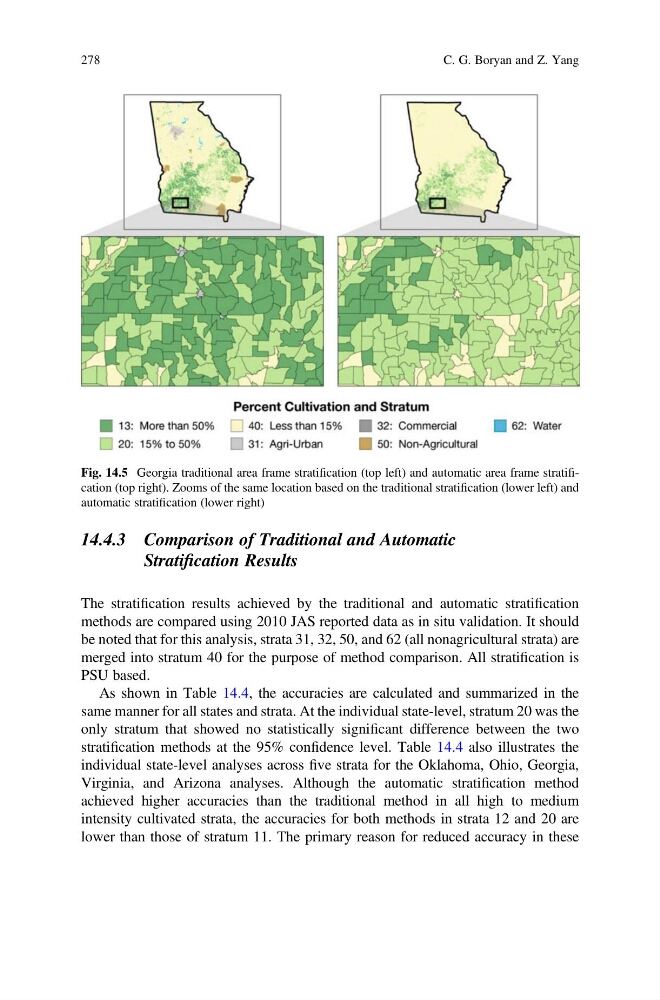
Fig. 14.5 Georgia traditional area frame stratification (top left) and automatic area frame stratification (top right). Zooms of the same location based on the traditional stratification (lower left) and
automatic stratification (lower right)
278
C. G. Boryan and Z. Yang
Stratification Results
The stratification results achieved by the traditional and automatic stratification
methods are compared using 2010 JAS reported data as in situ validation. It should
be noted that for this analysis, strata 31, 32, 50, and 62 (all nonagricultural strata) are
merged into stratum 40 for the purpose of method comparison. All stratification is
PSU based.
As shown in Table 14.4, the accuracies are calculated and summarized in the
same manner for all states and strata. At the individual state-level, stratum 20 was the
only stratum that showed no statistically significant difference between the two
stratification methods at the 95% confidence level. Table 14.4 also illustrates the
individual state-level analyses across five strata for the Oklahoma, Ohio, Georgia,
Virginia, and Arizona analyses. Although the automatic stratification method
achieved higher accuracies than the traditional method in all high to medium
intensity cultivated strata, the accuracies for both methods in strata 12 and 20 are
lower than those of stratum 11. The primary reason for reduced accuracy in these
Fig. 14.5 Georgia traditional area frame stratification (top left) and automatic area frame stratification (top right). Zooms of the same location based on the traditional stratification (lower left) and
automatic stratification (lower right)
278
C. G. Boryan and Z. Yang