

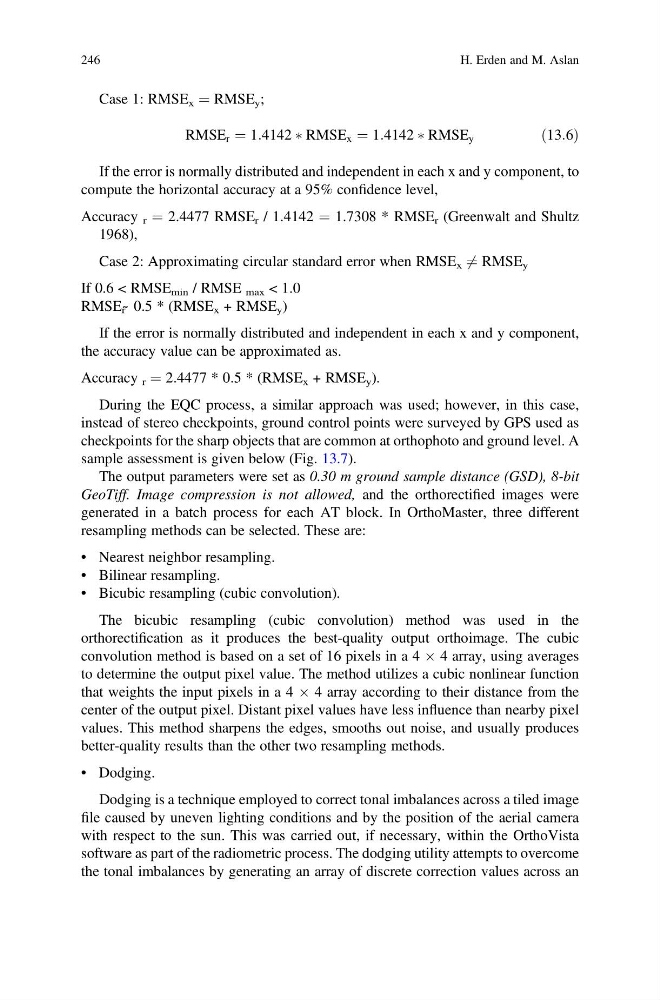
Case 1: RMSE x ¼ RMSE y ;
RMSE r ¼ 1:4142 Ã RMSE x ¼ 1:4142 Ã RMSE y
ð13:6Þ
If the error is normally distributed and independent in each x and y component, to
compute the horizontal accuracy at a 95% confidence level,
Accuracy r ¼ 2.4477 RMSE r / 1.4142 ¼ 1.7308 * RMSE r (Greenwalt and Shultz
1968),
Case 2: Approximating circular standard error when RMSE x 6 ¼ RMSE y
If 0.6 < RMSE min / RMSE max < 1.0
RMSE r 0.5 * (RMSE x + RMSE y )
If the error is normally distributed and independent in each x and y component,
the accuracy value can be approximated as.
Accuracy r ¼ 2.4477 * 0.5 * (RMSE x + RMSE y ).
During the EQC process, a similar approach was used; however, in this case,
instead of stereo checkpoints, ground control points were surveyed by GPS used as
checkpoints for the sharp objects that are common at orthophoto and ground level. A
sample assessment is given below (Fig. 13.7).
The output parameters were set as 0.30 m ground sample distance (GSD), 8-bit
GeoTiff. Image compression is not allowed, and the orthorectified images were
generated in a batch process for each AT block. In OrthoMaster, three different
resampling methods can be selected. These are:
• Nearest neighbor resampling.
• Bilinear resampling.
• Bicubic resampling (cubic convolution).
The bicubic resampling (cubic convolution) method was used in the
orthorectification as it produces the best-quality output orthoimage. The cubic
convolution method is based on a set of 16 pixels in a 4 Â 4 array, using averages
to determine the output pixel value. The method utilizes a cubic nonlinear function
that weights the input pixels in a 4 Â 4 array according to their distance from the
center of the output pixel. Distant pixel values have less influence than nearby pixel
values. This method sharpens the edges, smooths out noise, and usually produces
better-quality results than the other two resampling methods.
• Dodging.
Dodging is a technique employed to correct tonal imbalances across a tiled image
file caused by uneven lighting conditions and by the position of the aerial camera
with respect to the sun. This was carried out, if necessary, within the OrthoVista
software as part of the radiometric process. The dodging utility attempts to overcome
the tonal imbalances by generating an array of discrete correction values across an
246
H. Erden and M. Aslan
RMSE r ¼ 1:4142 Ã RMSE x ¼ 1:4142 Ã RMSE y
ð13:6Þ
If the error is normally distributed and independent in each x and y component, to
compute the horizontal accuracy at a 95% confidence level,
Accuracy r ¼ 2.4477 RMSE r / 1.4142 ¼ 1.7308 * RMSE r (Greenwalt and Shultz
1968),
Case 2: Approximating circular standard error when RMSE x 6 ¼ RMSE y
If 0.6 < RMSE min / RMSE max < 1.0
RMSE r 0.5 * (RMSE x + RMSE y )
If the error is normally distributed and independent in each x and y component,
the accuracy value can be approximated as.
Accuracy r ¼ 2.4477 * 0.5 * (RMSE x + RMSE y ).
During the EQC process, a similar approach was used; however, in this case,
instead of stereo checkpoints, ground control points were surveyed by GPS used as
checkpoints for the sharp objects that are common at orthophoto and ground level. A
sample assessment is given below (Fig. 13.7).
The output parameters were set as 0.30 m ground sample distance (GSD), 8-bit
GeoTiff. Image compression is not allowed, and the orthorectified images were
generated in a batch process for each AT block. In OrthoMaster, three different
resampling methods can be selected. These are:
• Nearest neighbor resampling.
• Bilinear resampling.
• Bicubic resampling (cubic convolution).
The bicubic resampling (cubic convolution) method was used in the
orthorectification as it produces the best-quality output orthoimage. The cubic
convolution method is based on a set of 16 pixels in a 4 Â 4 array, using averages
to determine the output pixel value. The method utilizes a cubic nonlinear function
that weights the input pixels in a 4 Â 4 array according to their distance from the
center of the output pixel. Distant pixel values have less influence than nearby pixel
values. This method sharpens the edges, smooths out noise, and usually produces
better-quality results than the other two resampling methods.
• Dodging.
Dodging is a technique employed to correct tonal imbalances across a tiled image
file caused by uneven lighting conditions and by the position of the aerial camera
with respect to the sun. This was carried out, if necessary, within the OrthoVista
software as part of the radiometric process. The dodging utility attempts to overcome
the tonal imbalances by generating an array of discrete correction values across an
246
H. Erden and M. Aslan