

alternative of time-domain variation or spatiotemporal variation of the input data is
also using their wavelet features. This usually improves the estimation performance
of the system (Fig. 7.17). For this reason, one of the most used methods nowadays is
the wavelet transformation.
Wavelets are a relatively new way of analyzing signal and data patterns. It is a
synthesis of older ideas with new mathematical results and efficient computational
algorithms (Percival and Walden 2000). One-channel digital signal in discrete time
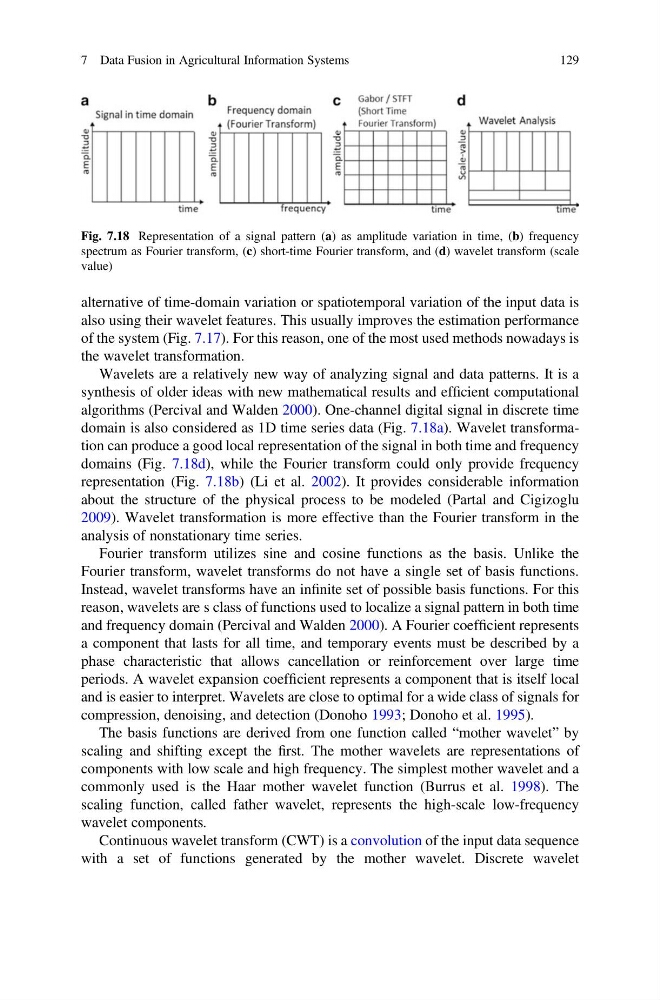
domain is also considered as 1D time series data (Fig. 7.18a). Wavelet transformation can produce a good local representation of the signal in both time and frequency
domains (Fig. 7.18d), while the Fourier transform could only provide frequency
representation (Fig. 7.18b) (Li et al. 2002). It provides considerable information
about the structure of the physical process to be modeled (Partal and Cigizoglu
2009). Wavelet transformation is more effective than the Fourier transform in the
analysis of nonstationary time series.
Fourier transform utilizes sine and cosine functions as the basis. Unlike the
Fourier transform, wavelet transforms do not have a single set of basis functions.
Instead, wavelet transforms have an infinite set of possible basis functions. For this
reason, wavelets are s class of functions used to localize a signal pattern in both time
and frequency domain (Percival and Walden 2000). A Fourier coefficient represents
a component that lasts for all time, and temporary events must be described by a
phase characteristic that allows cancellation or reinforcement over large time
periods. A wavelet expansion coefficient represents a component that is itself local
and is easier to interpret. Wavelets are close to optimal for a wide class of signals for
compression, denoising, and detection (Donoho 1993; Donoho et al. 1995).
The basis functions are derived from one function called “mother wavelet” by
scaling and shifting except the first. The mother wavelets are representations of
components with low scale and high frequency. The simplest mother wavelet and a
commonly used is the Haar mother wavelet function (Burrus et al. 1998). The
scaling function, called father wavelet, represents the high-scale low-frequency
wavelet components.
Continuous wavelet transform (CWT) is a convolution of the input data sequence
with a set of functions generated by the mother wavelet. Discrete wavelet
Fig. 7.18 Representation of a signal pattern (a) as amplitude variation in time, (b) frequency
spectrum as Fourier transform, (c) short-time Fourier transform, and (d) wavelet transform (scale
value)
7 Data Fusion in Agricultural Information Systems
129
also using their wavelet features. This usually improves the estimation performance
of the system (Fig. 7.17). For this reason, one of the most used methods nowadays is
the wavelet transformation.
Wavelets are a relatively new way of analyzing signal and data patterns. It is a
synthesis of older ideas with new mathematical results and efficient computational
algorithms (Percival and Walden 2000). One-channel digital signal in discrete time
domain is also considered as 1D time series data (Fig. 7.18a). Wavelet transformation can produce a good local representation of the signal in both time and frequency
domains (Fig. 7.18d), while the Fourier transform could only provide frequency
representation (Fig. 7.18b) (Li et al. 2002). It provides considerable information
about the structure of the physical process to be modeled (Partal and Cigizoglu
2009). Wavelet transformation is more effective than the Fourier transform in the
analysis of nonstationary time series.
Fourier transform utilizes sine and cosine functions as the basis. Unlike the
Fourier transform, wavelet transforms do not have a single set of basis functions.
Instead, wavelet transforms have an infinite set of possible basis functions. For this
reason, wavelets are s class of functions used to localize a signal pattern in both time
and frequency domain (Percival and Walden 2000). A Fourier coefficient represents
a component that lasts for all time, and temporary events must be described by a
phase characteristic that allows cancellation or reinforcement over large time
periods. A wavelet expansion coefficient represents a component that is itself local
and is easier to interpret. Wavelets are close to optimal for a wide class of signals for
compression, denoising, and detection (Donoho 1993; Donoho et al. 1995).
The basis functions are derived from one function called “mother wavelet” by
scaling and shifting except the first. The mother wavelets are representations of
components with low scale and high frequency. The simplest mother wavelet and a
commonly used is the Haar mother wavelet function (Burrus et al. 1998). The
scaling function, called father wavelet, represents the high-scale low-frequency
wavelet components.
Continuous wavelet transform (CWT) is a convolution of the input data sequence
with a set of functions generated by the mother wavelet. Discrete wavelet
Fig. 7.18 Representation of a signal pattern (a) as amplitude variation in time, (b) frequency
spectrum as Fourier transform, (c) short-time Fourier transform, and (d) wavelet transform (scale
value)
7 Data Fusion in Agricultural Information Systems
129