

specific calculations (ETc) require Kc factors of the plant for each phenological stage
and region. We have provided potential evapotranspiration (PET) data in the appendix as an independent factor from plant growth so that we can also investigate the
correlations with the phenological stages. Reference evapotranspiration with respect
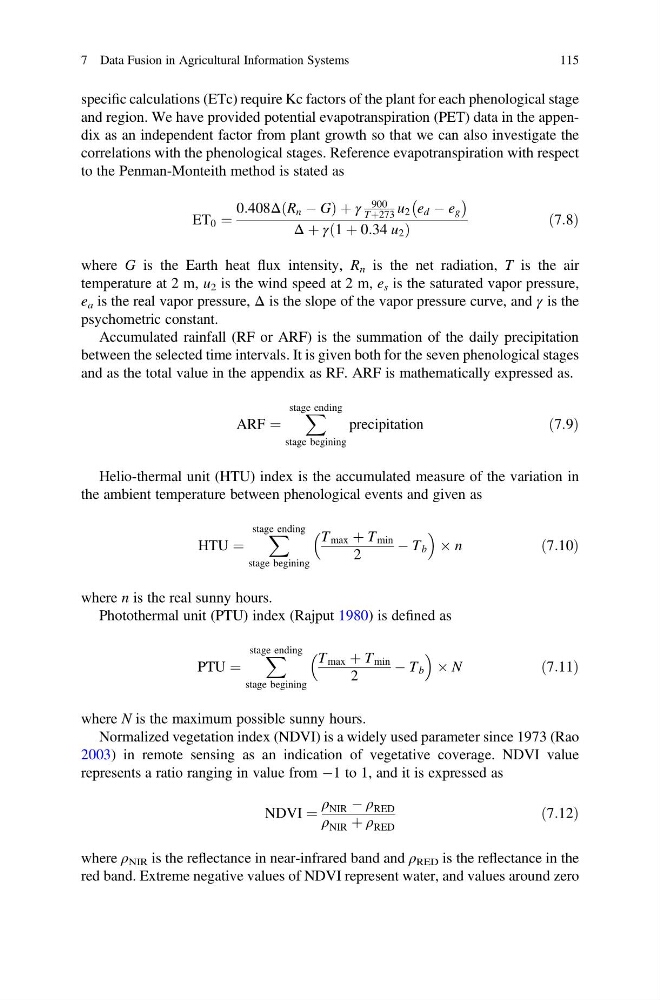
to the Penman-Monteith method is stated as
ET 0 ¼
0:408Δ R n À G
ð
Þþγ
900
Tþ273 u 2 e d À e g
À
Á
Δ þ γ 1 þ 0:34 u 2
ð
Þ
ð7:8Þ
where G is the Earth heat flux intensity, R n is the net radiation, T is the air
temperature at 2 m, u 2 is the wind speed at 2 m, e s is the saturated vapor pressure,
e a is the real vapor pressure, Δ is the slope of the vapor pressure curve, and γ is the
psychometric constant.
Accumulated rainfall (RF or ARF) is the summation of the daily precipitation
between the selected time intervals. It is given both for the seven phenological stages
and as the total value in the appendix as RF. ARF is mathematically expressed as.
ARF ¼
X
stage ending
stage begining
precipitation
ð7:9Þ
Helio-thermal unit (HTU) index is the accumulated measure of the variation in
the ambient temperature between phenological events and given as
HTU ¼
X
stage ending
stage begining
T max þ T min
2
À T b
 n
ð7:10Þ
where n is the real sunny hours.
Photothermal unit (PTU) index (Rajput 1980) is defined as
PTU ¼
X
stage ending
stage begining
T max þ T min
2
À T b
 N
ð7:11Þ
where N is the maximum possible sunny hours.
Normalized vegetation index (NDVI) is a widely used parameter since 1973 (Rao
2003) in remote sensing as an indication of vegetative coverage. NDVI value
represents a ratio ranging in value from À1 to 1, and it is expressed as
NDVI ¼
ρ NIR À ρ RED
ρ NIR þ ρ RED
ð7:12Þ
where ρ NIR is the reflectance in near-infrared band and ρ RED is the reflectance in the
red band. Extreme negative values of NDVI represent water, and values around zero
7 Data Fusion in Agricultural Information Systems
115
and region. We have provided potential evapotranspiration (PET) data in the appendix as an independent factor from plant growth so that we can also investigate the
correlations with the phenological stages. Reference evapotranspiration with respect
to the Penman-Monteith method is stated as
ET 0 ¼
0:408Δ R n À G
ð
Þþγ
900
Tþ273 u 2 e d À e g
À
Á
Δ þ γ 1 þ 0:34 u 2
ð
Þ
ð7:8Þ
where G is the Earth heat flux intensity, R n is the net radiation, T is the air
temperature at 2 m, u 2 is the wind speed at 2 m, e s is the saturated vapor pressure,
e a is the real vapor pressure, Δ is the slope of the vapor pressure curve, and γ is the
psychometric constant.
Accumulated rainfall (RF or ARF) is the summation of the daily precipitation
between the selected time intervals. It is given both for the seven phenological stages
and as the total value in the appendix as RF. ARF is mathematically expressed as.
ARF ¼
X
stage ending
stage begining
precipitation
ð7:9Þ
Helio-thermal unit (HTU) index is the accumulated measure of the variation in
the ambient temperature between phenological events and given as
HTU ¼
X
stage ending
stage begining
T max þ T min
2
À T b
 n
ð7:10Þ
where n is the real sunny hours.
Photothermal unit (PTU) index (Rajput 1980) is defined as
PTU ¼
X
stage ending
stage begining
T max þ T min
2
À T b
 N
ð7:11Þ
where N is the maximum possible sunny hours.
Normalized vegetation index (NDVI) is a widely used parameter since 1973 (Rao
2003) in remote sensing as an indication of vegetative coverage. NDVI value
represents a ratio ranging in value from À1 to 1, and it is expressed as
NDVI ¼
ρ NIR À ρ RED
ρ NIR þ ρ RED
ð7:12Þ
where ρ NIR is the reflectance in near-infrared band and ρ RED is the reflectance in the
red band. Extreme negative values of NDVI represent water, and values around zero
7 Data Fusion in Agricultural Information Systems
115