

7.3.2 Agrometeorological Indices and Regression-Based
Data Fusion for Yield Estimation.
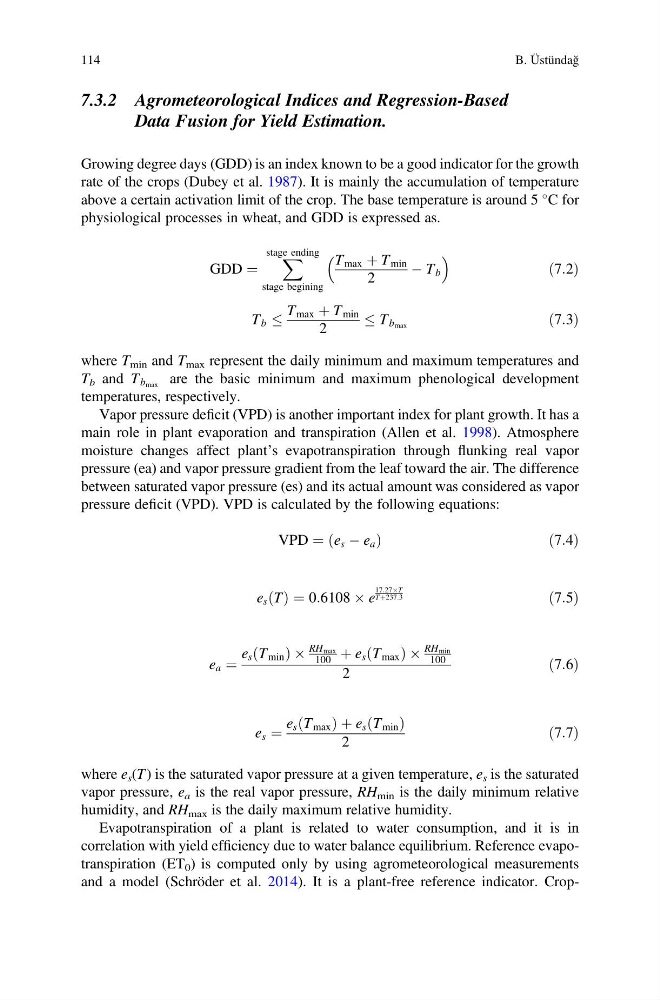
Growing degree days (GDD) is an index known to be a good indicator for the growth
rate of the crops (Dubey et al. 1987). It is mainly the accumulation of temperature
above a certain activation limit of the crop. The base temperature is around 5
C for
physiological processes in wheat, and GDD is expressed as.
GDD ¼
X
stage ending
stage begining
T max þ T min
2
À T b
ð7:2Þ
T b
T max þ T min
2
T b max
ð7:3Þ
where T min and T max represent the daily minimum and maximum temperatures and
T b and T b max are the basic minimum and maximum phenological development
temperatures, respectively.
Vapor pressure deficit (VPD) is another important index for plant growth. It has a
main role in plant evaporation and transpiration (Allen et al. 1998). Atmosphere
moisture changes affect plant’s evapotranspiration through flunking real vapor
pressure (ea) and vapor pressure gradient from the leaf toward the air. The difference
between saturated vapor pressure (es) and its actual amount was considered as vapor
pressure deficit (VPD). VPD is calculated by the following equations:
VPD ¼ e s À e a
ð
Þ
ð7:4Þ
e s T
ð Þ ¼ 0:6108 Â e
17:27ÂT
Tþ237:3
ð7:5Þ
e a ¼
e s T min
ð
ÞÂ
RH max
100 þ e s T max
ð
ÞÂ
RH min
100
2
ð7:6Þ
e s ¼
e s T max
ð
Þþe s T min
ð
Þ
2
ð7:7Þ
where e s (T ) is the saturated vapor pressure at a given temperature, e s is the saturated
vapor pressure, e a is the real vapor pressure, RH min is the daily minimum relative
humidity, and RH max is the daily maximum relative humidity.
Evapotranspiration of a plant is related to water consumption, and it is in
correlation with yield efficiency due to water balance equilibrium. Reference evapotranspiration (ET 0 ) is computed only by using agrometeorological measurements
and a model (Schröder et al. 2014). It is a plant-free reference indicator. Crop114
B. Üstündağ
Data Fusion for Yield Estimation.
Growing degree days (GDD) is an index known to be a good indicator for the growth
rate of the crops (Dubey et al. 1987). It is mainly the accumulation of temperature
above a certain activation limit of the crop. The base temperature is around 5
C for
physiological processes in wheat, and GDD is expressed as.
GDD ¼
X
stage ending
stage begining
T max þ T min
2
À T b
ð7:2Þ
T b
T max þ T min
2
T b max
ð7:3Þ
where T min and T max represent the daily minimum and maximum temperatures and
T b and T b max are the basic minimum and maximum phenological development
temperatures, respectively.
Vapor pressure deficit (VPD) is another important index for plant growth. It has a
main role in plant evaporation and transpiration (Allen et al. 1998). Atmosphere
moisture changes affect plant’s evapotranspiration through flunking real vapor
pressure (ea) and vapor pressure gradient from the leaf toward the air. The difference
between saturated vapor pressure (es) and its actual amount was considered as vapor
pressure deficit (VPD). VPD is calculated by the following equations:
VPD ¼ e s À e a
ð
Þ
ð7:4Þ
e s T
ð Þ ¼ 0:6108 Â e
17:27ÂT
Tþ237:3
ð7:5Þ
e a ¼
e s T min
ð
ÞÂ
RH max
100 þ e s T max
ð
ÞÂ
RH min
100
2
ð7:6Þ
e s ¼
e s T max
ð
Þþe s T min
ð
Þ
2
ð7:7Þ
where e s (T ) is the saturated vapor pressure at a given temperature, e s is the saturated
vapor pressure, e a is the real vapor pressure, RH min is the daily minimum relative
humidity, and RH max is the daily maximum relative humidity.
Evapotranspiration of a plant is related to water consumption, and it is in
correlation with yield efficiency due to water balance equilibrium. Reference evapotranspiration (ET 0 ) is computed only by using agrometeorological measurements
and a model (Schröder et al. 2014). It is a plant-free reference indicator. Crop114
B. Üstündağ