

46
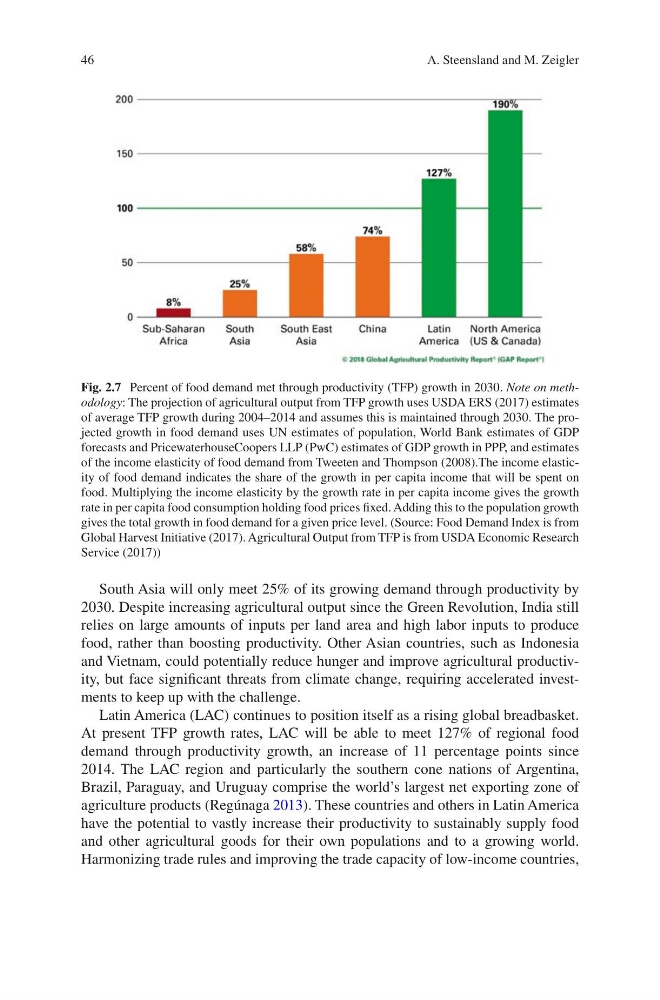
South Asia will only meet 25% of its growing demand through productivity by
2030. Despite increasing agricultural output since the Green Revolution, India still
relies on large amounts of inputs per land area and high labor inputs to produce
food, rather than boosting productivity. Other Asian countries, such as Indonesia
and Vietnam, could potentially reduce hunger and improve agricultural productivity, but face significant threats from climate change, requiring accelerated investments to keep up with the challenge.
Latin America (LAC) continues to position itself as a rising global breadbasket.
At present TFP growth rates, LAC will be able to meet 127% of regional food
demand through productivity growth, an increase of 11 percentage points since
2014. The LAC region and particularly the southern cone nations of Argentina,
Brazil, Paraguay, and Uruguay comprise the world’s largest net exporting zone of
agriculture products (Regúnaga 2013). These countries and others in Latin America
have the potential to vastly increase their productivity to sustainably supply food
and other agricultural goods for their own populations and to a growing world.
Harmonizing trade rules and improving the trade capacity of low-income countries,
Fig. 2.7 Percent of food demand met through productivity (TFP) growth in 2030. Note on methodology: The projection of agricultural output from TFP growth uses USDA ERS (2017) estimates
of average TFP growth during 2004–2014 and assumes this is maintained through 2030. The projected growth in food demand uses UN estimates of population, World Bank estimates of GDP
forecasts and PricewaterhouseCoopers LLP (PwC) estimates of GDP growth in PPP, and estimates
of the income elasticity of food demand from Tweeten and Thompson (2008).The income elasticity of food demand indicates the share of the growth in per capita income that will be spent on
food. Multiplying the income elasticity by the growth rate in per capita income gives the growth
rate in per capita food consumption holding food prices fixed. Adding this to the population growth
gives the total growth in food demand for a given price level. (Source: Food Demand Index is from
Global Harvest Initiative (2017). Agricultural Output from TFP is from USDA Economic Research
Service (2017))
A. Steensland and M. Zeigler
South Asia will only meet 25% of its growing demand through productivity by
2030. Despite increasing agricultural output since the Green Revolution, India still
relies on large amounts of inputs per land area and high labor inputs to produce
food, rather than boosting productivity. Other Asian countries, such as Indonesia
and Vietnam, could potentially reduce hunger and improve agricultural productivity, but face significant threats from climate change, requiring accelerated investments to keep up with the challenge.
Latin America (LAC) continues to position itself as a rising global breadbasket.
At present TFP growth rates, LAC will be able to meet 127% of regional food
demand through productivity growth, an increase of 11 percentage points since
2014. The LAC region and particularly the southern cone nations of Argentina,
Brazil, Paraguay, and Uruguay comprise the world’s largest net exporting zone of
agriculture products (Regúnaga 2013). These countries and others in Latin America
have the potential to vastly increase their productivity to sustainably supply food
and other agricultural goods for their own populations and to a growing world.
Harmonizing trade rules and improving the trade capacity of low-income countries,
Fig. 2.7 Percent of food demand met through productivity (TFP) growth in 2030. Note on methodology: The projection of agricultural output from TFP growth uses USDA ERS (2017) estimates
of average TFP growth during 2004–2014 and assumes this is maintained through 2030. The projected growth in food demand uses UN estimates of population, World Bank estimates of GDP
forecasts and PricewaterhouseCoopers LLP (PwC) estimates of GDP growth in PPP, and estimates
of the income elasticity of food demand from Tweeten and Thompson (2008).The income elasticity of food demand indicates the share of the growth in per capita income that will be spent on
food. Multiplying the income elasticity by the growth rate in per capita income gives the growth
rate in per capita food consumption holding food prices fixed. Adding this to the population growth
gives the total growth in food demand for a given price level. (Source: Food Demand Index is from
Global Harvest Initiative (2017). Agricultural Output from TFP is from USDA Economic Research
Service (2017))
A. Steensland and M. Zeigler