

47
coupled with improvements in supply chains and infrastructure, will foster timely
and beneficial trade to close food and agriculture demand gaps.
In 2030, North America is projected to reliably supply safe, abundant food for
the world, producing nearly as twice as much food to meet its own food demand.
However, the potential for a new era of trade protectionism has sent a chill through
agricultural producers who fear they will lose access to traditional trade partners or
fail to access new markets at a time when prices are low and farmers are struggling.
Investments in R&D would become more critical than ever under these circumstances (Box 2.5).
Box 2.5 Public Research Sparks Innovation and TFP
Due to agriculture’s dependence on limited resources like water and land, it
may be unique in its reliance on productivity and innovation to meet the rapidly growing demand of consumers by 2050 (Fuglie 2018). Agri-food innovation systems rely heavily on public agricultural research and development
(R&D) and extension systems as well as regulatory frameworks that incentivize risk taking innovation and investment. Such agricultural R&D investments
require long gestation periods of more than a decade to realize the full benefits
that these investments generate. Over time, they pay large dividends, including higher profits for farmers, more abundant food supply at lower cost for
consumers, and more opportunities and a higher quality of life in rural
communities.
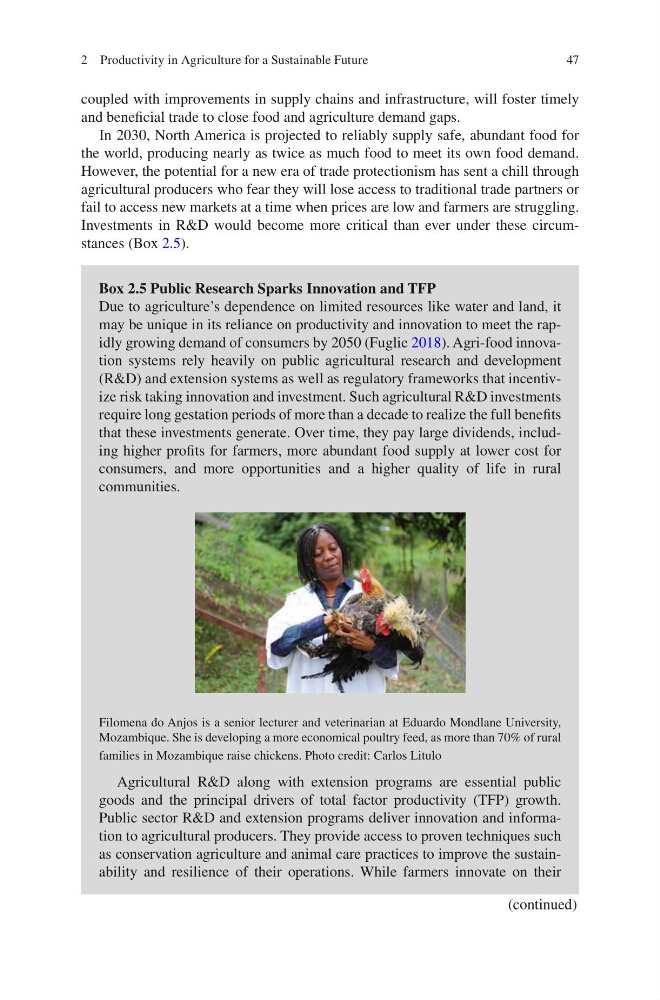
Filomena do Anjos is a senior lecturer and veterinarian at Eduardo Mondlane University,
Mozambique. She is developing a more economical poultry feed, as more than 70% of rural
families in Mozambique raise chickens. Photo credit: Carlos Litulo
Agricultural R&D along with extension programs are essential public
goods and the principal drivers of total factor productivity (TFP) growth.
Public sector R&D and extension programs deliver innovation and information to agricultural producers. They provide access to proven techniques such
as conservation agriculture and animal care practices to improve the sustainability and resilience of their operations. While farmers innovate on their
(continued)
2 Productivity in Agriculture for a Sustainable Future
coupled with improvements in supply chains and infrastructure, will foster timely
and beneficial trade to close food and agriculture demand gaps.
In 2030, North America is projected to reliably supply safe, abundant food for
the world, producing nearly as twice as much food to meet its own food demand.
However, the potential for a new era of trade protectionism has sent a chill through
agricultural producers who fear they will lose access to traditional trade partners or
fail to access new markets at a time when prices are low and farmers are struggling.
Investments in R&D would become more critical than ever under these circumstances (Box 2.5).
Box 2.5 Public Research Sparks Innovation and TFP
Due to agriculture’s dependence on limited resources like water and land, it
may be unique in its reliance on productivity and innovation to meet the rapidly growing demand of consumers by 2050 (Fuglie 2018). Agri-food innovation systems rely heavily on public agricultural research and development
(R&D) and extension systems as well as regulatory frameworks that incentivize risk taking innovation and investment. Such agricultural R&D investments
require long gestation periods of more than a decade to realize the full benefits
that these investments generate. Over time, they pay large dividends, including higher profits for farmers, more abundant food supply at lower cost for
consumers, and more opportunities and a higher quality of life in rural
communities.
Filomena do Anjos is a senior lecturer and veterinarian at Eduardo Mondlane University,
Mozambique. She is developing a more economical poultry feed, as more than 70% of rural
families in Mozambique raise chickens. Photo credit: Carlos Litulo
Agricultural R&D along with extension programs are essential public
goods and the principal drivers of total factor productivity (TFP) growth.
Public sector R&D and extension programs deliver innovation and information to agricultural producers. They provide access to proven techniques such
as conservation agriculture and animal care practices to improve the sustainability and resilience of their operations. While farmers innovate on their
(continued)
2 Productivity in Agriculture for a Sustainable Future