

flow batteries, they are suited for largescale applications. This is achieved by adjusting the size of its
external tank containing the electrolytes (Huang &
Wang, 2015; Perry & Weber, 2016; Soloveichik, 2015).
The solubility and redox potential of reversible redox
active components governs the energy density of the
redox flow batteries. This necessitates a proper design
and selection of the redox couple.
The redox couples of quinone/hydroquinone have
been identified as candidates of interest for metal-free
redox flow rechargeable batteries due to their good
solubility (greater than 1 M in a pH 0 electrolyte for
9,10-anthraquinone-2,7-disulphonic acid; AQDS) in
aqueous solvent, earth abundance (Huskinsom et al.,
2014; Saraf Nawar & Aziz, 2013), and fast kinetic
rate constants of charge transfer (e.g., for AQDS it is
7.2×10
−3 cm s
−1 ). Solubility and redox potentials of
quinones can further be tailored on introducing functional groups such as hydrophilic (Chen, Eisenach, &
Aziz, 2016; Chen et al., 2016; Er, 2015; Huskinson
et al., 2014; Huskinson et al., 2013; Saraf Nawar &
Aziz, 2013; Yang et al., 2014), electron-withdrawing,
and electron-donating groups. Generally solubility in
water improves with an increase in the number of
functional groups substituted, moreso on attaching the
hydrophilic groups away from the ketone units of the
quinones. Stability of quinones is essential for the long
life cycle of redox flow batteries. Er et al. found that
quinone oxidation results in a decomposition reaction,
e.g., carbon backbone oxidation and polymerization,
which is essential to lasting device performance. They
suggested a way to improve the stability by introducing
substituents, such as sulfonyl, hydroxyl, carboxyl, and
amino substituents to quinone’s C-H groups adjacent
to C=O groups, which are prone to oxidation. A summary of the quinone’s dependency on the substituents
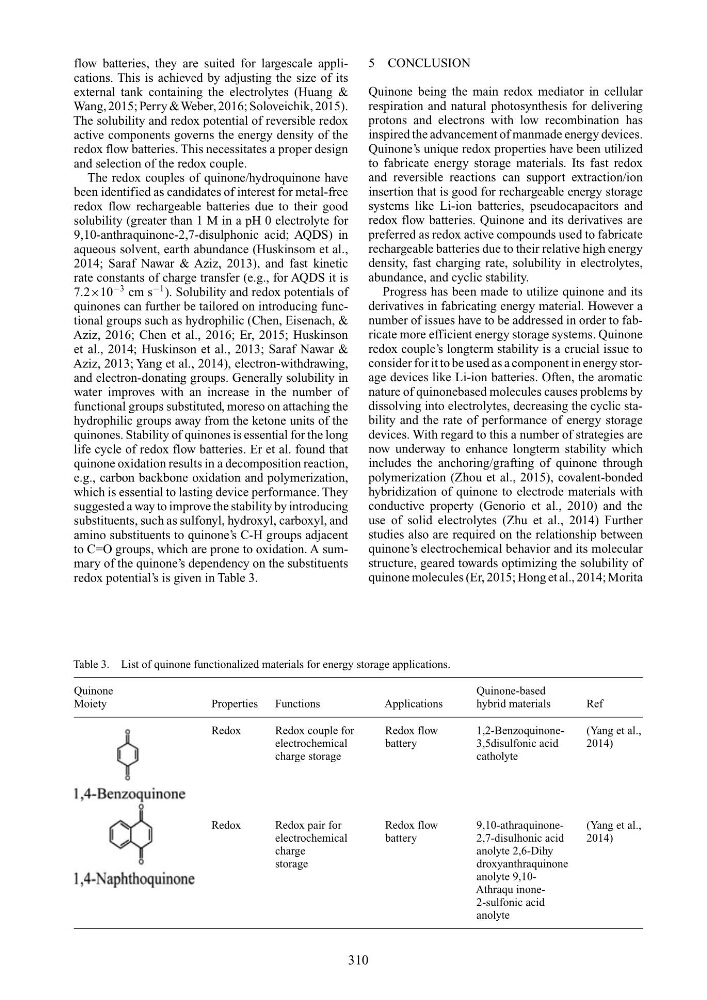
redox potential’s is given in Table 3.
Table 3. List of quinone functionalized materials for energy storage applications.
Quinone
Quinone-based
Moiety
Properties
Functions
Applications
hybrid materials
Ref
Redox
Redox couple for
electrochemical
charge storage
Redox flow
battery
1,2-Benzoquinone3,5disulfonic acid
catholyte
(Yang et al.,
2014)
Redox
Redox pair for
electrochemical
charge
storage
Redox flow
battery
9,10-athraquinone2,7-disulhonic acid
anolyte 2,6-Dihy
droxyanthraquinone
anolyte 9,10Athraqu inone2-sulfonic acid
anolyte
(Yang et al.,
2014)
5 CONCLUSION
Quinone being the main redox mediator in cellular
respiration and natural photosynthesis for delivering
protons and electrons with low recombination has
inspired the advancement of manmade energy devices.
Quinone’s unique redox properties have been utilized
to fabricate energy storage materials. Its fast redox
and reversible reactions can support extraction/ion
insertion that is good for rechargeable energy storage
systems like Li-ion batteries, pseudocapacitors and
redox flow batteries. Quinone and its derivatives are
preferred as redox active compounds used to fabricate
rechargeable batteries due to their relative high energy
density, fast charging rate, solubility in electrolytes,
abundance, and cyclic stability.
Progress has been made to utilize quinone and its
derivatives in fabricating energy material. However a
number of issues have to be addressed in order to fabricate more efficient energy storage systems. Quinone
redox couple’s longterm stability is a crucial issue to
consider for it to be used as a component in energy storage devices like Li-ion batteries. Often, the aromatic
nature of quinonebased molecules causes problems by
dissolving into electrolytes, decreasing the cyclic stability and the rate of performance of energy storage
devices. With regard to this a number of strategies are
now underway to enhance longterm stability which
includes the anchoring/grafting of quinone through
polymerization (Zhou et al., 2015), covalent-bonded
hybridization of quinone to electrode materials with
conductive property (Genorio et al., 2010) and the
use of solid electrolytes (Zhu et al., 2014) Further
studies also are required on the relationship between
quinone’s electrochemical behavior and its molecular
structure, geared towards optimizing the solubility of
quinone molecules (Er, 2015; Hong et al., 2014; Morita
310
external tank containing the electrolytes (Huang &
Wang, 2015; Perry & Weber, 2016; Soloveichik, 2015).
The solubility and redox potential of reversible redox
active components governs the energy density of the
redox flow batteries. This necessitates a proper design
and selection of the redox couple.
The redox couples of quinone/hydroquinone have
been identified as candidates of interest for metal-free
redox flow rechargeable batteries due to their good
solubility (greater than 1 M in a pH 0 electrolyte for
9,10-anthraquinone-2,7-disulphonic acid; AQDS) in
aqueous solvent, earth abundance (Huskinsom et al.,
2014; Saraf Nawar & Aziz, 2013), and fast kinetic
rate constants of charge transfer (e.g., for AQDS it is
7.2×10
−3 cm s
−1 ). Solubility and redox potentials of
quinones can further be tailored on introducing functional groups such as hydrophilic (Chen, Eisenach, &
Aziz, 2016; Chen et al., 2016; Er, 2015; Huskinson
et al., 2014; Huskinson et al., 2013; Saraf Nawar &
Aziz, 2013; Yang et al., 2014), electron-withdrawing,
and electron-donating groups. Generally solubility in
water improves with an increase in the number of
functional groups substituted, moreso on attaching the
hydrophilic groups away from the ketone units of the
quinones. Stability of quinones is essential for the long
life cycle of redox flow batteries. Er et al. found that
quinone oxidation results in a decomposition reaction,
e.g., carbon backbone oxidation and polymerization,
which is essential to lasting device performance. They
suggested a way to improve the stability by introducing
substituents, such as sulfonyl, hydroxyl, carboxyl, and
amino substituents to quinone’s C-H groups adjacent
to C=O groups, which are prone to oxidation. A summary of the quinone’s dependency on the substituents
redox potential’s is given in Table 3.
Table 3. List of quinone functionalized materials for energy storage applications.
Quinone
Quinone-based
Moiety
Properties
Functions
Applications
hybrid materials
Ref
Redox
Redox couple for
electrochemical
charge storage
Redox flow
battery
1,2-Benzoquinone3,5disulfonic acid
catholyte
(Yang et al.,
2014)
Redox
Redox pair for
electrochemical
charge
storage
Redox flow
battery
9,10-athraquinone2,7-disulhonic acid
anolyte 2,6-Dihy
droxyanthraquinone
anolyte 9,10Athraqu inone2-sulfonic acid
anolyte
(Yang et al.,
2014)
5 CONCLUSION
Quinone being the main redox mediator in cellular
respiration and natural photosynthesis for delivering
protons and electrons with low recombination has
inspired the advancement of manmade energy devices.
Quinone’s unique redox properties have been utilized
to fabricate energy storage materials. Its fast redox
and reversible reactions can support extraction/ion
insertion that is good for rechargeable energy storage
systems like Li-ion batteries, pseudocapacitors and
redox flow batteries. Quinone and its derivatives are
preferred as redox active compounds used to fabricate
rechargeable batteries due to their relative high energy
density, fast charging rate, solubility in electrolytes,
abundance, and cyclic stability.
Progress has been made to utilize quinone and its
derivatives in fabricating energy material. However a
number of issues have to be addressed in order to fabricate more efficient energy storage systems. Quinone
redox couple’s longterm stability is a crucial issue to
consider for it to be used as a component in energy storage devices like Li-ion batteries. Often, the aromatic
nature of quinonebased molecules causes problems by
dissolving into electrolytes, decreasing the cyclic stability and the rate of performance of energy storage
devices. With regard to this a number of strategies are
now underway to enhance longterm stability which
includes the anchoring/grafting of quinone through
polymerization (Zhou et al., 2015), covalent-bonded
hybridization of quinone to electrode materials with
conductive property (Genorio et al., 2010) and the
use of solid electrolytes (Zhu et al., 2014) Further
studies also are required on the relationship between
quinone’s electrochemical behavior and its molecular
structure, geared towards optimizing the solubility of
quinone molecules (Er, 2015; Hong et al., 2014; Morita
310