

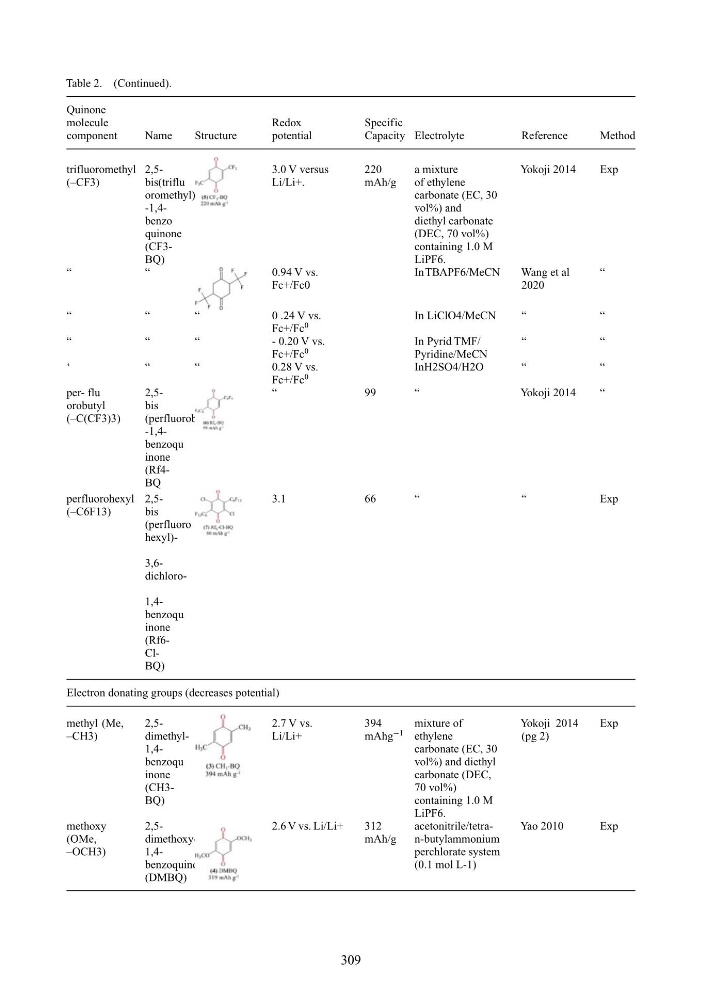
Table 2. (Continued).
Quinone
molecule
Redox
Specific
component
Name
Structure
potential
Capacity Electrolyte
Reference
Method
trifluoromethyl
(–CF3)
2,5bis(triflu
oromethyl)
-1,4benzo
quinone
(CF3BQ)
3.0 V versus
Li/Li+.
220
mAh/g
a mixture
of ethylene
carbonate (EC, 30
vol%) and
diethyl carbonate
(DEC, 70 vol%)
containing 1.0 M
LiPF6.
Yokoji 2014
Exp
“
“
0.94 V vs.
Fc+/Fc0
InTBAPF6/MeCN
Wang et al
2020
“
“
“
“
0 .24 V vs.
Fc+/Fc
0
In LiClO4/MeCN
“
“
“
“
“
- 0.20 V vs.
Fc+/Fc
0
In Pyrid TMF/
Pyridine/MeCN
“
“
‘
“
“
0.28 V vs.
Fc+/Fc
0
InH2SO4/H2O
“
“
per- flu
orobutyl
(–C(CF3)3)
2,5bis
(perfluorobutyl)
-1,4benzoqu
inone
(Rf4BQ
“
99
“
Yokoji 2014
“
perfluorohexyl
(–C6F13)
2,5bis
(perfluoro
1,4benzoqu
inone
ClBQ)
3.1
66
“
“
Exp
Electron donating groups (decreases potential)
methyl (Me,
–CH3)
1,4benzoqu
inone
(CH3BQ)
2.7 V vs.
Li/Li+
394
mAhg
−1
mixture of
ethylene
carbonate (EC, 30
vol%) and diethyl
carbonate (DEC,
70 vol%)
containing 1.0 M
LiPF6.
Yokoji 2014
(pg 2)
Exp
methoxy
(OMe,
–OCH3)
1,4benzoquinone
(DMBQ)
2.6 V vs. Li/Li+
312
mAh/g
acetonitrile/tetran-butylammonium
perchlorate system
(0.1 mol L-1)
Yao 2010
Exp
309
Quinone
molecule
Redox
Specific
component
Name
Structure
potential
Capacity Electrolyte
Reference
Method
trifluoromethyl
(–CF3)
2,5bis(triflu
oromethyl)
-1,4benzo
quinone
(CF3BQ)
3.0 V versus
Li/Li+.
220
mAh/g
a mixture
of ethylene
carbonate (EC, 30
vol%) and
diethyl carbonate
(DEC, 70 vol%)
containing 1.0 M
LiPF6.
Yokoji 2014
Exp
“
“
0.94 V vs.
Fc+/Fc0
InTBAPF6/MeCN
Wang et al
2020
“
“
“
“
0 .24 V vs.
Fc+/Fc
0
In LiClO4/MeCN
“
“
“
“
“
- 0.20 V vs.
Fc+/Fc
0
In Pyrid TMF/
Pyridine/MeCN
“
“
‘
“
“
0.28 V vs.
Fc+/Fc
0
InH2SO4/H2O
“
“
per- flu
orobutyl
(–C(CF3)3)
2,5bis
(perfluorobutyl)
-1,4benzoqu
inone
(Rf4BQ
“
99
“
Yokoji 2014
“
perfluorohexyl
(–C6F13)
2,5bis
(perfluoro
1,4benzoqu
inone
ClBQ)
3.1
66
“
“
Exp
Electron donating groups (decreases potential)
methyl (Me,
–CH3)
1,4benzoqu
inone
(CH3BQ)
2.7 V vs.
Li/Li+
394
mAhg
−1
mixture of
ethylene
carbonate (EC, 30
vol%) and diethyl
carbonate (DEC,
70 vol%)
containing 1.0 M
LiPF6.
Yokoji 2014
(pg 2)
Exp
methoxy
(OMe,
–OCH3)
1,4benzoquinone
(DMBQ)
2.6 V vs. Li/Li+
312
mAh/g
acetonitrile/tetran-butylammonium
perchlorate system
(0.1 mol L-1)
Yao 2010
Exp
309