

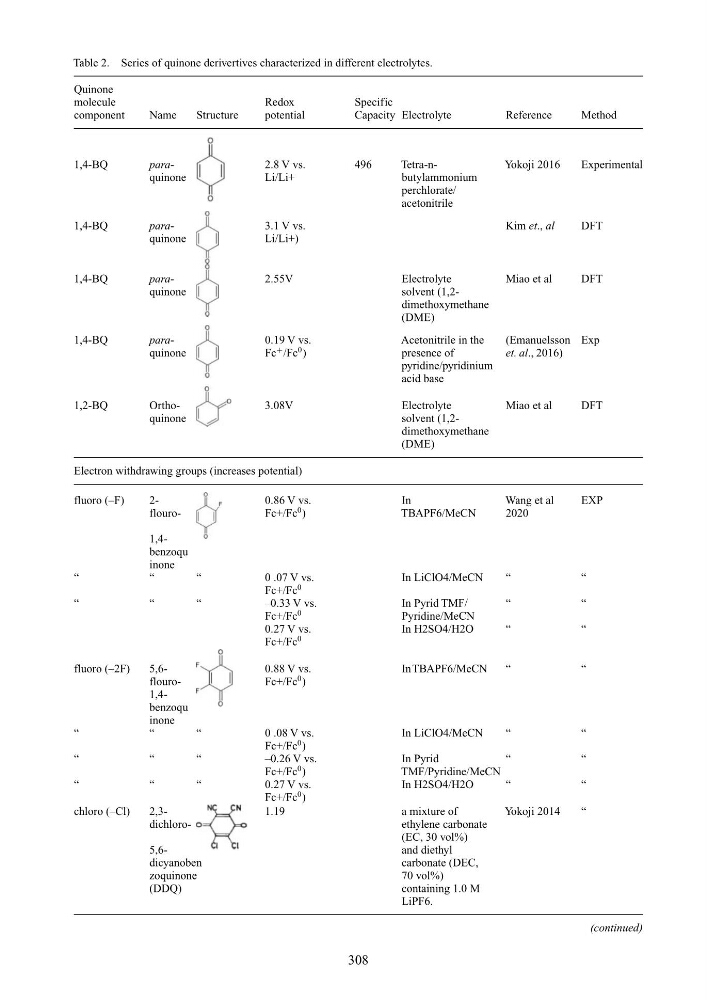
Table 2. Series of quinone derivertives characterized in different electrolytes.
Quinone
molecule
Redox
Specific
component
Name
Structure
potential
Capacity Electrolyte
Reference
Method
1,4-BQ
paraquinone
2.8 V vs.
Li/Li+
496
Tetra-nbutylammonium
perchlorate/
acetonitrile
Yokoji 2016
Experimental
1,4-BQ
paraquinone
3.1 V vs.
Li/Li+)
Kim et., al
DFT
1,4-BQ
paraquinone
2.55V
Electrolyte
solvent (1,2dimethoxymethane
(DME)
Miao et al
DFT
1,4-BQ
paraquinone
0.19 V vs.
Fc
+ /Fc
0 )
Acetonitrile in the
presence of
pyridine/pyridinium
acid base
(Emanuelsson
et. al., 2016)
Exp
1,2-BQ
Orthoquinone
3.08V
Electrolyte
solvent (1,2dimethoxymethane
(DME)
Miao et al
DFT
Electron withdrawing groups (increases potential)
fluoro (–F)
1,4benzoqu
inone
0.86 V vs.
Fc+/Fc
0 )
In
TBAPF6/MeCN
Wang et al
2020
EXP
“
“
“
0 .07 V vs.
Fc+/Fc
0
In LiClO4/MeCN
“
“
“
“
“
–0.33 V vs.
Fc+/Fc
0
In Pyrid TMF/
Pyridine/MeCN
“
“
0.27 V vs.
Fc+/Fc
0
In H2SO4/H2O
“
“
fluoro (–2F)
1,4benzoqu
inone
0.88 V vs.
Fc+/Fc
0 )
InTBAPF6/MeCN
“
“
“
“
“
0 .08 V vs.
Fc+/Fc
0 )
In LiClO4/MeCN
“
“
“
“
“
–0.26 V vs.
Fc+/Fc
0 )
In Pyrid
TMF/Pyridine/MeCN
“
“
“
“
“
0.27 V vs.
Fc+/Fc
0 )
In H2SO4/H2O
“
“
chloro (–Cl)
5,6dicyanoben
zoquinone
(DDQ)
1.19
a mixture of
ethylene carbonate
(EC, 30 vol%)
and diethyl
carbonate (DEC,
70 vol%)
containing 1.0 M
LiPF6.
Yokoji 2014
“
(continued)
308
Quinone
molecule
Redox
Specific
component
Name
Structure
potential
Capacity Electrolyte
Reference
Method
1,4-BQ
paraquinone
2.8 V vs.
Li/Li+
496
Tetra-nbutylammonium
perchlorate/
acetonitrile
Yokoji 2016
Experimental
1,4-BQ
paraquinone
3.1 V vs.
Li/Li+)
Kim et., al
DFT
1,4-BQ
paraquinone
2.55V
Electrolyte
solvent (1,2dimethoxymethane
(DME)
Miao et al
DFT
1,4-BQ
paraquinone
0.19 V vs.
Fc
+ /Fc
0 )
Acetonitrile in the
presence of
pyridine/pyridinium
acid base
(Emanuelsson
et. al., 2016)
Exp
1,2-BQ
Orthoquinone
3.08V
Electrolyte
solvent (1,2dimethoxymethane
(DME)
Miao et al
DFT
Electron withdrawing groups (increases potential)
fluoro (–F)
1,4benzoqu
inone
0.86 V vs.
Fc+/Fc
0 )
In
TBAPF6/MeCN
Wang et al
2020
EXP
“
“
“
0 .07 V vs.
Fc+/Fc
0
In LiClO4/MeCN
“
“
“
“
“
–0.33 V vs.
Fc+/Fc
0
In Pyrid TMF/
Pyridine/MeCN
“
“
0.27 V vs.
Fc+/Fc
0
In H2SO4/H2O
“
“
fluoro (–2F)
1,4benzoqu
inone
0.88 V vs.
Fc+/Fc
0 )
InTBAPF6/MeCN
“
“
“
“
“
0 .08 V vs.
Fc+/Fc
0 )
In LiClO4/MeCN
“
“
“
“
“
–0.26 V vs.
Fc+/Fc
0 )
In Pyrid
TMF/Pyridine/MeCN
“
“
“
“
“
0.27 V vs.
Fc+/Fc
0 )
In H2SO4/H2O
“
“
chloro (–Cl)
5,6dicyanoben
zoquinone
(DDQ)
1.19
a mixture of
ethylene carbonate
(EC, 30 vol%)
and diethyl
carbonate (DEC,
70 vol%)
containing 1.0 M
LiPF6.
Yokoji 2014
“
(continued)
308