

where Red is a reduced species and Oxd is an oxidized
species. During a redox reaction, the reduced species
Red is formed when an electron is gained by Oxd
species. This overall reaction is called a redox halfcell reaction. Such two half-cell reactions combine to
get a complete redox reaction.
In this section we will describe how reference electrodes are treated computationally for non-aqueous
and aqueous solutions. A brief explanation of how
the calculation of redox potentials relates to the thermodynamic cycle will then be given. It will also be
prudent to illustrate the existing methods used to predict the Gibbs free energy of a redox reaction and
then highlight the values of absolute potentials of common reference electrodes in non-aqueous and aqueous
solutions.
3.1 Reference electrodes on aqueous solutions
Reduction potential of a setup of chemical species
measures their tendency or ease to undergo oxidation
or reduction. Standard reduction potential which is
basically referenced relative to the standard hydrogen
electrode (SHE) is a potential measured under standard conditions (1 atm, 298 K, and 1 M). When used
its value is arbitrarily given as 0.00 volts. In practice
there exists other reference electrodes that are easier to use in aqueous solution than the SHE such as
the Ag
+ /AgCl electrode and saturated calomel electrode (SCE). Procedural experimentalists normally
uses any practical and suitable reference electrode
to examine the redox potentials of particular complexes, thereafter this redox potential would then be
converted with respect to the SHE, SCE or Ag
+ /AgCl.
However during conversion, the liquid junction is normally problematic and therefore caution should be
taken when converting the determined experimental
redox values with respect to the two chosen reference
electrode versus another. An example is when converting redox potential obtained against SCE to SHE,
a value of 0.24 V have to be subtracted from the values
obtained.
Typically, in an experiment the redox potential
values obtained are referenced with respect to the reference electrode values in literature. Although experimentally the SHE value being considered as zero, its
absolute reference values have been reported to range
from 4.24 to 4.73 eV (Fawcett & Acta, 2008; Hansen
& Kolb, 1979; Kelly, Cramer, & Truhlar, 2007; Reiss,
1985; Trasatti, 1986). SHE absolute value has been
debated for a number of years and in 1986 IUPAC recommended a SHE absolute value of 4.44 eV (Trasatti,
1986), a value recently confirmed experimentally
(Fawcett & Acta, 2008).
3.2 Reference electrodes on non-aqueous solutions
Other reactants may require the use of non-aqueous
solutions if they are insoluble or unstable in water.
In such a case ferrocene redox couple has been considered suitable for non-aqueous solutions. The redox
system of ferrocene/ferrocenium ion (Fc/Fc
+ ) was
tested in 22 non-aqueous solvents where it showed
solvent independent redox results. Hence IUPAC has
recommended it as a reference electrode for electrochemical experiments involving non-aqueous solutions (Gritzner & Kuta, 1982), and since then this
electrode has been widely accepted and used as a
suitable reference electrode for non-aqueous solutions.The Fc/Fc+ reference electrode half-cell reaction
system is as below:
Fc + +e− > Fc
3.3 Quinone computational studies for battery
materials
Intensive research on quinones from various disciplines is approached through DFT modeling, electrochemical tests, and organic synthesis, as depicted in
Figure 3. Although quinones and its derivatives have
been identified as promising materials (organic electrodes), only a few computational research studies to
date have examined their redox properties. Recently
Er et al (2015) used a high-throughput computational
approach and identified redox potentials of about 300
quinone derivatives with varied functionalities and
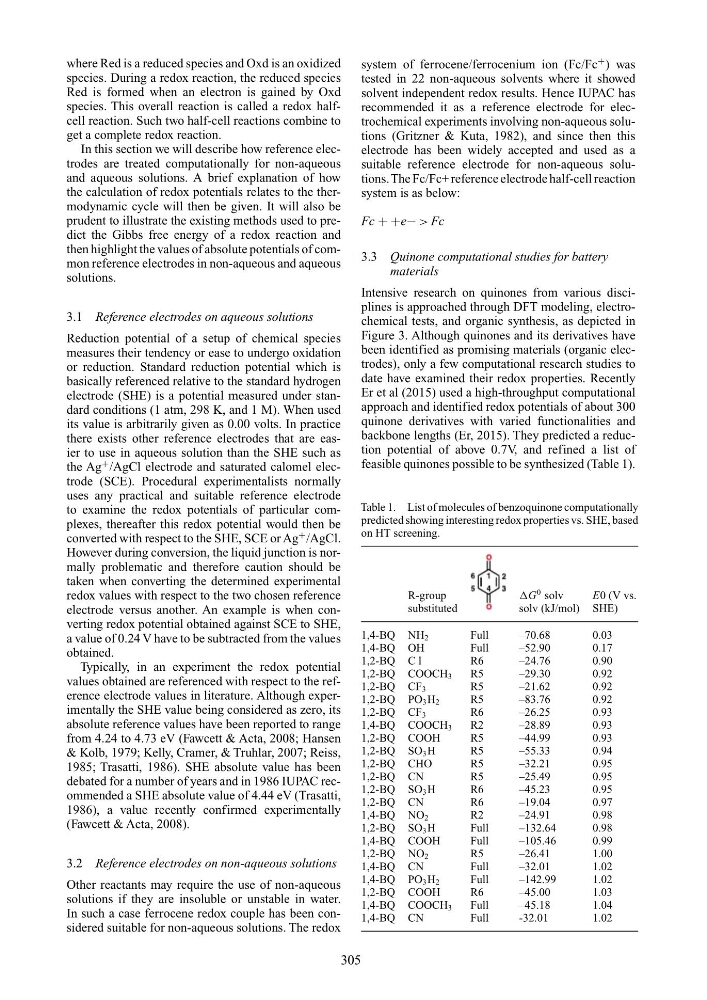
backbone lengths (Er, 2015). They predicted a reduction potential of above 0.7V, and refined a list of
feasible quinones possible to be synthesized (Table 1).
Table 1. List of molecules of benzoquinone computationally
predicted showing interesting redox properties vs. SHE, based
on HT screening.
R-group
G
0 solv
E0 (V vs.
substituted
solv (kJ/mol) SHE)
1,4-BQ NH 2
Full
–70.68
0.03
1,4-BQ OH
Full
–52.90
0.17
1,2-BQ C l
R6
–24.76
0.90
1,2-BQ COOCH 3
R5
–29.30
0.92
1,2-BQ CF 3
R5
–21.62
0.92
1,2-BQ PO 3 H 2
R5
–83.76
0.92
1,2-BQ CF 3
R6
–26.25
0.93
1,4-BQ COOCH 3
R2
–28.89
0.93
1,2-BQ COOH
R5
–44.99
0.93
1,2-BQ SO 3 H
R5
–55.33
0.94
1,2-BQ CHO
R5
–32.21
0.95
1,2-BQ CN
R5
–25.49
0.95
1,2-BQ SO 3 H
R6
–45.23
0.95
1,2-BQ CN
R6
–19.04
0.97
1,4-BQ NO 2
R2
–24.91
0.98
1,2-BQ SO 3 H
Full
–132.64
0.98
1,4-BQ COOH
Full
–105.46
0.99
1,2-BQ NO 2
R5
–26.41
1.00
1,4-BQ CN
Full
–32.01
1.02
1,4-BQ PO 3 H 2
Full
–142.99
1.02
1,2-BQ COOH
R6
–45.00
1.03
1,4-BQ COOCH 3
Full
–45.18
1.04
1,4-BQ CN
Full
-32.01
1.02
305
species. During a redox reaction, the reduced species
Red is formed when an electron is gained by Oxd
species. This overall reaction is called a redox halfcell reaction. Such two half-cell reactions combine to
get a complete redox reaction.
In this section we will describe how reference electrodes are treated computationally for non-aqueous
and aqueous solutions. A brief explanation of how
the calculation of redox potentials relates to the thermodynamic cycle will then be given. It will also be
prudent to illustrate the existing methods used to predict the Gibbs free energy of a redox reaction and
then highlight the values of absolute potentials of common reference electrodes in non-aqueous and aqueous
solutions.
3.1 Reference electrodes on aqueous solutions
Reduction potential of a setup of chemical species
measures their tendency or ease to undergo oxidation
or reduction. Standard reduction potential which is
basically referenced relative to the standard hydrogen
electrode (SHE) is a potential measured under standard conditions (1 atm, 298 K, and 1 M). When used
its value is arbitrarily given as 0.00 volts. In practice
there exists other reference electrodes that are easier to use in aqueous solution than the SHE such as
the Ag
+ /AgCl electrode and saturated calomel electrode (SCE). Procedural experimentalists normally
uses any practical and suitable reference electrode
to examine the redox potentials of particular complexes, thereafter this redox potential would then be
converted with respect to the SHE, SCE or Ag
+ /AgCl.
However during conversion, the liquid junction is normally problematic and therefore caution should be
taken when converting the determined experimental
redox values with respect to the two chosen reference
electrode versus another. An example is when converting redox potential obtained against SCE to SHE,
a value of 0.24 V have to be subtracted from the values
obtained.
Typically, in an experiment the redox potential
values obtained are referenced with respect to the reference electrode values in literature. Although experimentally the SHE value being considered as zero, its
absolute reference values have been reported to range
from 4.24 to 4.73 eV (Fawcett & Acta, 2008; Hansen
& Kolb, 1979; Kelly, Cramer, & Truhlar, 2007; Reiss,
1985; Trasatti, 1986). SHE absolute value has been
debated for a number of years and in 1986 IUPAC recommended a SHE absolute value of 4.44 eV (Trasatti,
1986), a value recently confirmed experimentally
(Fawcett & Acta, 2008).
3.2 Reference electrodes on non-aqueous solutions
Other reactants may require the use of non-aqueous
solutions if they are insoluble or unstable in water.
In such a case ferrocene redox couple has been considered suitable for non-aqueous solutions. The redox
system of ferrocene/ferrocenium ion (Fc/Fc
+ ) was
tested in 22 non-aqueous solvents where it showed
solvent independent redox results. Hence IUPAC has
recommended it as a reference electrode for electrochemical experiments involving non-aqueous solutions (Gritzner & Kuta, 1982), and since then this
electrode has been widely accepted and used as a
suitable reference electrode for non-aqueous solutions.The Fc/Fc+ reference electrode half-cell reaction
system is as below:
Fc + +e− > Fc
3.3 Quinone computational studies for battery
materials
Intensive research on quinones from various disciplines is approached through DFT modeling, electrochemical tests, and organic synthesis, as depicted in
Figure 3. Although quinones and its derivatives have
been identified as promising materials (organic electrodes), only a few computational research studies to
date have examined their redox properties. Recently
Er et al (2015) used a high-throughput computational
approach and identified redox potentials of about 300
quinone derivatives with varied functionalities and
backbone lengths (Er, 2015). They predicted a reduction potential of above 0.7V, and refined a list of
feasible quinones possible to be synthesized (Table 1).
Table 1. List of molecules of benzoquinone computationally
predicted showing interesting redox properties vs. SHE, based
on HT screening.
R-group
G
0 solv
E0 (V vs.
substituted
solv (kJ/mol) SHE)
1,4-BQ NH 2
Full
–70.68
0.03
1,4-BQ OH
Full
–52.90
0.17
1,2-BQ C l
R6
–24.76
0.90
1,2-BQ COOCH 3
R5
–29.30
0.92
1,2-BQ CF 3
R5
–21.62
0.92
1,2-BQ PO 3 H 2
R5
–83.76
0.92
1,2-BQ CF 3
R6
–26.25
0.93
1,4-BQ COOCH 3
R2
–28.89
0.93
1,2-BQ COOH
R5
–44.99
0.93
1,2-BQ SO 3 H
R5
–55.33
0.94
1,2-BQ CHO
R5
–32.21
0.95
1,2-BQ CN
R5
–25.49
0.95
1,2-BQ SO 3 H
R6
–45.23
0.95
1,2-BQ CN
R6
–19.04
0.97
1,4-BQ NO 2
R2
–24.91
0.98
1,2-BQ SO 3 H
Full
–132.64
0.98
1,4-BQ COOH
Full
–105.46
0.99
1,2-BQ NO 2
R5
–26.41
1.00
1,4-BQ CN
Full
–32.01
1.02
1,4-BQ PO 3 H 2
Full
–142.99
1.02
1,2-BQ COOH
R6
–45.00
1.03
1,4-BQ COOCH 3
Full
–45.18
1.04
1,4-BQ CN
Full
-32.01
1.02
305