

investigated in aqueous media and this was done only
on the full and single substitutions as the solvation-free
energy (DG 0solv ) and E 0 of the intermediate substitutions are assumed to be in-between the two ends.
2.2 Redox properties
The biological nature of quinones can be summarized
by their two properties. First is its ability to undergo
nucleophilic attack leading to either increased toxicity or detoxification. Secondly is that quinone and
its derivatives undergo a reversible oxido-reduction
process. From Laviron’s theory, (Laviron, 1984) this
can sequentially be coupled with electrons and protons through a number of oxidation and reduction
reactions. Studies on the electrochemistry of quinones
in aprotic, buffed, and unbuffered aqueous solutions
have previously been carried out to shed light on their
redox behavior (Guin, Das, & Mandal, 2011; Hawley, Piekarski, & Adams, 1967; Rich, 1982; Sasaki
et al., 1990). Quinones undergo one-step two-proton–
electron reduction in aqueous buffer at neutral and
acidic pH displaying a reversible reduction CV wave.
This corresponds to the oxidation and reduction of
quinone/hydroquinone couple. The redox potential has
perfect linear pH dependence with –59 pH
−1 as its
slope. (Laitinen & Harris, 1975). The two protons and
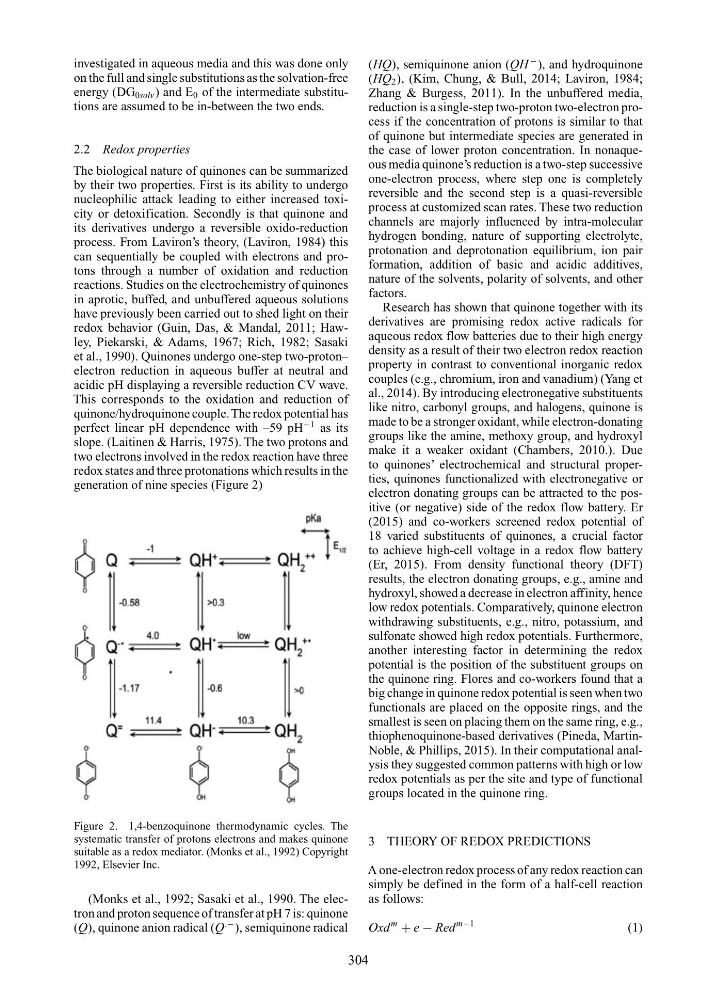
two electrons involved in the redox reaction have three
redox states and three protonations which results in the
generation of nine species (Figure 2)
Figure 2. 1,4-benzoquinone thermodynamic cycles. The
systematic transfer of protons electrons and makes quinone
suitable as a redox mediator. (Monks et al., 1992) Copyright
1992, Elsevier Inc.
(Monks et al., 1992; Sasaki et al., 1990. The electron and proton sequence of transfer at pH 7 is: quinone
(Q), quinone anion radical (Q
.− ), semiquinone radical
(HQ), semiquinone anion (QH
− ), and hydroquinone
(HQ 2 ), (Kim, Chung, & Bull, 2014; Laviron, 1984;
Zhang & Burgess, 2011). In the unbuffered media,
reduction is a single-step two-proton two-electron process if the concentration of protons is similar to that
of quinone but intermediate species are generated in
the case of lower proton concentration. In nonaqueous media quinone’s reduction is a two-step successive
one-electron process, where step one is completely
reversible and the second step is a quasi-reversible
process at customized scan rates. These two reduction
channels are majorly influenced by intra-molecular
hydrogen bonding, nature of supporting electrolyte,
protonation and deprotonation equilibrium, ion pair
formation, addition of basic and acidic additives,
nature of the solvents, polarity of solvents, and other
factors.
Research has shown that quinone together with its
derivatives are promising redox active radicals for
aqueous redox flow batteries due to their high energy
density as a result of their two electron redox reaction
property in contrast to conventional inorganic redox
couples (e.g., chromium, iron and vanadium) (Yang et
al., 2014). By introducing electronegative substituents
like nitro, carbonyl groups, and halogens, quinone is
made to be a stronger oxidant, while electron-donating
groups like the amine, methoxy group, and hydroxyl
make it a weaker oxidant (Chambers, 2010.). Due
to quinones’ electrochemical and structural properties, quinones functionalized with electronegative or
electron donating groups can be attracted to the positive (or negative) side of the redox flow battery. Er
(2015) and co-workers screened redox potential of
18 varied substituents of quinones, a crucial factor
to achieve high-cell voltage in a redox flow battery
(Er, 2015). From density functional theory (DFT)
results, the electron donating groups, e.g., amine and
hydroxyl, showed a decrease in electron affinity, hence
low redox potentials. Comparatively, quinone electron
withdrawing substituents, e.g., nitro, potassium, and
sulfonate showed high redox potentials. Furthermore,
another interesting factor in determining the redox
potential is the position of the substituent groups on
the quinone ring. Flores and co-workers found that a
big change in quinone redox potential is seen when two
functionals are placed on the opposite rings, and the
smallest is seen on placing them on the same ring, e.g.,
thiophenoquinone-based derivatives (Pineda, MartinNoble, & Phillips, 2015). In their computational analysis they suggested common patterns with high or low
redox potentials as per the site and type of functional
groups located in the quinone ring.
3 THEORY OF REDOX PREDICTIONS
A one-electron redox process of any redox reaction can
simply be defined in the form of a half-cell reaction
as follows:
Oxd
m + e − Red
m−1
(1)
304
on the full and single substitutions as the solvation-free
energy (DG 0solv ) and E 0 of the intermediate substitutions are assumed to be in-between the two ends.
2.2 Redox properties
The biological nature of quinones can be summarized
by their two properties. First is its ability to undergo
nucleophilic attack leading to either increased toxicity or detoxification. Secondly is that quinone and
its derivatives undergo a reversible oxido-reduction
process. From Laviron’s theory, (Laviron, 1984) this
can sequentially be coupled with electrons and protons through a number of oxidation and reduction
reactions. Studies on the electrochemistry of quinones
in aprotic, buffed, and unbuffered aqueous solutions
have previously been carried out to shed light on their
redox behavior (Guin, Das, & Mandal, 2011; Hawley, Piekarski, & Adams, 1967; Rich, 1982; Sasaki
et al., 1990). Quinones undergo one-step two-proton–
electron reduction in aqueous buffer at neutral and
acidic pH displaying a reversible reduction CV wave.
This corresponds to the oxidation and reduction of
quinone/hydroquinone couple. The redox potential has
perfect linear pH dependence with –59 pH
−1 as its
slope. (Laitinen & Harris, 1975). The two protons and
two electrons involved in the redox reaction have three
redox states and three protonations which results in the
generation of nine species (Figure 2)
Figure 2. 1,4-benzoquinone thermodynamic cycles. The
systematic transfer of protons electrons and makes quinone
suitable as a redox mediator. (Monks et al., 1992) Copyright
1992, Elsevier Inc.
(Monks et al., 1992; Sasaki et al., 1990. The electron and proton sequence of transfer at pH 7 is: quinone
(Q), quinone anion radical (Q
.− ), semiquinone radical
(HQ), semiquinone anion (QH
− ), and hydroquinone
(HQ 2 ), (Kim, Chung, & Bull, 2014; Laviron, 1984;
Zhang & Burgess, 2011). In the unbuffered media,
reduction is a single-step two-proton two-electron process if the concentration of protons is similar to that
of quinone but intermediate species are generated in
the case of lower proton concentration. In nonaqueous media quinone’s reduction is a two-step successive
one-electron process, where step one is completely
reversible and the second step is a quasi-reversible
process at customized scan rates. These two reduction
channels are majorly influenced by intra-molecular
hydrogen bonding, nature of supporting electrolyte,
protonation and deprotonation equilibrium, ion pair
formation, addition of basic and acidic additives,
nature of the solvents, polarity of solvents, and other
factors.
Research has shown that quinone together with its
derivatives are promising redox active radicals for
aqueous redox flow batteries due to their high energy
density as a result of their two electron redox reaction
property in contrast to conventional inorganic redox
couples (e.g., chromium, iron and vanadium) (Yang et
al., 2014). By introducing electronegative substituents
like nitro, carbonyl groups, and halogens, quinone is
made to be a stronger oxidant, while electron-donating
groups like the amine, methoxy group, and hydroxyl
make it a weaker oxidant (Chambers, 2010.). Due
to quinones’ electrochemical and structural properties, quinones functionalized with electronegative or
electron donating groups can be attracted to the positive (or negative) side of the redox flow battery. Er
(2015) and co-workers screened redox potential of
18 varied substituents of quinones, a crucial factor
to achieve high-cell voltage in a redox flow battery
(Er, 2015). From density functional theory (DFT)
results, the electron donating groups, e.g., amine and
hydroxyl, showed a decrease in electron affinity, hence
low redox potentials. Comparatively, quinone electron
withdrawing substituents, e.g., nitro, potassium, and
sulfonate showed high redox potentials. Furthermore,
another interesting factor in determining the redox
potential is the position of the substituent groups on
the quinone ring. Flores and co-workers found that a
big change in quinone redox potential is seen when two
functionals are placed on the opposite rings, and the
smallest is seen on placing them on the same ring, e.g.,
thiophenoquinone-based derivatives (Pineda, MartinNoble, & Phillips, 2015). In their computational analysis they suggested common patterns with high or low
redox potentials as per the site and type of functional
groups located in the quinone ring.
3 THEORY OF REDOX PREDICTIONS
A one-electron redox process of any redox reaction can
simply be defined in the form of a half-cell reaction
as follows:
Oxd
m + e − Red
m−1
(1)
304